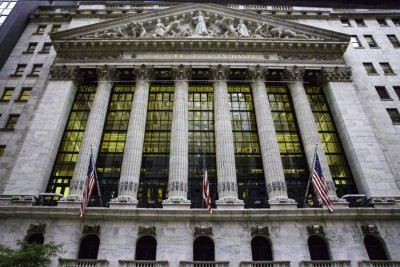
NEW YORK, July 17, 2026, 09:48 EDT — U.S. stock futures extended their decline Friday morning as a broad selloff in semiconductor stocks deepened the $10 billion divide between growth and value shares. The rout, which began in chip stocks earlier this week, has now spread to megacap growth names, dragging down major indices ahead of the opening bell.
As of 9:33 a.m. EDT, the SPDR S&P 500 ETF (SPY) traded at $741.77, down 1.19%, while the iShares Semiconductor ETF (SOXX) fell 4.22% to $508.13. Nasdaq 100 futures dropped 1.9%, S&P 500 futures declined 0.9%, and Dow Jones Industrial Average futures slipped 0.65%. The gap between Nasdaq and Dow futures widened to 1.25 percentage points, reflecting a shift in investor sentiment.
Data from LSEG Lipper for the week ending July 15 showed investors pulled $7.18 billion from growth funds, while value funds attracted $3 billion for the third consecutive week. Overall, equity funds saw $4.8 billion in outflows, while bond funds took in $9.89 billion. The $10.18 billion difference between growth outflows and value inflows underscores a rotation away from high-valuation tech stocks.
The selloff in semiconductor stocks was widespread, with all components of the SOXX index poised to fall at the open. The index last traded below $524.01; a close below that level would mark a 20% decline from its June high, entering correction territory. The Philadelphia chip index had surged 87.75% in the previous quarter but has fallen 8.48% so far this week as of Thursday, suggesting profit-taking after a strong rally rather than purely demand-driven weakness.
Nvidia (NVDA) slid 2.5% before the bell, while Applied Materials (AMAT) and Lam Research (LRCX) each declined nearly 4%. Taiwan Semiconductor Manufacturing (TSM) and ASML Holding (ASML) reported robust earnings, but shares remained under pressure as valuation concerns outweighed recent profit gains. "This is morphing from just a chip selloff into something far broader," said Chris Beauchamp, chief market analyst at IG Group.
Economic data added to the pressure. U.S. import prices rose 0.3% in June, defying expectations for a 0.7% decline, pushing annual import inflation to 7.1%, the highest since August 2022. Nonfuel import prices increased 0.4%, driven partly by higher costs for computers, peripherals, and semiconductors. Industrial production edged up just 0.1% in June, with manufacturing output unchanged, while capacity utilization remained at 76.1%, well below its historical average.
Oil prices added to discount-rate concerns as Brent crude climbed 2.1% to $86, marking a roughly 13% gain for the week. Dallas Fed President Lorie Logan stated that modestly higher rates could help align policy risks, while Fed Vice Chair Philip Jefferson said a rate hike remains possible if inflation persists. The combination of rising import prices, stagnant industrial output, and higher oil costs has fueled concerns about persistent inflation and potential monetary tightening.
In corporate news, Netflix (NFLX) dropped 11.3% after projecting third-quarter revenue and profit below Wall Street expectations. Intuitive Surgical (ISRG) declined nearly 10% after maintaining its procedure-growth forecast, disappointing investors who had hoped for an upward revision. These earnings misses added to the bearish sentiment.
The next key event is the release of the preliminary University of Michigan sentiment data and household inflation expectations at 10 a.m. EDT. Risks remain on both sides: weaker sentiment or easing tensions in the Gulf could trigger short covering, while a fresh oil surge or higher inflation expectations may widen the gap between growth and value stocks further.