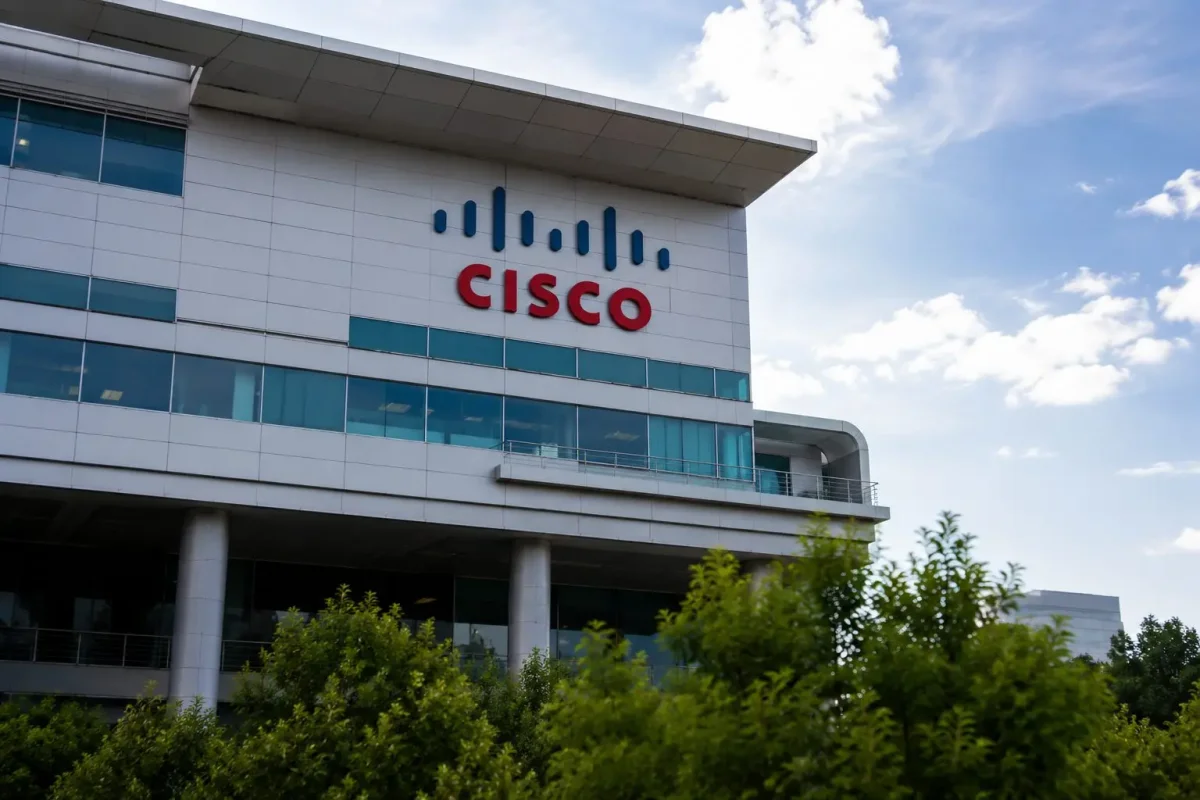
Cisco Systems (NASDAQ:CSCO) ended Friday's trading session at $114.17, posting a 1.25% gain for the day and a 2.0% advance over the course of the week. This performance outpaced the Nasdaq Composite's weekly decline of 2.1% by a notable margin of 4.1 percentage points.
However, the move higher was not accompanied by robust trading volume. Average daily turnover during the period stood at approximately 16.0 million shares, roughly 33% below the stock's typical volume. This discrepancy has led some analysts to question whether the rally can be sustained, as it suggests a lack of broad institutional participation.
Valuation and Income Appeal
The spread between Cisco's weekly gain and the Nasdaq's decline serves as a key indicator for investors. It implies that Cisco may be viewed as a lower-multiple haven in the event of an AI-driven market downturn. The stock currently trades at a trailing price-to-earnings ratio of 38.0x, which is significantly lower than peers such as Arista Networks (NYSE:ANET) at 59.6x and Broadcom (NASDAQ:AVGO) at 63.6x.
Additionally, Cisco offers an income component through its quarterly dividend of $0.42 per share, scheduled for payment on July 22. This dividend yield may attract income-focused investors seeking stability in a volatile market.
Fundamentals and AI Demand
Despite the subdued trading volume, Cisco's underlying business fundamentals remain solid. The company reported fiscal third-quarter revenue of $15.8 billion, a 12% increase year over year, setting a new record. Networking revenue surged 25%, while product sales climbed 17%. Services revenue edged down 1%, and security revenue was flat.
AI-driven demand has been a significant growth catalyst. Cisco secured $5.3 billion in hyperscaler AI infrastructure orders by the end of the third quarter, prompting the company to raise its annual order target to $9 billion. Networking orders rose more than 50%, and data-center switching orders advanced over 40%.
Ryan Lee of Direxion described this trend as "hyperscaler capex spilling downstream," highlighting Cisco's ability to maintain stability even as chip stocks lost ground.
Margin and Outlook
However, margin compression remains a concern. Adjusted gross margin declined to 66.0% from 68.6% in the same period a year ago. The stock is still trading 12.4% below its 52-week high reached on June 4, indicating that investors are cautious about the company's near-term prospects.
For the fourth quarter, Cisco projects revenue between $16.7 billion and $16.9 billion, with adjusted earnings per share in the range of $1.16 to $1.18. Early consensus estimates align closely with the midpoint of this guidance, with analysts expecting $16.82 billion in revenue and $1.17 in adjusted EPS.
Upcoming Catalysts and Risks
Several key events are scheduled for the coming week that could influence Cisco's trajectory. The Federal Reserve will convene on July 28-29, and second-quarter GDP data along with June inflation figures are due on July 30. Earnings reports from major cloud companies are also expected to provide fresh insight into data center investment trends. If capital spending guidance strengthens, it would support Cisco's updated AI-related order targets.
On the downside, low trading volume exposes the rally to potential pullbacks. Other risks include further margin compression, stagnant security sales, and the possibility of elevated interest rates, which could erode Cisco's valuation buffer.