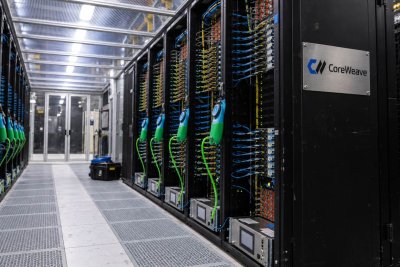
CoreWeave Inc. (NASDAQ:CRWV) largely maintained its post-earnings gains on Thursday, with shares trading at $107.23 as of 12:54 EDT, a modest 0.5% decline for the session. The stock had surged 19% on Wednesday to $107.73 after the company reported a robust revenue backlog of $104.2 billion, a 246% increase year-over-year. This positive momentum reflects investor enthusiasm for the company's demand visibility, but underlying capital expenditure and financing metrics are prompting a closer look at the sustainability of its growth trajectory.
Quarterly Performance and Backlog Growth
In the second quarter of 2026, CoreWeave reported revenue of $2.575 billion, a 112% jump from $1.212 billion in the same period last year. Adjusted EBITDA also doubled to $1.510 billion, though the margin contracted by three percentage points to 59%. Adjusted operating income fell to $128 million from $200 million a year ago, with the margin dropping to 5% from 16%. The company posted a net loss of $626 million, deepening from $290 million in the prior-year quarter, reflecting heavy depreciation and infrastructure costs.
The order backlog, a key indicator of future demand, reached $104.2 billion. However, the schedule reveals that only 21% of this backlog (approximately $21.9 billion) is expected to be realized within the next 24 months. Another 39% (about $40.6 billion) is slated for months 25 through 48, while the remaining 40% (around $41.7 billion) is projected beyond four years. Additionally, the company noted that over $25 billion in new contracts signed in early Q3 were not included in the backlog total, though these commitments remain contingent on delivery and service capacity.
Capital Expenditure and Debt Burden
CoreWeave's capital expenditures for the quarter totaled $9.352 billion, a figure that is 3.63 times its quarterly revenue. This aggressive investment in data centers and infrastructure is essential to converting its backlog into revenue, but it underscores a significant capital intensity. The company's net interest expense rose 140% to $640 million, representing nearly 25% of revenue. Cash and equivalents stood at $5.524 billion, up from $3.127 billion at year-end, while total recourse and non-recourse debt reached $35.068 billion, or 6.35 times cash. On a net basis, debt less cash was $29.544 billion.
Chief Executive Michael Intrator emphasized that scale is now yielding “expanding operating leverage,” citing accelerating customer demand as more enterprises adopt AI infrastructure. However, the adjusted operating results show sequential improvement but a year-over-year decline, highlighting the ongoing cost pressures.
Analyst Reactions and Market Sentiment
Wall Street's response has been mixed. Needham and Barclays both hold ratings, with Barclays setting a price target of $105, just slightly below the current trading level. Bernstein SocGen Group is more bearish, with a sell rating and a $74 target, while Piper Sandler is bullish with a buy rating and a $153 target. DA Davidson maintains a hold with a $100 target. The broader consensus target stands at $142.54, implying a potential upside of about 33% from Thursday's midday price.
The market's reaction reflects a delicate balance. On one hand, the backlog provides unprecedented demand visibility. On the other, the capital outlay and debt levels pose significant risks. Investors are watching whether CoreWeave can convert its massive order book into revenue faster than its financing costs accumulate.
Outlook and Risks
For the full year 2026, CoreWeave projects revenue between $12.4 billion and $13.2 billion. With $4.65 billion already reported in the first half, the second half is expected to generate $7.75 billion to $8.55 billion. Based on midpoint guidance, fourth-quarter revenue would need to be approximately $4.62 billion, following a third-quarter midpoint of $3.53 billion, implying a sequential increase of 31%.
Key risks include potential data-center delays that could impact backlog conversion, high debt levels and rising interest costs that may weigh on equity returns, and the possibility of faster deployments or more favorable financing improving cash flow. The rally in earnings places a premium on demand, but the next challenge is capital efficiency. CoreWeave must demonstrate that it can turn its substantial backlog into revenue more rapidly than its financing expenses erode value.