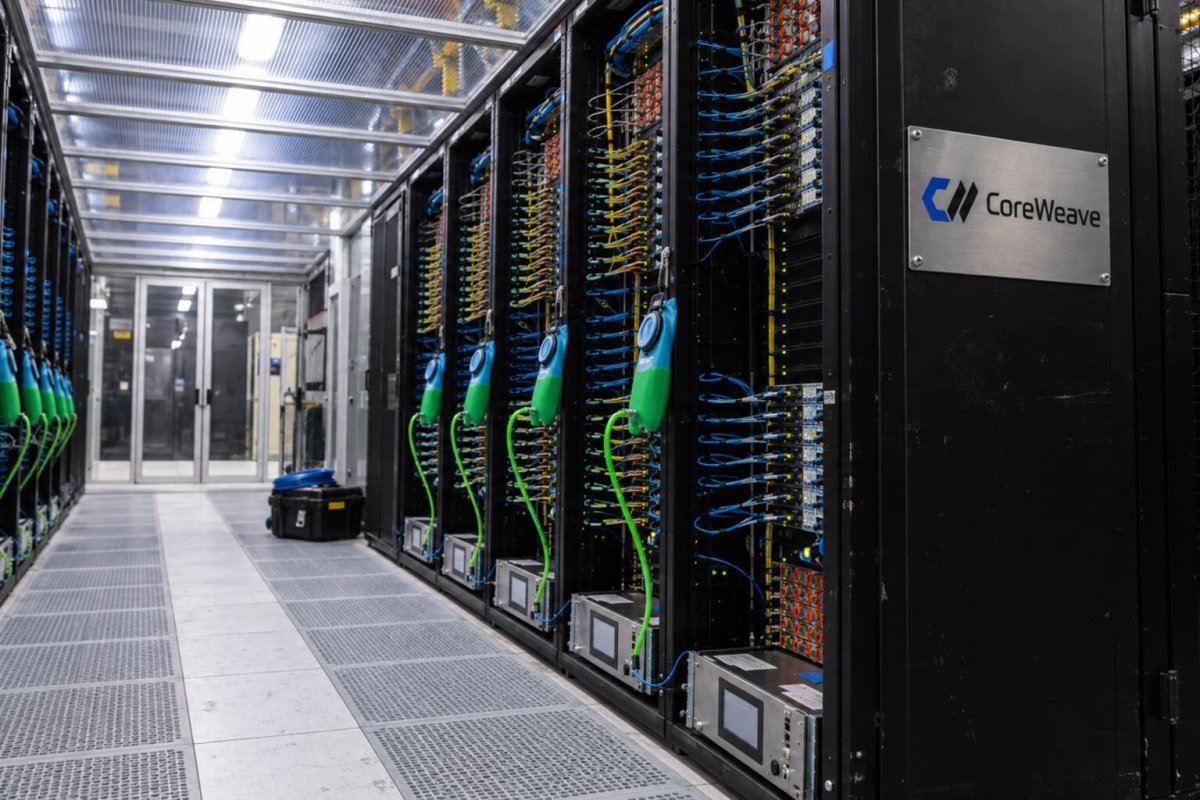
CoreWeave's stock experienced a remarkable surge on Tuesday, climbing 14.8% to $102.57 by late morning, even though the company released no significant new announcements. This jump, which added approximately $7.3 billion to the company's market value, appears to be driven by renewed investor enthusiasm for the AI cloud computing sector rather than any specific corporate development.
Volume and Momentum
Trading volume was notably heavy, with over 23 million shares changing hands before noon—more than 80% of the company's three-month daily average. This level of activity indicates a genuine market move, though the lack of a clear catalyst has left analysts searching for explanations. The company's investor relations page showed no new press releases as of publication, and early financial coverage found no single fresh corporate trigger.
Backlog and Growth Prospects
The bullish case for CoreWeave centers on its massive revenue backlog. In its second-quarter earnings report, the company disclosed revenue of $2.575 billion, representing a 112% year-over-year increase. More impressively, it reported a revenue backlog of $104.2 billion, a figure that excludes over $25 billion in customer commitments secured early in the third quarter.
At Tuesday's market capitalization of roughly $56.6 billion, the stock trades at only 0.54 times its reported backlog—a metric that appears attractive but requires nuance. The backlog includes remaining performance obligations and other estimated future revenue from committed contracts, but recognition depends on CoreWeave's ability to deliver capacity and make services available. Notably, 40% of the June backlog is expected to be recognized more than four years out, making it a long-term indicator rather than an immediate revenue driver.
Financial Leverage and Capital Intensity
The market is not merely valuing signed demand; it is underwriting CoreWeave's ability to finance, build, and energize the infrastructure needed to fulfill those contracts. The company's August outlook projects 2026 revenue of $12.4 billion to $13.2 billion, with capital expenditures between $35 billion and $39 billion. At the midpoints, this implies capex of 2.9 times revenue—an extraordinarily high ratio that underscores the capital-intensive nature of the business.
CoreWeave's latest Form 10-Q reported total indebtedness of $35.6 billion as of June 30, against $5.524 billion in cash and cash equivalents. This debt represents about 63% of Tuesday's equity value, before considering an additional $16.3 billion in operating and finance lease liabilities. The cost of this leverage is already evident in the financial statements: second-quarter net interest expense was $640 million, equal to nearly 25% of revenue and more than five times adjusted operating income. Several delayed-draw facilities carried effective interest rates of 9% to 15% at quarter-end.
Cash Flow and EBITDA Gap
The cash flow statement reveals the company's reliance on external financing. In the first half of the year, CoreWeave generated $3.663 billion in operating cash flow, but purchases of property and equipment consumed $14.117 billion. Net debt issuance provided $16.747 billion, partially offset by $5.219 billion in repayments. While customer prepayments help, the buildout still requires outside capital on a scale that makes interest rates, delivery schedules, and utilization critical to the investment thesis.
Investors should also scrutinize the company's profitability metrics. CoreWeave reported $1.51 billion in adjusted EBITDA for the second quarter, a 59% margin. However, depreciation and amortization totaled $1.393 billion, leaving adjusted operating income at just $128 million and a GAAP operating loss of $49 million. After interest and other items, the net loss reached $626 million.
This gap between EBITDA and actual profitability is not merely an accounting footnote for a business built on short-lived, fast-evolving computing equipment. EBITDA excludes the depreciation attached to the servers and infrastructure that generate revenue, as well as the interest cost of financing them. The more decision-useful measure is whether adjusted operating income can grow faster than the asset base and debt burden.
Guidance and What to Watch
For the third quarter, CoreWeave guides to revenue of $3.45 billion to $3.60 billion, adjusted operating income of $200 million to $260 million, and capex of $11.5 billion to $13.5 billion. At the midpoints, this implies a 6.5% adjusted operating margin and capex equal to 3.55 times quarterly revenue. Beating the margin range while delivering capacity on schedule would support Tuesday's enthusiasm. Conversely, a construction delay, lower utilization, or another step-up in financing costs would work against the stock.
The next proof does not need to be another giant contract headline. CoreWeave must convert the more than $25 billion in early-third-quarter commitments into durable backlog, turn contracted power into active capacity, and demonstrate that operating income is scaling faster than interest expense. These are the links between AI demand and value for common shareholders.
Tuesday's surge indicates that investors are again willing to pay ahead of that proof. The counterargument is that there is no new company fact commensurate with a 14.8% one-day move, while the capital structure makes execution mistakes unusually expensive. CoreWeave's demand signal is powerful, but at $102.57, the burden shifts to delivery.