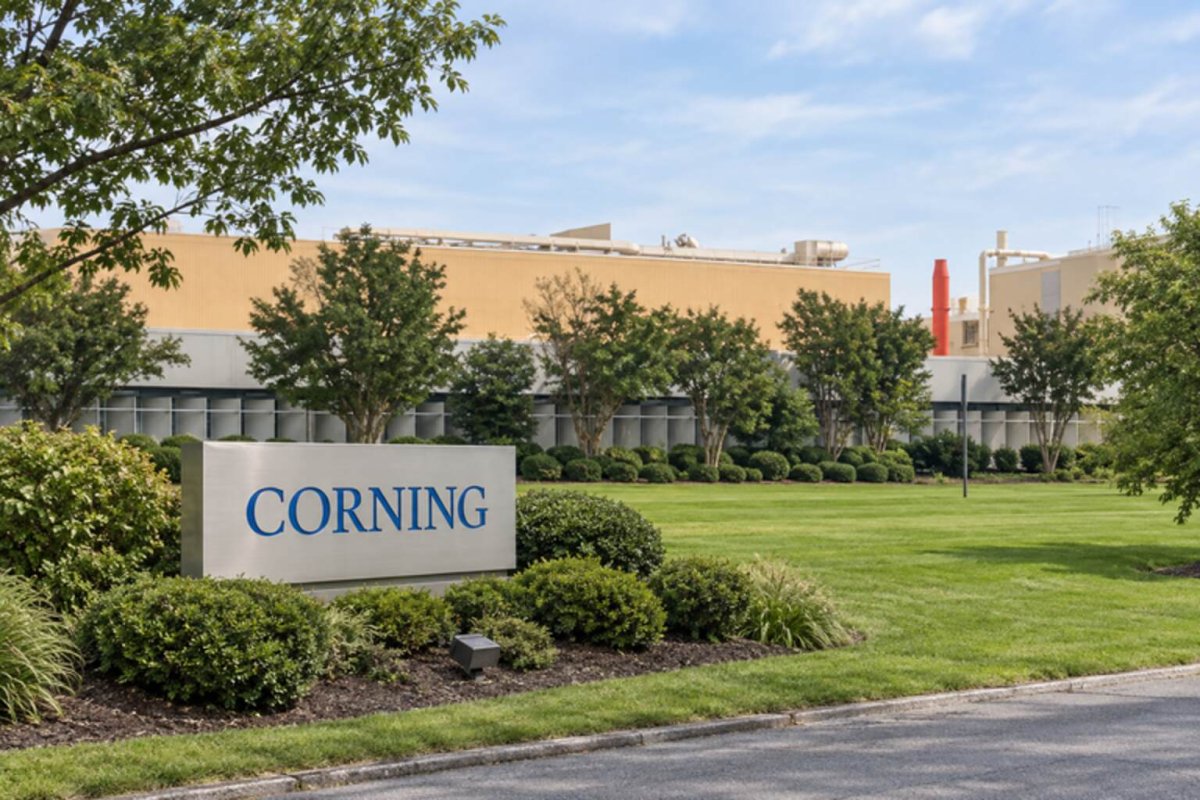
Corning (NYSE: GLW) has initiated a $2 billion at-the-market (ATM) equity offering program, a move that, while substantial in absolute terms, represents a relatively modest addition to the company's outstanding share count. Based on Friday's closing price of $166.40, the full utilization of this authorization would necessitate the issuance of approximately 12.0 million new shares. Against the 861.4 million shares reported outstanding as of July 24, this would translate into a share-count increase of roughly 1.40%, resulting in an existing shareholder's ownership dilution of about 1.38%.
Capacity vs. Issuance: A Critical Distinction
It is essential to differentiate between the authorized capacity and actual issuance. Corning has not yet sold any stock under this program. In a Form 8-K filed after the market close on Friday, the company disclosed that it has appointed Goldman Sachs to act as its sales agent, with the authority to sell up to $2 billion of common stock "from time to time" through an ATM program. This structure grants Corning full control over the price, timing, and size of any sales, and the company retains the ability to halt the program at any point without exhausting the authorization.
Calculating the Dilution Impact
The following calculations are based on the September 11 closing price of $166.40 and Corning's latest reported share count. Actual results will vary depending on the prices at which Goldman Sachs executes any sales.
- Maximum gross ATM proceeds: $2.000 billion
- Approximate proceeds after 1% commission: $1.980 billion
- Implied new shares at $166.40: 12.02 million
- Shares outstanding on July 24: 861.39 million
- Share-count increase: 1.40%
- Existing-holder ownership dilution: 1.38%
- Cash at June 30: $2.504 billion
- 2026 capital-spending outlook: About $2.0 billion
Sources: Corning's September 11 ATM filing and June-quarter 10-Q. Calculations assume the full $2 billion is sold at $166.40; net proceeds exclude expenses other than the stated 1% sales commission.
Price Sensitivity: The Immediate Risk
The most immediate risk is price sensitivity. If the stock were to trade at $140, the same gross proceeds would require approximately 14.3 million shares, representing a 1.66% increase over the July share count. Conversely, at a price of $190, the company would need to issue roughly 10.5 million shares, or 1.22% of the current total. The ATM structure allows management to wait for favorable trading conditions, but shareholders will not know the realized price or total issuance until Corning reports the sales in its quarterly filings.
Why Add Equity Capacity Now?
Corning's balance sheet does not suggest a company in urgent need of capital. The June-quarter filing revealed $2.504 billion in cash, $8.424 billion in total debt, and $2.079 billion in operating cash flow for the first half of the year. After subtracting $754 million in reported capital expenditures, the company generated approximately $1.325 billion in simple operating cash flow after capex.
However, there is a notable funding requirement on the horizon. Corning expects full-year capital spending of approximately $2 billion, which coincidentally matches the gross size of the ATM program. The company has indicated plans to invest in capacity and technology to meet growing demand, particularly in its Optical Communications segment, which saw first-half sales surge 34% year-over-year to $3.918 billion. Consolidated GAAP sales rose 18% to $8.649 billion during the same period.
Use of Proceeds: General Corporate Purposes
Corning has stated that the proceeds will be used for "general corporate purposes," without earmarking funds for a specific factory, acquisition, or debt repayment. Nevertheless, the economics offer a plausible rationale: at the current price and share count, Corning's equity value stands at approximately $143.3 billion. By issuing shares equal to less than 1.5% of its outstanding stock, management can raise an amount equivalent to a full year of planned capital expenditures. This is an inference drawn from the numbers, not a commitment regarding the use of proceeds.
The Constructive Case and the Counterargument
The constructive case for the offering is straightforward. If Corning sells shares selectively at a high valuation and directs the capital toward capacity that sustains Optical Communications growth—or reduces debt carrying a higher after-tax cost than the new equity—future cash flow could more than offset the roughly 1.4% ownership dilution. The distribution agreement charges a 1% commission, providing a clear benchmark for evaluating execution costs.
The strongest counterargument is that the authorization arrives despite healthy liquidity and without a specific project attached. If Corning issues the full amount after the stock weakens, and then spends the proceeds on capacity that earns poor returns, the apparent 1.4% dilution bargain would prove misleading. A slowdown in optical demand would amplify this risk.
What to Watch Next
Investors should not focus on short-term stock price movements. The next meaningful evidence will come from future 10-Q filings, which will detail ATM proceeds, the weighted-average sale price, and the change in shares outstanding. These figures should be compared against capex, operating cash flow, and segment margins. Until actual sales are reported, the $2 billion authorization represents financial flexibility—not a completed dilution event.