Corning Incorporated (NYSE:GLW) experienced a sharp sell-off on Thursday, with shares closing at $196.79, down $23.84 or 10.81% from the previous session. The decline came ahead of the July 4th holiday, with U.S. markets closed on Friday. The stock traded in a wide range of $193.54 to $224.01, reflecting significant volatility.
The pullback follows a remarkable rally that has seen Corning shares surge more than 124% year-to-date and over 271% over the past twelve months. The company's market capitalization stands at approximately $169.36 billion, with a trailing price-to-earnings ratio of 94.45. In contrast, the broader S&P 500 index added 1.8% for the week through Thursday, while the Nasdaq Composite lost 0.8% amid weakness in semiconductor stocks.
AI Data Center Demand Remains Strong
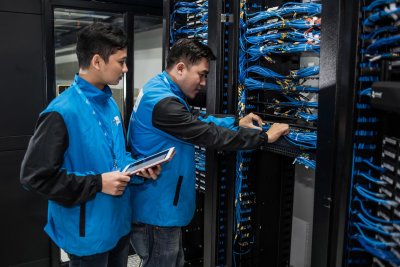
Despite the stock's decline, fundamental demand drivers remain intact. Sudhir Pillai, Corning's managing director and president for India, Middle East and Africa, emphasized in a July 3 interview with the Economic Times that AI data centers are "big fiber guzzlers," consuming approximately ten times more fiber than traditional hyperscale data centers. Pillai also noted that Corning is developing fiber that is 40% thinner, enabling greater capacity within existing duct and rack infrastructure.
Corning's new optical connectivity plant in Pune, India, is scheduled to open in the fourth quarter of 2026. The facility, located adjacent to Corning's existing optical fiber site that has been operational since 2012, will produce specialized optical connectivity products primarily for hyperscale and AI-based data centers.
Financial Performance and Guidance
In the first quarter of 2026, Corning reported core sales of $4.35 billion, up 18% year-over-year, with core earnings per share of $0.70, a 30% increase. The Optical Communications segment led the way with sales of $1.846 billion, up 36% year-over-year. Glass Innovations revenue edged up 1% to $1.42 billion, while the Automotive segment saw a slight decline of 1% to $437 million. Solar segment revenue surged 80% to $370 million, and Life Sciences and Emerging Growth remained flat at $272 million.
CEO Wendell Weeks described the first-quarter results as maintaining a "powerful trajectory" under the company's Springboard plan. Corning also secured two new hyperscaler deals similar to its agreement with Meta Platforms (NASDAQ:META), which could be worth up to $6 billion. For the second quarter, Corning guided for core sales of approximately $4.6 billion and core EPS of $0.73 to $0.77.
Strategic Partnerships and Capacity Expansion
In May, NVIDIA (NASDAQ:NVDA) and Corning announced plans to significantly expand U.S. production of optical connectivity products for AI data centers. Corning aims to increase its U.S. optical connectivity manufacturing capacity by tenfold and boost fiber capacity by more than 50%. The expansion will add three new plants in North Carolina and Texas. NVIDIA CEO Jensen Huang disclosed a "multi-billion-dollar prepayment" to support Corning's factory investments, separate from NVIDIA's option to take an approximately $3 billion equity stake.
Amazon (NASDAQ:AMZN) also extended its commitment in June, entering into a multiyear, multibillion-dollar agreement with Corning for optical fiber, cable, and connectivity equipment to power Amazon's U.S. data centers. The deal is expected to create 1,000 jobs at Corning's North Carolina facilities.
Market Outlook
The key question for investors is whether Thursday's sharp reset marks a buying opportunity or the beginning of a deeper correction. Trading volume surged to approximately 21.2 million shares, well above the 65-day average of 14.5 million, indicating heightened investor activity. While the stock's valuation remains elevated, the underlying demand from AI data centers and strategic partnerships with major technology companies provide a strong fundamental backdrop.