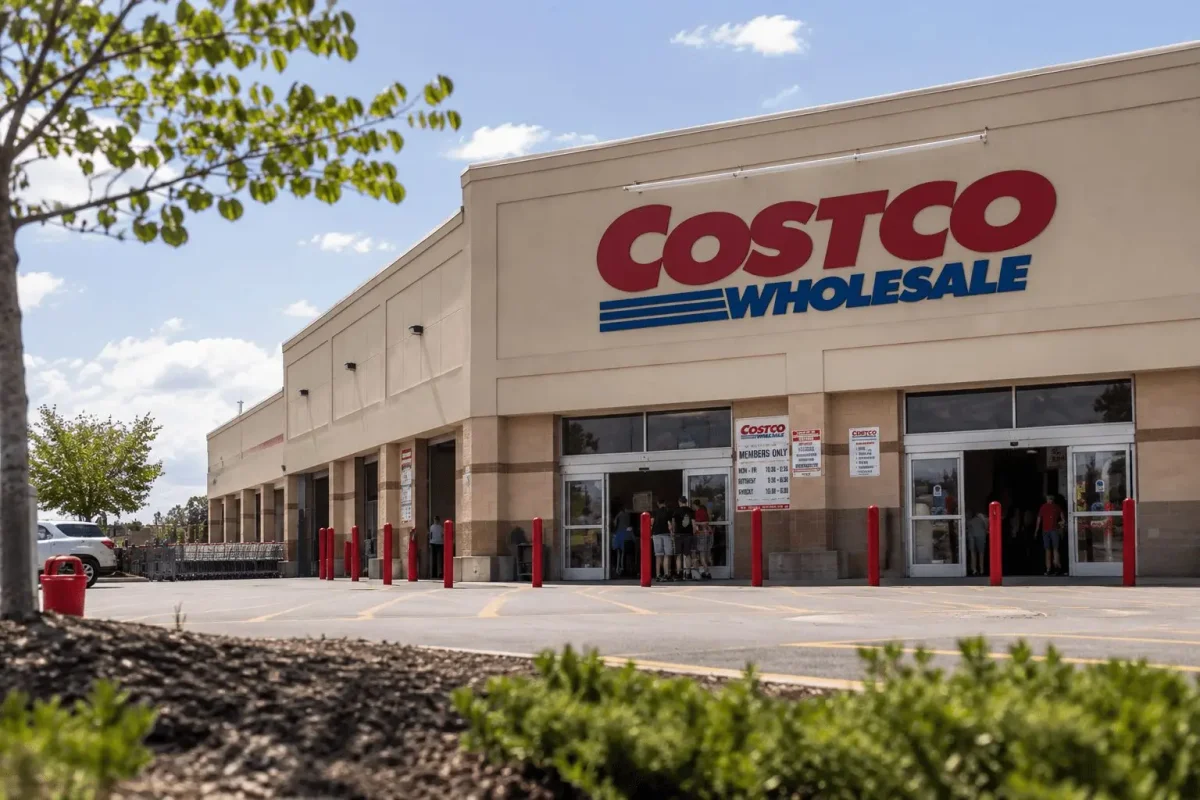
Costco Wholesale (NASDAQ:COST) reported July net sales of $23.12 billion, a 10.7% increase year-over-year, and adjusted comparable sales growth of 6.6%—matching the pace seen in the fiscal third quarter. Despite the double-digit top-line advance, shares were little changed in Monday's session, hovering near $947.58, as investors remain focused on the stock's lofty valuation.
The market's muted reaction underscores a growing tension: while Costco continues to demonstrate robust consumer demand, its shares trade at a premium that leaves little room for error. At 47.7 times trailing earnings, the stock's valuation reflects a reliability premium that demands consistent, above-average growth. July's adjusted comparable sales of 6.6% were steady, but digital comparable sales growth eased to 18.2% from 20.9% in the prior period, signaling a slight deceleration in e-commerce momentum.
For the first 48 weeks of the fiscal year, net sales rose 10.1%, with total comparable sales up 8.4% on a reported basis and 6.7% adjusted. The company's membership base remains a key strength, with renewal rates in the U.S. and Canada reaching 92.2% and membership fees advancing 10.7% in the fiscal third quarter. Diluted earnings per share for Q3 climbed 15.2% to $4.93, outpacing the 11.6% sales growth, a testament to Costco's operational efficiency.
CEO Ron Vachris has emphasized a pricing strategy that prioritizes value: “Our goal is to be the first to lower prices and last to raise them.” That approach has helped sustain customer loyalty, but it also pressures margins—gross margin contracted by 21 basis points in Q3, though it ticked up by one basis point when excluding gasoline inflation.
Valuation Gap Widens vs. Peers
Costco's valuation premium is most evident when compared to its retail peers. Walmart (NYSE:WMT) trades at 39.2 times trailing earnings, a 21.4% discount to Costco, while BJ's Wholesale Club (NYSE:BJ) trades at 22.1 times—a 115.4% premium for Costco. This premium leaves Costco with less cushion in the event of a slowdown, and any multiple compression could offset gains from sales growth.
Wall Street's average price target of $1,090.03 implies a 15.0% upside from current levels, but it relies on an aggressive assumption: that Costco will trade at 48.0 times fiscal-2027 earnings. With consensus EPS estimates of $20.53 for fiscal 2026 and $22.69 for fiscal 2027, the implied forward P/E on fiscal-2027 earnings is 48.0x, requiring a 4.1% multiple expansion on top of the 10.5% expected EPS growth.
Analyst Divergence Highlights Risk
Recent analyst actions illustrate the split in sentiment. On August 6, Bernstein's Zhihan Ma reiterated a Buy with a $1,194 target (26% upside), while Deutsche Bank's Krisztina Katai raised her target to $1,120 (18.2% upside). Conversely, Roth MKM's Bill Kirk maintained a Sell with a $781 target (17.6% downside). Of 41 analysts, 17 rate the stock Hold or lower, with targets ranging from $781 to $1,315.
Alternative valuation models paint a more sober picture. A GuruFocus discounted cash flow analysis released Monday suggested a value of $421.23 based on earnings and $559.77 using free cash flow, while the GF Value came in at $1,028.80. These figures highlight the sensitivity of the stock's valuation to growth assumptions.
Path to Trillion Remains Distant
Costco's market capitalization of $421.1 billion puts it far from the $1 trillion milestone. To reach that level, the stock would need to rise to approximately $2,250—a 137.5% increase. If earnings per share grow at 10% annually and the multiple holds steady, reaching $1 trillion would take roughly nine years.
Key risks to the thesis include softer consumer spending, tariff impacts, wage inflation, commodity price swings, and currency fluctuations. Additionally, price-led investments could pressure margins, and any de-rating could negate gains from sales growth.
Investors will get the next data point on September 2, when August sales figures are released, followed by fourth-quarter earnings on September 24. The focus will be on adjusted comparable sales, membership revenue trends, and margin conversion. Costco has maintained its sales momentum; now it faces the tougher challenge of delivering faster profit growth while preserving its premium valuation.