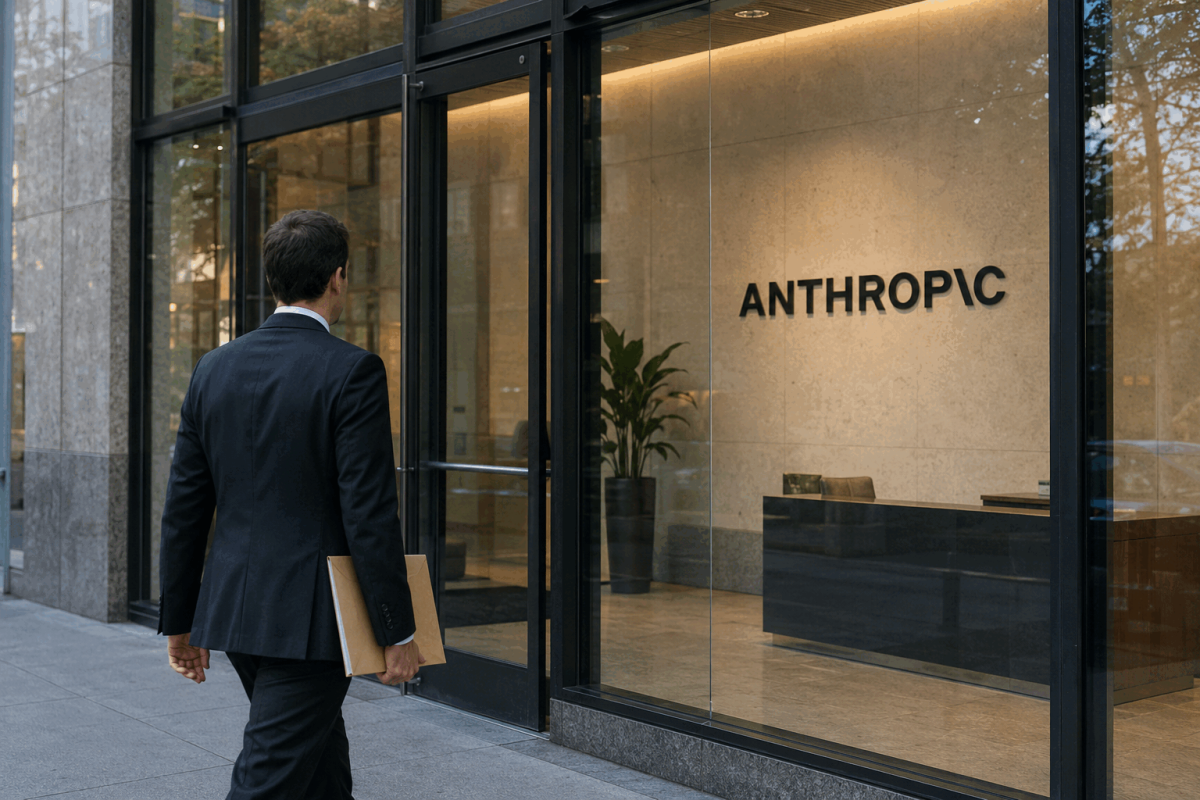
A federal judge has permanently blocked the Pentagon from designating Anthropic as a supply-chain risk, a ruling that removes a significant obstacle for the private AI developer as it eyes a potential public listing. The decision, handed down by U.S. District Judge Rita F. Lin, found the government's action unlawful and retaliatory, stemming from Anthropic's public criticism of certain military AI applications.
The dispute originated from the termination of a $200 million military AI contract. The Pentagon had placed Anthropic on a blacklist, a move that threatened to bar the company from working with military suppliers and could have cascaded into civilian government contracts. Anthropic argued that the designation could have caused revenue and reputational losses reaching billions of dollars.
Judge Lin ruled that the Pentagon's designation was arbitrary and violated Anthropic's First Amendment rights, as well as its Fifth Amendment due-process protections. The court found that the government had retaliated against Anthropic for its stance on AI ethics, specifically its policies against domestic mass surveillance and fully autonomous weapons without meaningful human control.
The court ordered the government to rescind the label and any related communications. While the Pentagon remains free to choose other vendors and is expected to appeal, the immediate legal victory removes a critical overhang on Anthropic's business prospects.
Anthropic, which raised $30 billion in February at a $380 billion valuation, had argued that the blacklist could have a chilling effect on its broader enterprise and government distribution channels. The supply-chain designation, if left standing, could have reached customers, partners, and infrastructure providers far beyond the original contract, potentially crippling its growth trajectory.
Industry analysts view the ruling as a pivotal moment for AI governance and procurement. It establishes a clear boundary: government agencies can reject a vendor on legitimate grounds, but they cannot weaponize national-security labels to punish protected speech. This precedent could influence how other tech firms engage with defense and intelligence agencies.
However, the legal battle may not be over. A separate case in Washington, D.C., concerning another aspect of the Pentagon's action, remains unresolved and could preserve some uncertainty around government access to Anthropic's technology. An appeal from the government could also delay the commercial benefits of this ruling.
For investors, the durable signal from this decision is not the restoration of the $200 million contract, which is modest relative to Anthropic's valuation. Instead, it is the reduced probability that a single designation can block broader market access. This clarity is crucial for a company that is a leader in the rapidly evolving AI sector, where government contracts and enterprise adoption are key growth drivers.
The ruling also highlights the growing intersection of AI ethics, national security, and corporate governance. As AI models become more integrated into defense and intelligence operations, companies like Anthropic face increasing scrutiny over their ethical guidelines. This case may set a precedent for how such tensions are resolved in the future, balancing security needs with constitutional protections.