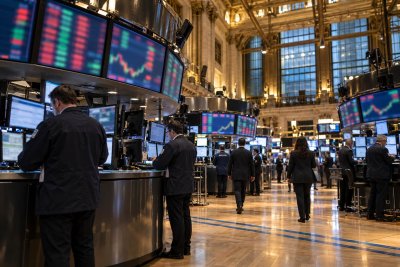
U.S. equity futures showed minimal movement in early Wednesday trading, with major indices hovering near the flatline as the financial world turned its focus to the imminent release of the February Consumer Price Index (CPI). The critical inflation gauge, scheduled for 8:30 a.m. ET, is expected to heavily influence market sentiment and the Federal Reserve's policy trajectory.
Inflation Data Takes Center Stage
The upcoming CPI report arrives just one week before the Federal Reserve's next policy meeting, adding to its significance. Economists surveyed by Reuters anticipate a 0.3% monthly increase in the headline CPI for February, translating to a 2.4% annual gain. The core measure, which excludes volatile food and energy components, is forecast to rise 0.2% for the month and 2.5% over the past year. Persistent pressures from gasoline prices and potential tariff effects have clouded the inflation outlook, leading some analysts to express concern. "Progress on lowering inflation is stalling out again," remarked Sarah House, a senior economist at Wells Fargo.
Oracle Soars on Bullish Outlook
In premarket action, Oracle (ORCL) commanded attention with its stock surging 8.3%. The catalyst was a significant upward revision to the company's fiscal 2027 revenue target, now set at $90 billion, which comfortably exceeds the $86.6 billion consensus estimate among analysts. A key metric, remaining performance obligations—representing future contracted revenue—soared 325% to $553 billion. The technology giant is aggressively competing to secure artificial intelligence cloud contracts from rivals like Amazon Web Services and Microsoft Azure. eMarketer analyst Jacob Bourne described the update as "a beat and a stress test result for the AI trade."
Bank of America Provides Upbeat Guidance
Bank of America (BAC) also contributed to the premarket narrative, offering positive guidance for the first quarter. Co-President Dean Athanasia projected net interest income to climb by at least 7%. He further indicated that investment banking fees are poised for a 10% increase, while markets revenue is on track for a low double-digit percentage gain. Athanasia characterized these projections as "all good revenues," signaling strength in the bank's core operations.
Energy Market Swings Add Uncertainty
The energy complex continues to inject volatility into the market. After plunging over 10% on Tuesday—its sharpest single-day decline since 2022—oil prices staged a rebound. As of 0727 GMT Wednesday, Brent crude futures traded at $88.39 per barrel, with U.S. West Texas Intermediate (WTI) crude at $84.43. Traders are assessing whether unprecedented stockpile releases coordinated by the International Energy Agency can effectively counter supply disruptions stemming from the ongoing conflict involving Iran. "How oil prices will evolve will depend on the duration of the Iran war," noted DBS analyst Suvro Sarkar.
Market Sentiment Remains Cautious
Tuesday's trading session reflected underlying investor anxiety. The S&P 500 declined 0.21%, and the Dow Jones Industrial Average dipped 0.07%. The Nasdaq Composite initially advanced but surrendered most gains to close only marginally higher, pressured by renewed geopolitical tensions in the Middle East. "There's a lot of confusion among investors," observed Tim Ghriskey, a senior portfolio strategist at Ingalls & Snyder. The previous day's oil price collapse provided a lift to Asian and European equities but offered little support to U.S. stocks, marking a departure from recent correlation patterns.
Stagflation Fears Linger
The market faces clear risks as the trading day begins. A hotter-than-expected CPI print or another surge in crude prices could severely pressure rate-sensitive growth stocks and rekindle fears of stagflation. Notably, average U.S. gasoline prices have climbed above $3.50 per gallon, a 17% increase since the onset of the latest conflict. Luke Tilley, chief economist at Wilmington Trust, warned that oil sustaining a trading range between $85 and $100 per barrel for an extended period would "materially increase the risk of recession."