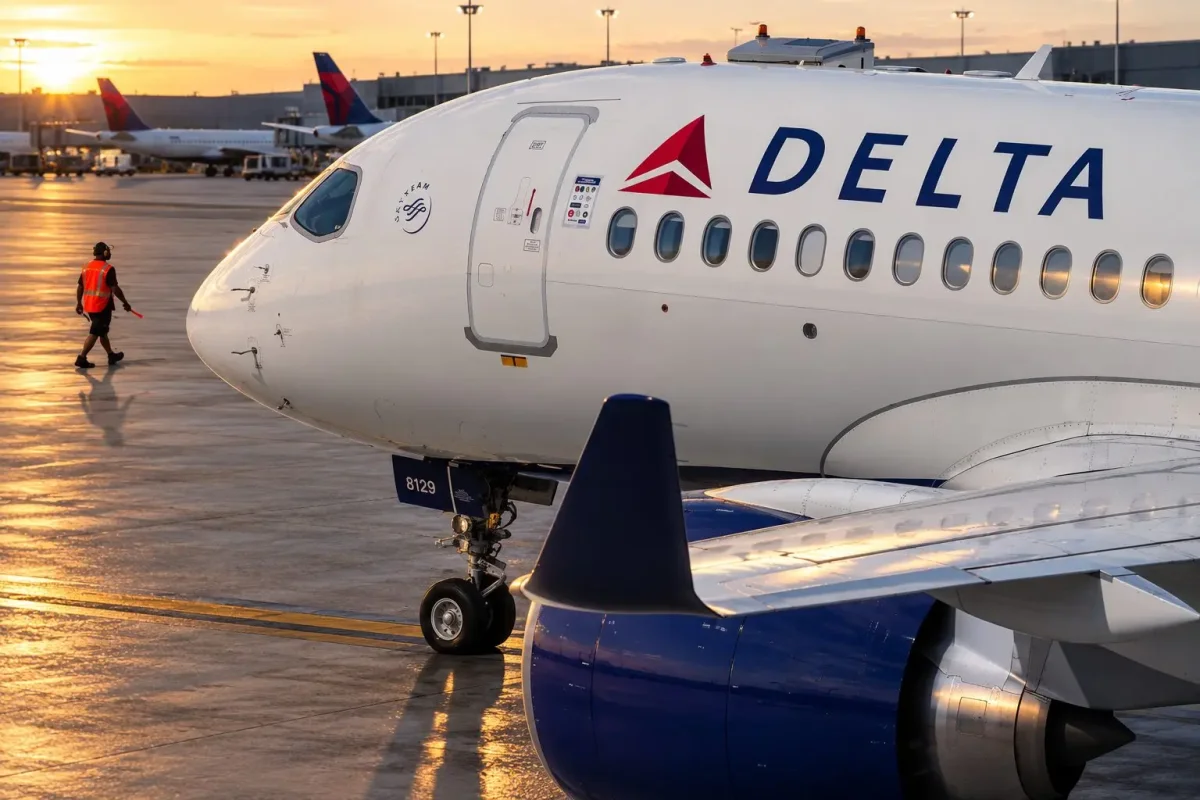
Delta Air Lines (NYSE:DAL) is taking a measured approach to its new nonstop service between Los Angeles (LAX) and Manila, Philippines, with a phased launch designed to limit initial capacity exposure. The carrier plans to begin with three weekly flights on March 28, 2027, before expanding to daily service from June 7, 2027. The route will not carry passengers until 2027, with investor value tied to anticipated future premium demand and connecting traffic.
If operated daily at full capacity, the route would generate between 1.46 billion and 1.63 billion available seat miles (ASMs) annually, representing roughly 0.5% of Delta's second-quarter system capacity on an annualized basis. The distance between Los Angeles and Manila is approximately 7,300 miles, a significant mileage total for a single daily flight.
Premium Focus Aligns with Revenue Trends
Delta's two published configurations for its A350-900 aircraft each offer 80 Delta One and Premium Select seats. With daily flights, this would add up to 560 premium seats per week in each direction. The emphasis on premium cabins aligns with Delta's strongest revenue segment: premium revenue grew 17% in the last quarter, while overall system capacity increased only about 1%.
Jeff Arinder, Delta's vice president of network planning, described Manila as a logical addition to the network, noting that Los Angeles is home to one of the largest Filipino communities outside the Philippines. Delta will be the sole U.S. carrier on the route, competing against Philippine Airlines, owned by PAL Holdings (PSE:PAL), which currently operates the route and increased weekly frequencies from 14 to 18 flights in June.
Market Share and Capacity Dynamics
During the initial three-flight-per-week phase, Delta will account for 14.3% of nonstop departures, offering 825–918 seats weekly in each direction. Once daily service begins, its share rises to 28% of joint daily departures, with 1,925–2,142 seats per week. Nonstop frequency overall would increase by about 39% over the Philippine Airlines baseline of 18 weekly flights, though the initial schedule brings a more modest 17% rise.
The route benefits from substantial domestic feed via Delta's Los Angeles hub, which operates over 160 peak-day departures to more than 50 destinations. This connectivity is expected to drive connecting traffic and support load factors.
Financial Context and Risk Factors
Delta reported adjusted revenue of $17.7 billion for the second quarter, a 14% increase year-over-year. The carrier maintained its full-year adjusted earnings outlook at $6.50 to $7.50 per share. However, the company faces headwinds: adjusted fuel costs rose 77% last quarter, and risks remain centered on fuel prices, aircraft deployment, and pricing competition. Philippine Airlines could respond by cutting fares or adding capacity, potentially pressuring yields.
U.S. markets did not trade on Saturday. Delta shares closed Friday at $84.17, down 2.9% on the session and 3.7% for the week. The next sector assessment is scheduled for Thursday, July 23, when American Airlines Group (NASDAQ:AAL) and Southwest Airlines (NYSE:LUV) are set to release second-quarter earnings. Investors will focus on updates regarding pricing, capacity, and fuel costs.