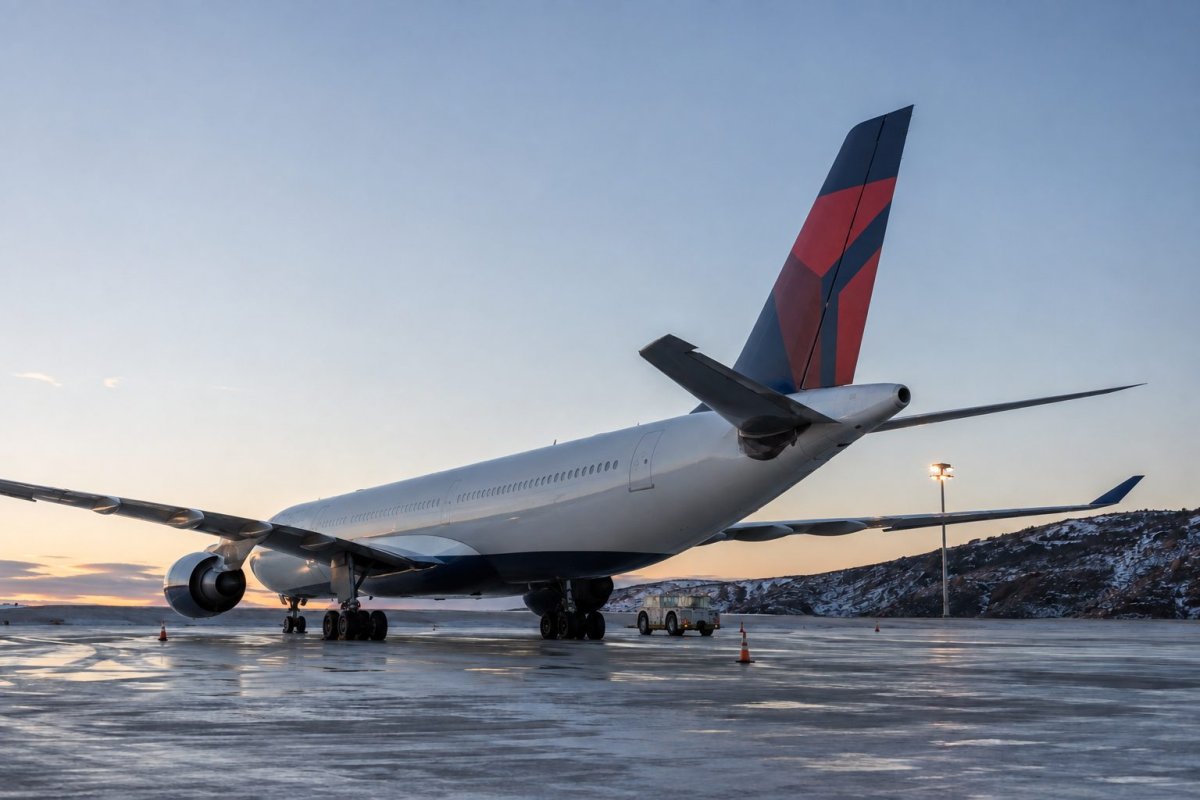
Delta Air Lines (NYSE: DAL) shares ended Monday's trading session virtually flat, closing at $82.48, a modest 0.08% gain, following the safe diversion of Flight 182 over the weekend. The incident, which involved a mechanical issue with one engine on an Airbus A330-300, did not trigger a sell-off, indicating that investors perceive the event as an isolated operational challenge rather than a systemic fleet risk.
Incident Overview
Flight 182, en route from New York to Rome, was forced to divert to St. John's International Airport on Sunday night. The aircraft landed safely at approximately 23:20 local time after the crew reported an engine problem. All 267 passengers and 13 crew members disembarked without injury. Delta promptly arranged accommodations, meals, and alternative travel for affected customers, using another aircraft to continue their journeys.
The A330-300 involved represents a single unit out of Delta's 31-aircraft subfleet of that model, which accounts for roughly 3.1% of the airline's mainline fleet of 989 planes. The subfleet's average age is 16.9 years, as of December 31.
Market Reaction
The market's muted response underscores a confidence that the financial impact will be contained. Delta's stock performance mirrored broader sector trends, with United Airlines (NASDAQ: UAL) gaining 0.35%, Southwest Airlines (NYSE: LUV) up 0.82%, and JetBlue Airways (NASDAQ: JBLU) climbing 1.23%. This suggests the incident was not seen as company-specific negative news.
The calm close follows a turbulent week for Delta, which saw shares decline from $87.59 on August 17 to $82.41 by August 21, a drop of 5.9%. Friday's trading volume of 5.1 million shares was below the 50-day average of approximately 6.8 million, indicating subdued investor activity.
Analyst Sentiment
Wall Street analysts have not revised their earnings estimates in response to the diversion. The consensus rating remains "Strong Buy," based on 25 analysts, with an average price target of $105.31—representing a potential upside of 27.7% from Monday's close. Target prices range from $50 to $125, reflecting a wide dispersion of opinions.
Recent analyst actions include Jefferies' Sheila Kahyaoglu reiterating a "Buy" rating with a $110 target on August 21, and Wells Fargo's Christian Wetherbee maintaining a "Buy" with a $105 target on August 20. Other notable ratings include DBS' Jason Sum ($110, August 13), Citi's John Godyn ($110, August 7), and Goldman Sachs' Catherine O'Brien ($116, August 3).
Financial Resilience
Delta's operational cushion extends beyond the immediate repair costs. The carrier reported $17.7 billion in adjusted revenue for the June quarter, with an adjusted operating margin of 8.8%. Management reaffirmed full-year adjusted earnings guidance of $6.50 to $7.50 per share and free cash flow guidance of $3 billion to $4 billion.
CEO Ed Bastian had previously stated that Delta was "executing from a position of strength" at the time of those results. The recent incident presents a test of operational reliability amid elevated fuel and non-fuel costs, but the financial framework remains robust.
Fleet Modernization
Delta is already transitioning its long-haul fleet toward newer, more efficient aircraft. In January, the airline ordered 16 A330-900s and 15 A350-900s, with deliveries commencing in 2029. This order supports a gradual replacement of older widebody aircraft, including early A330 variants, reducing future maintenance risks.
Key Watch Items
Investors should monitor three developments this week: the timeline for the aircraft's return to service, any regulatory inspection directives affecting sister aircraft, and any schedule disruptions beyond the affected passengers. As of Monday's market close, no broader action had been announced.
Risk Assessment
The benign share reaction could reverse if investigators uncover a common engine or maintenance issue. A multi-aircraft inspection would increase cancellations, passenger compensation costs, and replacement capacity expenses. However, the current fleet math supports the market's verdict: Flight 182 is an operational incident with a contained financial footprint. The investment case changes only if a single grounded jet escalates into a subfleet problem.