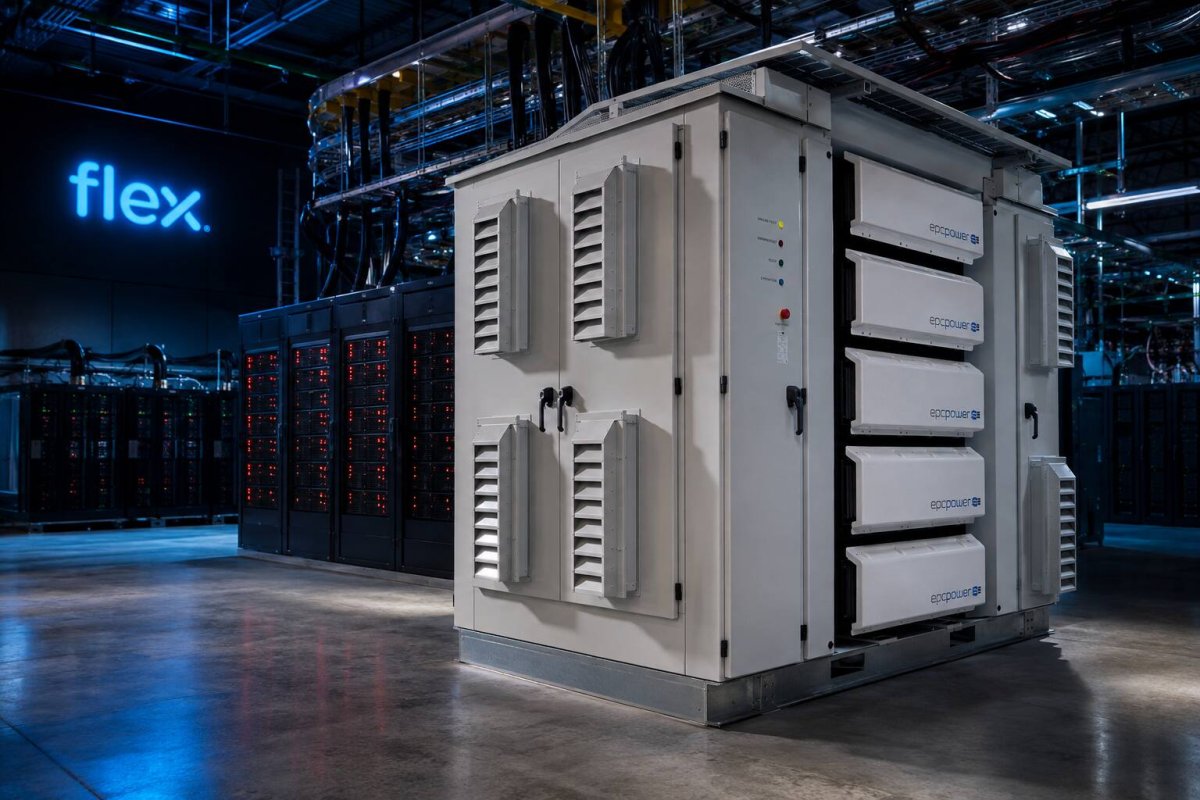
Flex Ltd. (NASDAQ: FLEX) saw its market value climb by $598 million on Friday after announcing a $4.4 billion all-cash acquisition of EPC Power. The strategic rationale won early approval from investors, but the financing structure remains a point of uncertainty. The purchase price is fixed, yet the company has not disclosed how it will balance debt and equity to fund the deal.
At Friday's closing price of $109.51, the transaction represents 10.9% of Flex's equity value. The valuation implies 5.5 times EPC's expected 2026 revenue and a steeper 13.1 times projected 2027 EBITDA. These figures underscore the premium Flex is paying for EPC's growth potential in the power conversion market.
Shares opened strong, hitting an intraday high of $111.60 before retreating to $107.49 at midday. They recovered to close at $109.51, up 1.5% from the prior close of $107.89. The trading pattern suggests cautious optimism rather than an outright celebration, with volume reaching 4.49 million shares.
The acquisition is structured as a locked-box deal with a June 30 valuation date. Citi and Bank of America have committed a fully underwritten 364-day bridge facility for the entire $4.4 billion. Flex says permanent financing will combine debt and equity, but no specific mix, coupon, or issuance price has been revealed.
Analysts have modeled the potential impact on Flex's share count and interest expense. A 100% equity scenario would require issuing 40.2 million new shares, diluting existing shareholders by 9.8%. Conversely, a 100% debt scenario would add $4.4 billion to borrowings, increasing annual interest costs by an estimated $211 million at Flex's current average rate of 4.8%.
Flex's June balance sheet showed $5.2 billion in debt and $2.84 billion in cash. Adding the full $4.4 billion in debt would push total borrowings to $9.6 billion. These boundary cases highlight the trade-offs Flex faces: equity dilution versus higher leverage.
EPC Power is projected to generate $800 million in revenue this year, with management expecting roughly 40% organic growth in 2027 and an EBITDA margin near 30%. If these forecasts hold, 2027 revenue would reach $1.12 billion, and EBITDA would approach $336 million. The 13.1 times EBITDA multiple is reasonable only if this growth materializes.
CEO Revathi Advaithi described a "generational shift in power architecture," citing the need for high-voltage conversion and rapid response to unstable loads in AI data centers. EPC's M System boasts over 99% efficiency and 99.9% availability, using silicon-carbide modules and grid-forming controls. Nvidia's push toward 800-volt DC racks aligns with Flex's existing power and cooling offerings, making EPC a strategic fit.
Flex's cloud and power segment posted $2.20 billion in June-quarter sales, up 35% year-over-year, with segment income rising 38% to $214 million. EPC's projected 30% EBITDA margin could enhance the overall mix, though integration costs are expected to weigh on near-term results.
The financing timeline is tight. The deal is expected to close in the fourth quarter, while Flex still targets the spin-off of its Cloud and Power Infrastructure business for early 2027. A Form 10 is planned for this month, followed by an investor day on November 10. These documents should clarify the capital structure of the future independent company.
Wall Street remains constructive on the deal, but the undisclosed financing mix and the aggressive valuation leave room for skepticism. Investors will be watching closely for details on permanent funding, pro forma share count, and debt allocation.