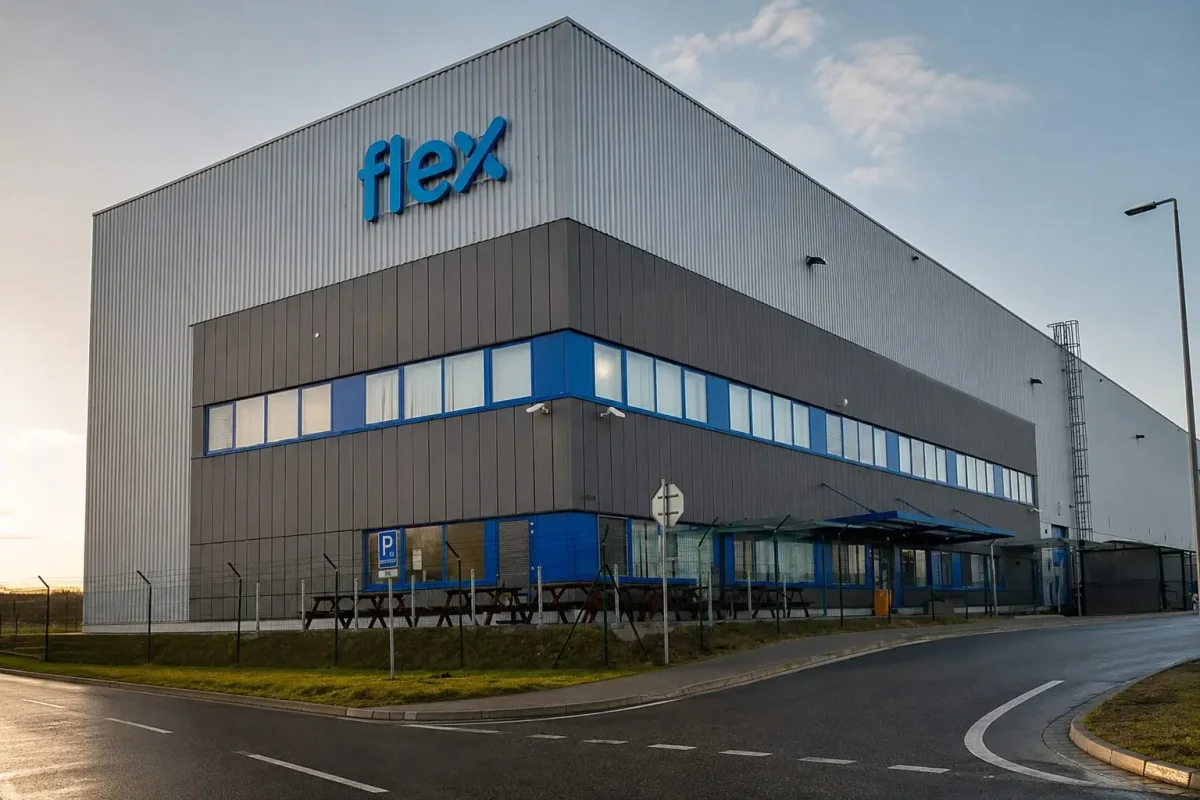
Flex Ltd. (FLEX) is set to make its debut in the S&P 500 when trading opens Monday, capping a turbulent holiday-shortened week for the electronics manufacturing services provider. The stock closed Thursday at $147.61, the last regular session before U.S. markets were closed Friday for the Juneteenth holiday. That closing price represents a decline of roughly 1.4% from the prior Friday's close of $149.71, despite a late-week bounce.
The index promotion, moving Flex from the S&P MidCap 400 to the large-cap benchmark, had been widely anticipated for two weeks. The stock experienced unusually heavy volume during the rebalance window, with shares falling on Monday, Tuesday, and Wednesday before rallying 3.13% on Thursday on volume of about 80.9 million shares. Still, the week's net decline underscores that index inclusion does not eliminate two-way price risk.
AI Infrastructure Pivot
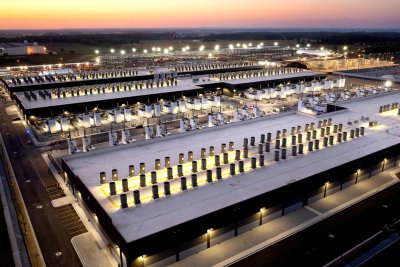
Beyond index membership, the core investment thesis for Flex revolves around its repositioning as a supplier to the artificial intelligence data-center buildout, not merely a contract manufacturer. The company plans to spin off its cloud and power infrastructure business into a separate publicly traded entity by early 2027, creating a dedicated unit focused on power, cooling, and integrated systems for AI data centers. Chief Executive Revathi Advaithi has called the S&P 500 promotion a 'landmark milestone.'
The AI angle is grounded in concrete product launches. On June 1, Flex introduced power products for high-density AI racks, including a 110 kW power shelf designed for NVIDIA's Vera Rubin NVL72 platforms. Chris Butler, president of embedded and critical power at Flex, noted that 'rapid growth of AI is driving new demands' on data-center power infrastructure.
Financial Performance and Guidance
The company's own numbers provide a foundation for the bull case. In May, Flex reported fiscal fourth-quarter net sales of $7.5 billion and fiscal 2026 net sales of $27.9 billion, up 17% and 8% year-over-year, respectively. Management guided fiscal 2027 net sales to a range of $32.3 billion to $33.8 billion and adjusted earnings per share (excluding selected items) to between $4.21 and $4.51.
Market Context and Peer Read-Through
The broader market provided a tailwind late in the week. U.S. stocks rallied Thursday, with the S&P 500 gaining 1.08% and the Nasdaq rising 1.91%, as chip shares strengthened and inflation fears eased following a U.S.-Iran peace agreement, according to Reuters. Technology led S&P sector gains, offering a favorable backdrop for Flex, though not a company-specific catalyst.
Peer read-through from Jabil (JBL) is supportive albeit crowded. Jabil recently raised its 2026 profit forecast and lifted its AI-related revenue outlook to approximately $13.6 billion. CEO Mike Dastoor stated that 'AI infrastructure demand remains extremely strong,' a sentiment that also frames what investors are pricing into Flex.
Risks and Forward Outlook
The risk is that the stock has run ahead of near-term proof points. Once index-related buying subsides, FLEX may trade more on execution: whether the spin-off closes on schedule, whether AI power and cooling demand remains robust, and whether margins can withstand competition, supply-chain constraints, and macroeconomic shocks. Flex itself has cautioned that the spin-off may not be completed on the expected timeline, or at all, and that anticipated benefits could take longer to materialize.
Monday's open will reveal how much forced index demand remains. After that, the question becomes more fundamental: can Flex translate a strong index event into another quarter of hard evidence on revenue, margins, and its AI infrastructure order book?