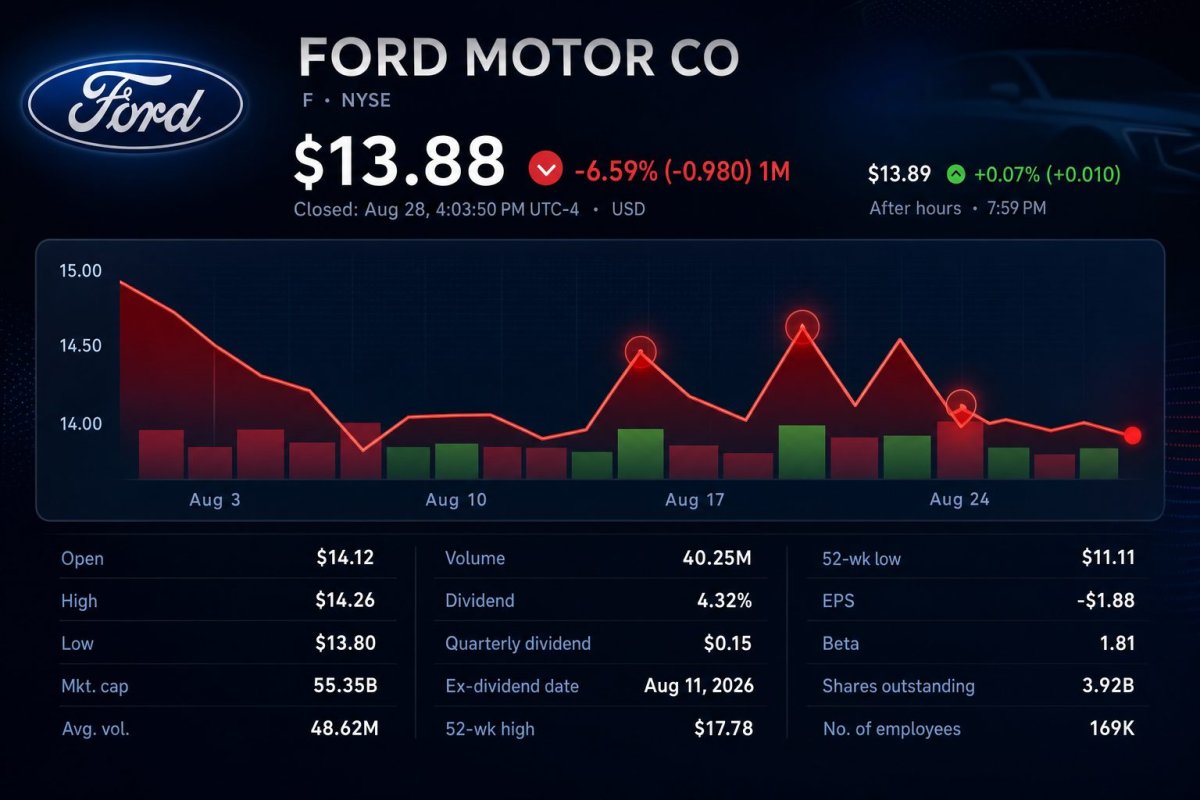
Ford Motor Co. (NYSE: F) saw its shares ease 0.5% on Friday, closing at $13.88, as a new U.S.-Canada trade dispute added pressure to the automaker's already modest valuation. The stock traded at roughly 7.5 times the consensus 2026 earnings estimate of $1.85 per share, reflecting both a potential value opportunity and significant execution risks.
The decline came despite a broader market uptick, with the auto sector as a whole dropping 1.78% on the day. Ford's trading volume reached 40.25 million shares, about 25% below its 65-day average, suggesting cautious investor sentiment.
Tariff Concerns Escalate
The immediate catalyst for the share drop is the escalating tariff dispute between the U.S. and Canada. Washington has warned it may impose 50% tariffs on Canadian-built cars and auto parts starting January 2027, following stalled trade negotiations. Such tariffs could increase Ford's production costs, particularly for vehicles assembled in Canada, and disrupt its North American supply chain.
This is not the first tariff-related headache for Ford. Earlier this month, the company faced a trade-rule cost equivalent to 19% of its profit forecast, and analysts have been closely monitoring the potential impact of tariffs on the automaker's margins.
Valuation and Analyst Outlook
Despite the tariff headwinds, Ford's valuation remains attractive on a forward basis. The stock's 7.5x price-to-earnings multiple is well below the broader market average, offering a potential cushion for investors. However, this discount also reflects the market's skepticism about Ford's ability to execute its turnaround plan.
Wall Street analysts have an average price target of $15.81 on Ford shares, implying a potential 13.9% upside from Friday's close. The target range is wide, from a low of $11 to a high of $20, underscoring the uncertainty surrounding the company's electric vehicle investments and trade policy.
Of the 23 analysts covering the stock, seven rate it a Buy, 13 say Hold, and three have Underperform ratings, resulting in an overall Overweight consensus.
Financial Performance and Guidance
Ford's second-quarter results, released in July, showed revenue of $48.3 billion and adjusted EBIT of $2.5 billion, a 17% increase year-over-year. Management raised its full-year adjusted EBIT guidance to a range of $10 billion to $11 billion, and lifted adjusted free cash flow guidance to $6 billion to $7 billion.
The company's business segments remain uneven. Ford Pro, its commercial vehicle unit, is expected to generate $7 billion to $7.5 billion in earnings, while the Model e EV division is projected to lose about $4 billion. This disparity highlights the challenges Ford faces in its transition to electric vehicles.
One-time charges continue to weigh on reported earnings. Ford recorded a net loss of $1.3 billion in the second quarter, largely due to $4.2 billion in charges related to the BlueOval SK exit and the termination of certain EV initiatives.
Liquidity and Upcoming Catalysts
Ford's balance sheet remains a key strength. The company ended the quarter with $22.3 billion in cash and $43.4 billion in total liquidity, providing a buffer against potential tariff shocks or operational setbacks.
Investors will get the next update when Ford reports third-quarter earnings on October 28. Analysts expect adjusted earnings of $0.41 per share, up from the $0.37 consensus three months ago, indicating some optimism about near-term performance.
However, risks remain elevated. Beyond tariffs, Ford faces ongoing losses in its EV segment, higher warranty costs, and a potentially softer U.S. auto cycle. These factors could offset the benefits of its improved cash flow guidance and keep the stock's valuation range-bound.