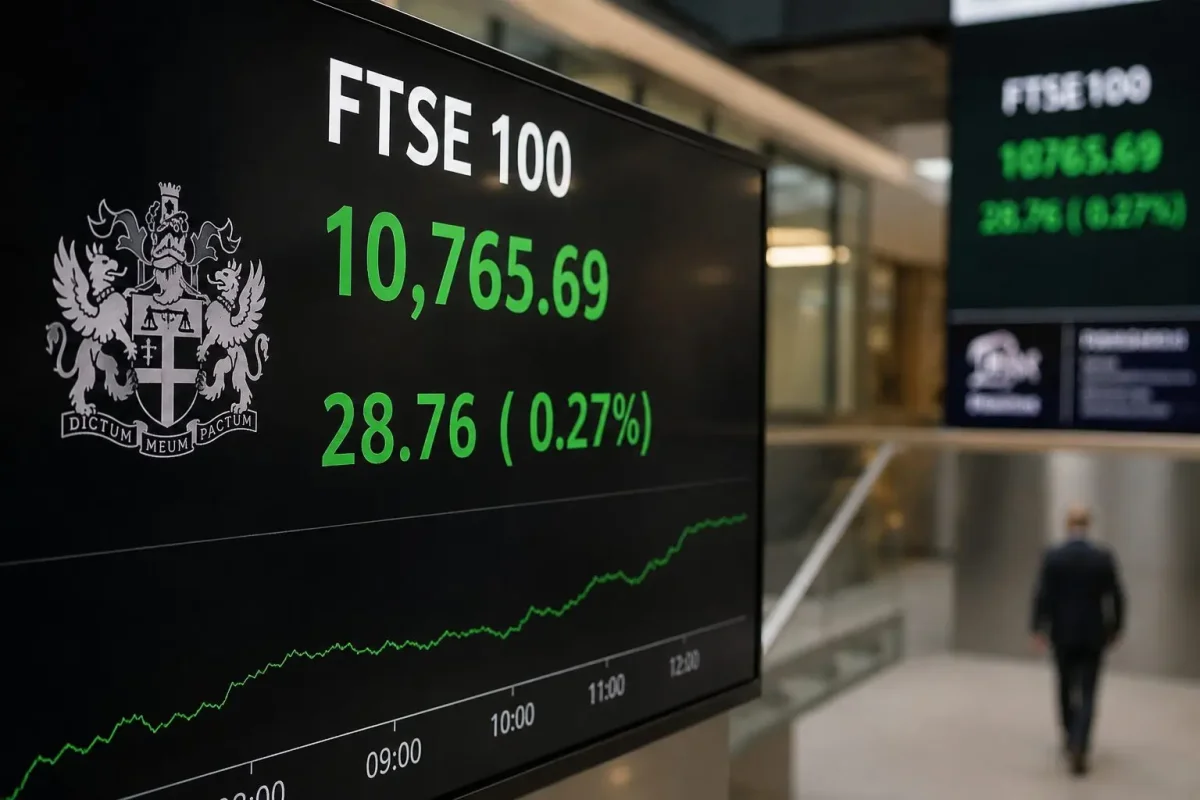
London stocks opened higher on Monday, but the bulk of those gains faded within the first hour of trading as a sharp decline in crude oil prices triggered a significant sector rotation. By 09:40 BST, the FTSE 100 was up just 0.27% at 10,765.69, having started the session with a more robust 0.88% advance.
The initial surge of 94.72 points from Friday's close was quickly trimmed to a net gain of 29.46 points, erasing approximately 69% of the early momentum. In contrast, the mid-cap FTSE 250 index fared considerably better, rising 0.60% to 23,944.58, outperforming the blue-chip index by roughly 0.33 percentage points.
Oil Price Plunge Drives Divergence
The primary catalyst for the market's divergent performance was a steep drop in oil prices. Brent crude fell over 5% as geopolitical tensions between the U.S. and Iran showed signs of easing. This decline sent a strong signal across markets: lower fuel costs are a boon for consumers, airlines, and government bonds, but they pressure the near-term revenue outlooks for major oil companies.
European travel stocks climbed 2.4%, while the energy sector slid 2%. Shares of International Consolidated Airlines Group (LON:IAG) jumped 3.7% at the open. Conversely, BP (LON:BP) slipped nearly 3.4%, and Shell (LON:SHEL) dropped around 1.5%. The disparity underscores how lower fuel prices can swiftly boost airline margins even as they reduce realized prices and projected cash flow for producers.
Earnings Highlights: Vodafone and AstraZeneca
Among large-cap stocks, Vodafone Group (LON:VOD) delivered notable gains, with shares advancing roughly 4%. The telecoms giant reported a 5.2% rise in organic service revenue, while organic adjusted EBITDAaL climbed by 6.2%. Chief Executive Margherita Della Valle pointed to “broad-based growth across all of our segments,” and the company anticipates earnings close to the higher end of its updated outlook.
AstraZeneca (LON:AZN) climbed 1.6% following a second-quarter profit beat. Core earnings were up 18% at $2.63 per share, while revenue grew 5% to $15.38 billion. Chief Executive Pascal Soriot stated that over “twenty high-value readouts” are expected in the next 18 months. The company maintained its 2026 forecast and its $80 billion revenue ambition for 2030. Despite the positive results, AstraZeneca shares remain roughly 8% lower year-to-date.
Bond Market Rally and BoE Outlook
UK government bonds rallied as oil prices pulled back, with benchmark gilt yields sliding to their lowest level in a week. According to a Reuters survey, all 70 economists predict the Bank of England will keep its 3.75% rate unchanged at its meeting on Thursday. The upcoming BoE decision is the next key local event, with investors keen to see if officials view the recent oil decline as lasting. A renewed jump in energy prices could swiftly restore worries over inflation and interest rates.
Risks Remain Elevated
Monday's trading supported a relative rotation rather than broad-based exposure to UK equities. Gains were stronger in mid-cap and travel sectors, reflecting oil price relief, while the FTSE 100, which is heavily weighted towards energy stocks, saw smaller moves. However, risks stay elevated. This pause in hostilities does not equate to a formal ceasefire, and Houthi attacks continue to pose a threat to regional energy assets. Any resumption of strikes could quickly undo Monday's advances in airlines, bonds, and mid-cap stocks.