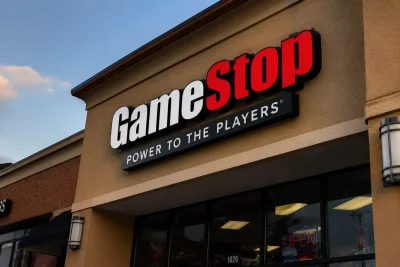
GameStop Corp. (GME) has made a bold $55.5 billion bid to acquire eBay Inc. (EBAY), offering $125 per share in a cash-and-stock deal. The proposal, announced on Sunday, represents a 46% premium over eBay's unaffected closing price from February 4, the date GameStop began accumulating its stake. However, Wall Street remains deeply skeptical about the deal's feasibility, given that eBay's market capitalization is nearly four times that of the video game retailer.
EBay shares jumped in premarket trading on Monday, but remained well below the offer price, indicating investor doubt about the deal's completion. Meanwhile, GameStop's stock slipped around 3% as the market digested the news. The gap between eBay's trading price and the offer price underscores the significant hurdles GameStop faces in pulling off this acquisition.
GameStop disclosed that it holds a 5% economic interest in eBay, combining both common stock and derivatives that track eBay's share price. The company plans to file a Schedule 13D with the SEC, as required for investors crossing the 5% ownership threshold, as well as a Hart-Scott-Rodino notification for antitrust review. The financing structure includes approximately $9.4 billion in cash and liquid investments from GameStop's balance sheet as of January 31, along with a highly-confident letter from TD Securities backing up to $20 billion in third-party acquisition financing. However, this letter is not a binding commitment, and the remaining funds would likely require significant debt and equity issuance.
CEO Ryan Cohen has pitched the acquisition as a strategic pivot for GameStop, which has been struggling with declining sales as more gamers shift to digital downloads and streaming. Fourth-quarter revenue fell 14% in March, and the company's net sales for fiscal 2025 slid to $3.63 billion from $3.82 billion the previous year. Despite these challenges, GameStop has built a substantial cash pile, with cash, cash equivalents, and marketable securities reaching $9.0 billion at the end of the fourth quarter, doubling from a year earlier. Net income also climbed to $418.4 million.
Cohen envisions combining GameStop's 1,600 U.S. locations with eBay's marketplace to create a stronger competitor to Amazon. He told the Wall Street Journal that eBay 'could be a legit competitor to Amazon' and that he believes eBay 'should be worth – and will be worth – a lot more money,' potentially worth 'hundreds of billions of dollars.' GameStop argues its physical stores could support eBay with authentication, intake, fulfillment, and live commerce services.
EBay, for its part, has not commented on the offer. The company's recent financial performance has been strong, with first-quarter revenue of $3.1 billion, up 19% year-over-year, and gross merchandise volume reaching $22.2 billion, an 18% increase. Operating cash flow from continuing operations stood at $970 million. These numbers highlight eBay's robust business model, which contrasts with GameStop's declining core operations.
Analysts have expressed significant doubts about the deal. Bernstein analysts highlighted 'significant financing challenges' for GameStop, pointing to its lighter balance sheet and the scale of both debt and equity that would be required. They added they would be 'even more surprised if anything became of it.' Investor Michael Burry also weighed in, calling a full takeover tough for GameStop to pull off given the valuation gap.
GameStop's proposal remains non-binding and faces numerous hurdles. The company noted in its filing that there is no guarantee eBay's board will engage, financing will materialize, regulators will approve, shareholders will support the deal, or that the touted cost savings will be realized. The Hart-Scott-Rodino antitrust review adds another layer of complexity. The market's reaction suggests that while Cohen's vision is ambitious, the path to execution is fraught with uncertainty.