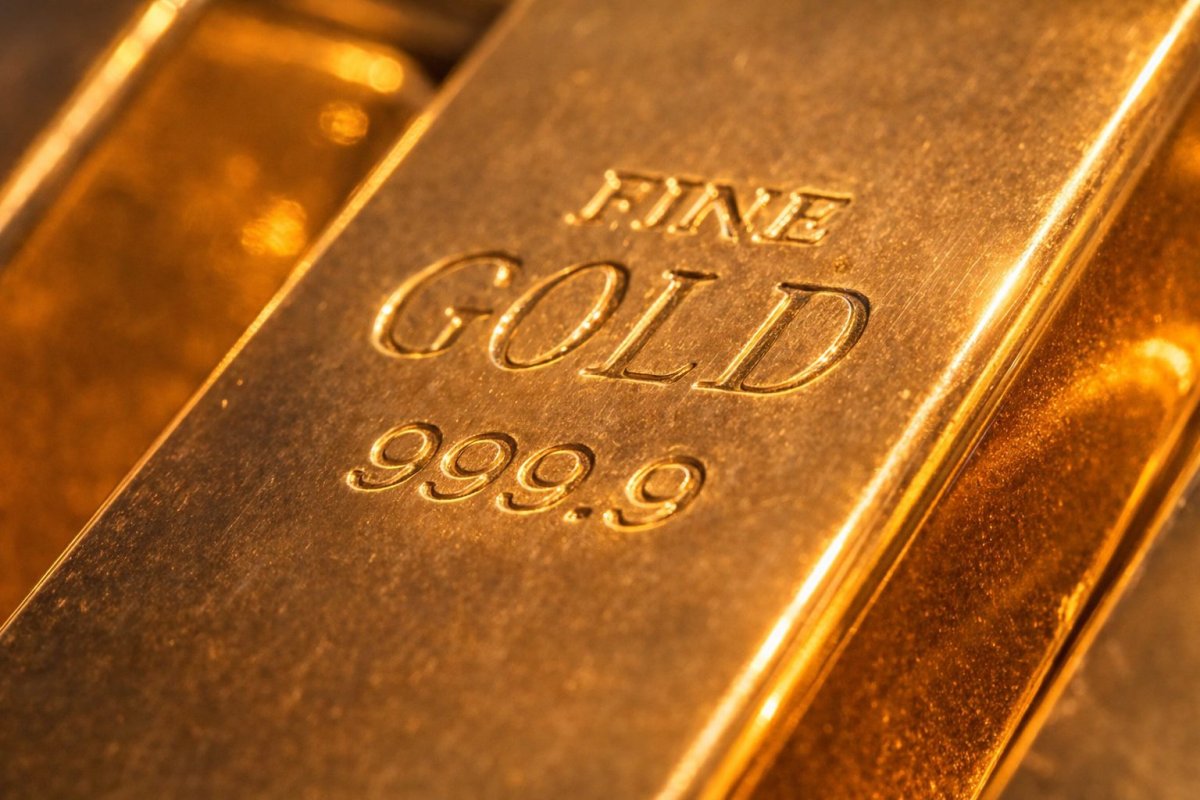
Gold prices staged a significant recovery during Thursday's trading session, climbing more than 1% as the U.S. dollar retreated and government bond yields moved lower. The precious metal found support after a brutal March that marked its worst monthly performance in over a decade.
Price Action and Key Drivers
Spot gold traded at $4,789.67 per ounce by 1:30 p.m. Eastern Time, representing a gain of 1.6%. U.S. gold futures contracts for June delivery settled at $4,818.00, up 0.9% for the session. Analysts pointed to a weaker greenback as the primary catalyst for the rally. The U.S. Dollar Index, which measures the currency against a basket of peers, declined approximately 0.37%. Concurrently, the yield on the benchmark 10-year U.S. Treasury note fell to around 4.27%. These moves typically enhance gold's appeal, making it cheaper for foreign buyers and reducing the opportunity cost of holding the non-yielding asset.
Geopolitical and Economic Crosscurrents
Market participants maintained a cautious stance amid a delicate two-week ceasefire agreement between the United States and Iran, with Pakistan acting as an intermediary. The truce, signed on Wednesday, helped lift gold to a near three-week peak. However, analysts warned the situation remains precarious, with the strategic Strait of Hormuz still blockaded. Edward Meir, an analyst at Marex, noted the ceasefire "could help roll back some inflationary pressures" but cautioned that markets are "still not out of the woods."
All eyes are now on Friday's release of the U.S. Consumer Price Index (CPI) for March, scheduled for 8:30 a.m. ET. This inflation gauge is closely watched for clues on the path of retail prices and the Federal Reserve's subsequent policy moves. Persistent price pressures have kept the central bank in a hawkish posture. The Fed's preferred inflation measure, the Personal Consumption Expenditures (PCE) price index, rose 2.8% year-over-year in February, with core PCE increasing 3.0% annually.
Context from a Brutal March
Thursday's advance comes as gold attempts to recover from a historically poor month. According to data from China's central bank, spot gold plummeted 11.52% in March, its steepest monthly decline since 2008. The World Gold Council also characterized March as the metal's worst performance since June 2013. Despite the sell-off, official sector demand has shown resilience. China's central bank added to its gold reserves for a seventeenth consecutive month in March, and a recent survey indicated nearly 40% of global reserve managers are considering increasing their holdings.
Fed Policy and Market Implications
Minutes from the Federal Reserve's March 17-18 policy meeting, released Wednesday, revealed officials held the benchmark interest rate steady in a range of 3.50% to 3.75%. Policymakers emphasized that future decisions will depend on incoming economic data and forecasts. Notably, the minutes suggested a growing inclination among some officials to consider rate hikes if inflation proves more persistent than expected. This higher-for-longer interest rate environment traditionally pressures gold, which offers no yield.
The market narrative is not one-directional. A sustained ceasefire could ease oil prices further and boost investor risk appetite, potentially diminishing gold's safe-haven appeal. Conversely, a collapse of the truce or a hotter-than-expected CPI print on Friday could reinforce expectations that the Fed will maintain restrictive policy, potentially fueling further volatility. Derek Halpenny of MUFG highlighted the fragility of the situation, stating, "The entire ceasefire remains tenuous."
Broader Precious Metals Rally
The rally extended across the precious metals complex. Silver outperformed, with spot prices jumping 2.9% to $76.24 an ounce. Platinum surged 3.8% to $2,106.01, while palladium edged 0.3% higher to $1,558.75. The moves underscore a broad-based bid for hard assets amid the current macroeconomic and geopolitical landscape.
Ultimately, the trajectory for gold hinges on the interplay between central bank policy, currency movements, and geopolitical developments. Friday's inflation data will provide the next critical test for whether the metal's recent rebound can evolve into a more sustained recovery or if it will face renewed pressure from a data-dependent Federal Reserve.