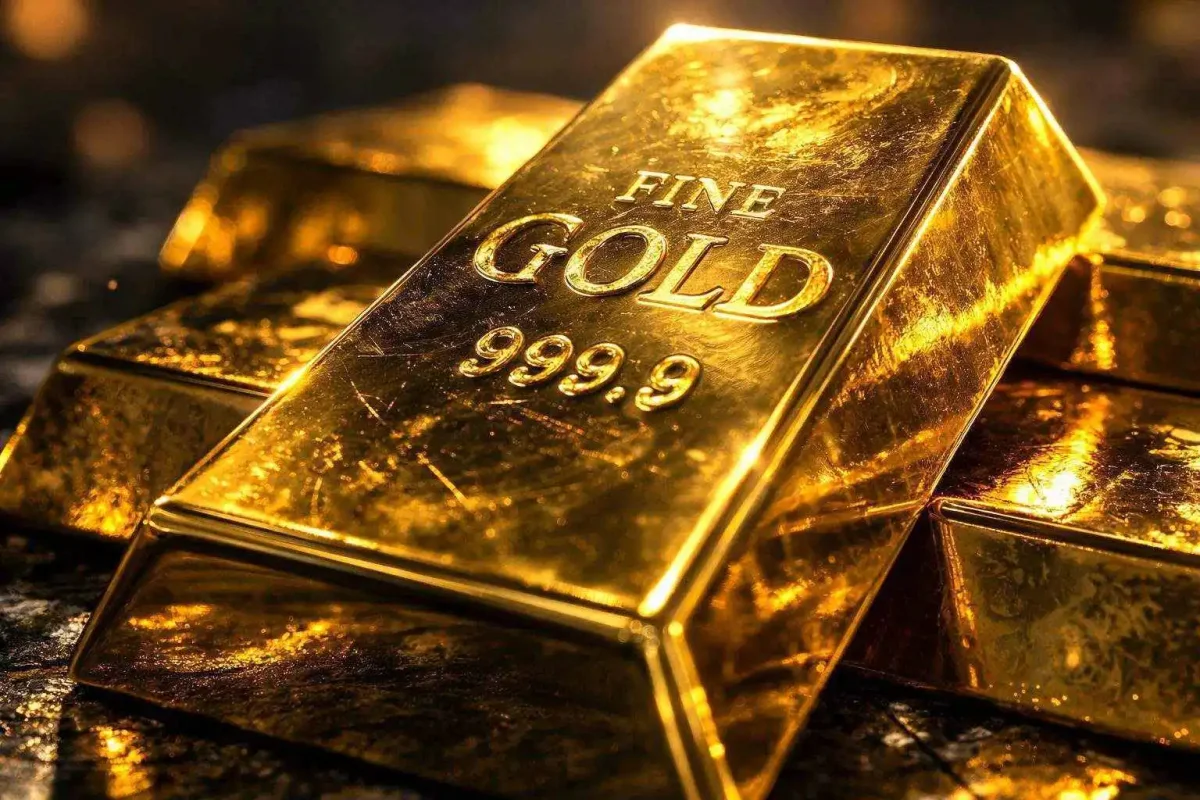
Gold prices retreated on Monday, touching their lowest level in a week, as a resurgent U.S. dollar and a significant spike in crude oil markets weighed on investor sentiment toward the precious metal. Spot gold was last seen trading at $4,818.03 per ounce, a decline of 0.3%, while the more actively traded June gold futures contract settled at $4,839.10, down 0.8%.
The session's dynamics presented a complex picture for gold, which often benefits from geopolitical uncertainty. Fresh tensions between the United States and Iran, including a reported U.S. seizure of an Iranian cargo ship and retaliatory threats from Tehran, sent oil prices soaring by approximately 5%. This development, however, had a dual effect. While it elevated geopolitical risk, it also stoked immediate concerns that higher energy costs could perpetuate inflationary pressures, potentially keeping interest rates elevated for longer.
This inflation-focused narrative worked against gold. The metal, which offers no yield, becomes less attractive to investors when real interest rates rise. The prospect of stubborn inflation bolstered U.S. Treasury yields and the dollar, the latter making gold more expensive for holders of other currencies. "Gold is taking a backseat as traders favor the dollar for safety," noted Han Tan, chief market analyst at Bybit. He suggested spot gold is likely to remain below the $5,000 threshold barring a significant and sustained de-escalation of tensions.
Market analysts highlighted the $5,000 per ounce level as the critical near-term resistance point that bullish traders need to conquer. Jim Wyckoff, senior analyst at Kitco Metals, pointed out that June gold bulls are specifically targeting a sustained close above that symbolic barrier. Conversely, traders cited persistent "bearish daily elements," primarily the strength in the dollar and bond yields, as headwinds.
The immediate outlook appears finely balanced. Fawad Razaqzada, market analyst at City Index and FOREX.com, cited the Middle East situation as a reason for turning "slightly to the downside" on gold in the short term. He warned that another spike in oil could further propel the dollar and yields, keeping gold subdued. This creates a scenario where gold is behaving more as a sensitive gauge of inflation and real rates than a pure geopolitical hedge.
Despite the near-term pressures, longer-term structural supports for gold remain intact. Nikos Tzabouras, senior market analyst at Tradu.com, highlighted persistent central bank purchases, ongoing concerns about de-dollarization, and fears of currency debasement as fundamental factors providing a floor for bullion prices.
Trading activity reflected the mixed sentiment. At 10:00 a.m. Eastern Time, open interest for COMEX gold futures—a measure of outstanding contracts—rose to 360,881, an increase of 14,538 from the previous session. Estimated trading volume stood at 89,375 contracts. Each COMEX gold futures contract represents 100 troy ounces of the metal.
The weakness extended across the precious metals complex. Silver followed gold lower, dropping 0.8% to $80.18 per ounce. Platinum fell more sharply, declining 1.2% to $2,077.35, while palladium edged down 0.3% to $1,554.48. Both platinum and palladium briefly touched their lowest prices in a week during the session.
In summary, the path for gold hinges on the interplay between competing forces. A further escalation in oil prices could reinforce dollar and yield strength, potentially capping gold below $5,000 even amid high geopolitical risk. Alternatively, a cooling of U.S.-Iran tensions or a retreat in U.S. yields could provide the catalyst for buyers to mount another challenge at the key psychological $5,000 level. For now, the market's focus has shifted from pure risk aversion to the nuanced implications of energy-driven inflation.