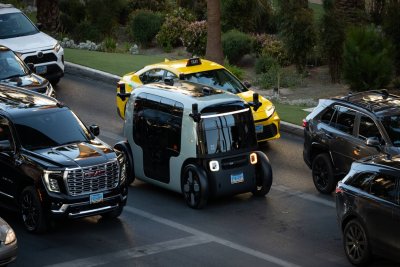
Grab Holdings Limited has commenced Singapore's inaugural public autonomous ride-hailing service, deploying a limited fleet of self-driving shuttles in the Punggol residential district. The initiative, developed in collaboration with Chinese autonomous technology firm WeRide, has already facilitated trips for over 1,000 early-access users, with the vehicles collectively traversing more than 30,000 kilometers. Alejandro Osorio, Grab's Managing Director for Singapore, stated the program is designed to integrate autonomous technology into daily transportation while helping the company's driver-partners transition to evolving roles within the ecosystem.
Strategic Timing for Margin Enhancement
The launch occurs as Grab intensifies efforts to position its technological investments as core drivers of future profitability, rather than ancillary projects. This strategic push was underscored last week by the company's announcement of a plan to repurchase up to $400 million of its shares. Chief Financial Officer Peter Oey characterized the recent stock decline as a "clear opportunity" to enhance shareholder value, reaffirming Grab's target of achieving $1.5 billion in adjusted EBITDA by 2028. The company defines adjusted EBITDA as operating profit excluding specific items.
Focus on Profitable Growth and Automation
In February, President and Chief Operating Officer Alex Hungate outlined Grab's ambition for annual revenue growth exceeding 20% through 2028. He emphasized that reinvesting capital in Southeast Asia remains the company's top priority. Hungate noted the regional ride-hailing market has matured beyond a subsidy-driven growth phase, with a sharper contemporary focus on sustainable profitability. This shift, he explained, places automation and artificial intelligence at the forefront of Grab's strategy, transforming them from experimental concepts into fundamental business drivers.
Regulatory Framework and Service Details
The Land Transport Authority of Singapore has authorized autonomous vehicle rides for the public on designated Routes 1 and 3, effective April 1. The service will initially be offered free of charge, with a flat fare of S$4 scheduled to take effect in mid-2026 when revenue-generating operations begin. The authority projects that the AV shuttles could reduce certain commute times by up to 15 minutes, with safety and operational protocols remaining under continuous supervision.
WeRide's Cost-Saving Proposition
WeRide has actively promoted the economic advantages of its technology ahead of the service launch. On March 16, the company asserted that its GXR platform could potentially reduce the cost of an autonomous driving suite by 50% and lower the total cost of ownership by 84%. Founder Tony Han identified Southeast Asia as a "core growth market" for the firm. Dominic Ong, Grab's head of autonomous mobility, added that the Singapore pilot aims to demonstrate the technology's community benefits as local regulations and infrastructure continue to develop.
Expansion and Investor Scrutiny
The autonomous service debut follows closely on Grab's agreement to acquire Delivery Hero's Foodpanda Taiwan unit for $600 million, marking its first expansion outside Southeast Asia. The company anticipates closing the transaction in the second half of 2026, expecting it to contribute at least $60 million in incremental adjusted EBITDA by 2028.
However, expansion has not fully alleviated investor concerns. In February, Grab provided 2026 revenue guidance in a range of $4.04 billion to $4.10 billion, which fell short of Wall Street expectations. CFO Peter Oey indicated the company would maintain stable ride prices to attract new users, a strategy deemed crucial as consumer spending on non-essentials tightens.
Regulatory and Competitive Pressures
Beyond technological bets, Grab faces significant regulatory challenges. In January, reports indicated Indonesia is considering draft rules that could lower commission caps for ride-hailing platforms to 10% from the current 20%. The proposed regulations would also require companies, including Grab and rival GoTo, to cover additional insurance and social costs for drivers—a move that would directly pressure margins in Southeast Asia's largest ride-hailing market.
Grab's entry into autonomous rides also places it in an accelerating global competition. In December, reports surfaced that Uber and Lyft were planning robotaxi pilot programs in the UK. WeRide, Grab's partner, has already partnered with Uber for fully driverless trips in Abu Dhabi and launched passenger services in Dubai. The broader industry trend signals a rapid progression beyond controlled test runs toward limited commercial deployment.