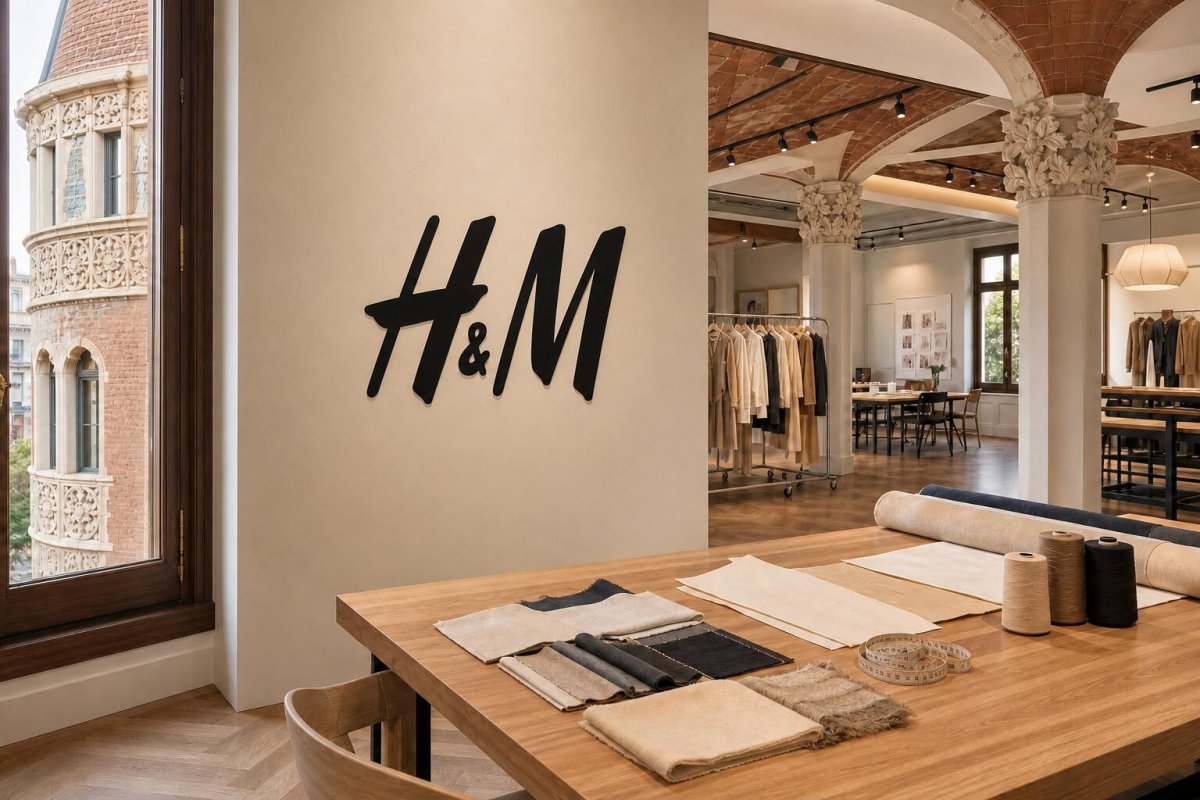
H&M Hennes & Mauritz AB (STO:HM-B) has inaugurated a production office in Barcelona, consolidating design, purchasing, and supplier management under a single roof. The move is a strategic response to a persistent challenge in its operating model: while leaner inventory levels have bolstered margins, they have also led to missed sales opportunities due to stockouts.
The new office, located in the historic Casa de les Punxes, will house teams responsible for design, product development, buying, and supplier relations. According to Spanish fashion news outlet Modaes, the office will also conduct trend and market research. H&M stated that the proximity to selected suppliers is expected to facilitate faster collaboration, creating a more integrated workflow.
This setup is distinct from a conventional sourcing outpost. By bringing designers and production experts together, ideas can be tested against real-world constraints early in the process, reducing the risk of costly missteps. Buyers can also communicate shifts in consumer demand directly to suppliers, bypassing the delays of a fragmented chain.
As of January 2026, H&M operated 12 local production offices with approximately 1,300 employees. The company has not disclosed whether the Barcelona office will add to these numbers or if staffing will be reallocated from other locations. No specific investment budget, headcount, or lead-time reduction targets were provided, leaving the initiative's financial impact unquantified.
The announcement comes as H&M continues to navigate the delicate balance between inventory efficiency and sales growth. In its second quarter, inventory decreased by 10% year-over-year to SEK 34.94 billion, with currency-adjusted inventory down 2%. Stock represented 15.8% of rolling 12-month sales, a level that has supported profitability. Adjusted operating profit rose 11% to SEK 6.59 billion, and the adjusted operating margin improved to 12.0%. Gross margin also expanded to 56.6% from 55.4%.
However, sales performance has lagged. Second-quarter revenue fell 3% to SEK 54.83 billion, though local-currency sales were roughly flat, aided by a 3% reduction in store count. Chief Executive Daniel Ervér acknowledged in June that tight inventory had sometimes constrained the company's ability to meet demand, highlighting the need for better precision between availability and consumer demand.
The Barcelona office is designed to address this gap. By shortening the feedback loop between design, production, and sales, H&M hopes to reorder popular items more quickly and discontinue weak ones earlier. The risk is that improved responsiveness could lead to higher inventory levels if not managed carefully, potentially negating recent margin gains.
Investors will be watching the company's upcoming nine-month report, scheduled for September 24 at 8:00 a.m. CEST. That report will not reflect the Barcelona office's impact, as the third quarter ended before its opening. Instead, it will provide a baseline for assessing future progress. Key metrics to monitor include management's commentary on product availability, full-price sell-through, and the trajectory of inventory relative to sales.
On Monday, H&M's Class B shares closed at SEK 173.35, down 1.23% from Friday's close. The stock traded as high as SEK 175.45 before ending at the session low. Volume was 874,058 shares. There is no evidence that the Barcelona announcement caused the decline; the stock's trailing price-to-earnings ratio of 22.57 suggests investors are pricing in expectations, leaving limited room for disappointment.
In summary, the Barcelona production office represents a credible operational bet to improve product speed and reduce the trade-off between inventory efficiency and sales growth. While the initiative's success remains unproven, it signals management's awareness of the need to adapt to a fast-changing retail environment. The September report will offer a clearer view of whether H&M can sustain its margin improvements while capturing more demand.
