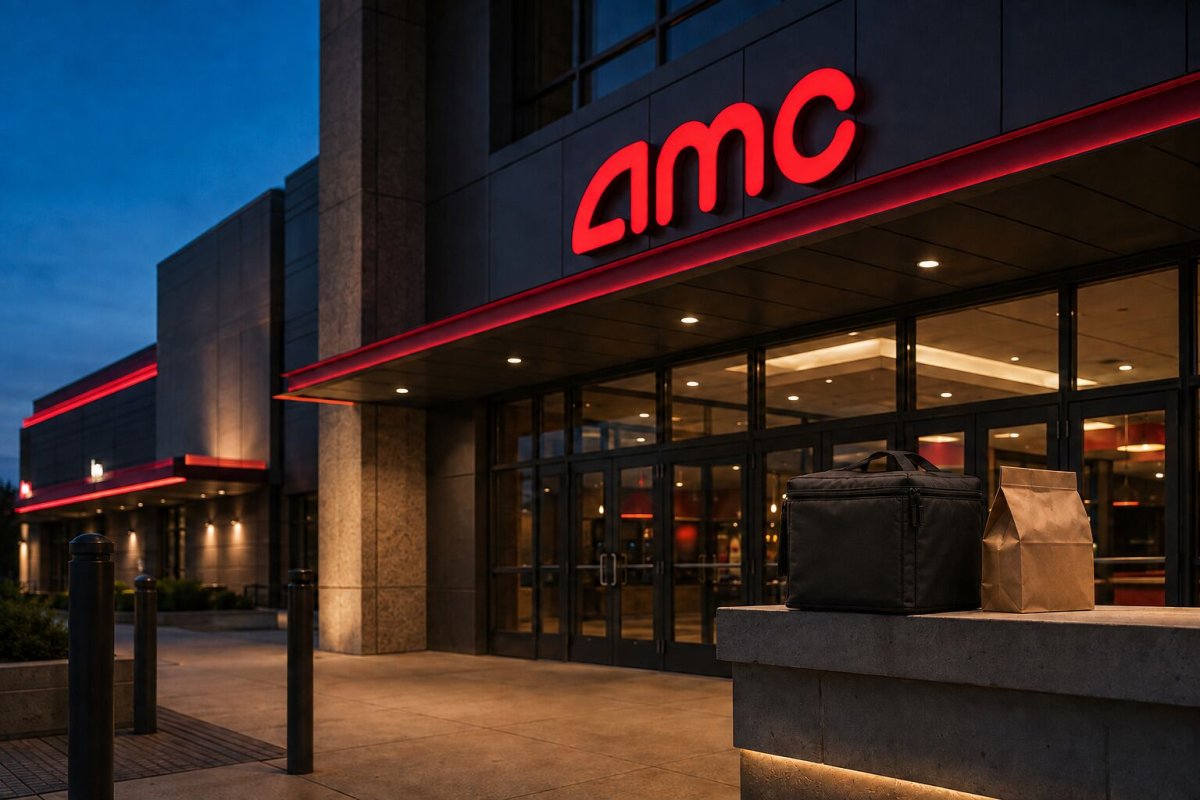
AMC Entertainment Holdings Inc. (NYSE:AMC) has been offering movie theater popcorn and other concessions through third-party delivery platforms such as Uber Eats, DoorDash, and Grubhub at select locations. This service has been available for several years, but the company has not disclosed any financial metrics related to these delivery operations, leaving investors without a clear picture of its impact.
As of Monday, September 7, AMC's official home-delivery page listed all three delivery partners, but it also noted that availability is limited to participating theaters and that additional fees (delivery, service, and small-order) may apply. The timing of this rediscovery is notable: the New York Stock Exchange was closed for Labor Day, so the news comes at a quiet time. AMC shares closed Friday at $2.65, up 4.33% from the prior close of $2.54, with about 57.1 million shares traded, according to Yahoo Finance.
The company originally announced its delivery plans in November 2021, stating that consumers would be able to order freshly popped popcorn from nearby theaters through existing delivery apps starting in 2022. The initial release also mentioned theater pickup and grocery-store products. By February 2023, AMC's annual filing confirmed that freshly popped popcorn was available through home-delivery services, and the most recent annual filing (February 2025) repeated that statement. Thus, the current "now available" label does not indicate a new launch; it simply confirms the ongoing availability.
Financials: Concessions Strong, Delivery Opaque
For the six months ended June 30, 2026, AMC reported food-and-beverage revenue of $923.4 million, up 17.9% from $783.0 million a year earlier. The direct food cost ratio improved to 18.9% from 19.6%. In the second quarter, U.S. spend per patron rose 2.1% to $8.95. However, the company does not break out delivery sales, order volume, or channel profitability.
Food and beverage accounted for 35% of AMC's first-half revenue. Subtracting direct food costs of $174.1 million leaves $749.3 million before labor, rent, marketing, platform charges, and overhead. This is not a delivery margin; it includes all concession sales. Investors cannot determine how much of the 17.9% revenue increase came from third-party apps.
The company attributes the growth to higher attendance and increased spending per patron. Consolidated first-half attendance rose 13.6% to 118.9 million, and U.S. food-and-beverage revenue per patron increased 2.8% to $8.76. Physical traffic remains the primary driver. In early August, AMC reported record weekend food-and-beverage revenue, but did not disclose the dollar amount or a delivery split.
Balance Sheet: High Hurdle
CEO Adam Aron called the second quarter "nothing short of extraordinary." Quarterly free cash flow reached $190.1 million, though the first-half total was only $15.4 million due to a weak first quarter. As of June 30, AMC held $778.4 million in cash, but corporate borrowings had $3.91 billion in principal, leaving a $3.14 billion gap. First-half interest expense on corporate borrowings was $235.8 million.
With a market value near $2.37 billion, AMC's capital structure remains a challenge. Small delivery experiments are unlikely to move the needle. The channel must generate repeat orders and cash after platform charges, labor, and packaging.
To provide decision-useful information, AMC would need to quantify active delivery locations, channel sales, order growth, and contribution after fulfillment costs. Until then, quarterly attendance and concession-spend data remain the better indicators. Food-and-beverage growth above attendance, with a stable cost ratio, would support better monetization, but it would not prove that delivery caused the gain.
In summary, the current attention on AMC's delivery service is a rediscovery of an established offer, not a new earnings event. Investors should focus on the company's core metrics and await more transparent disclosure on its delivery channel.