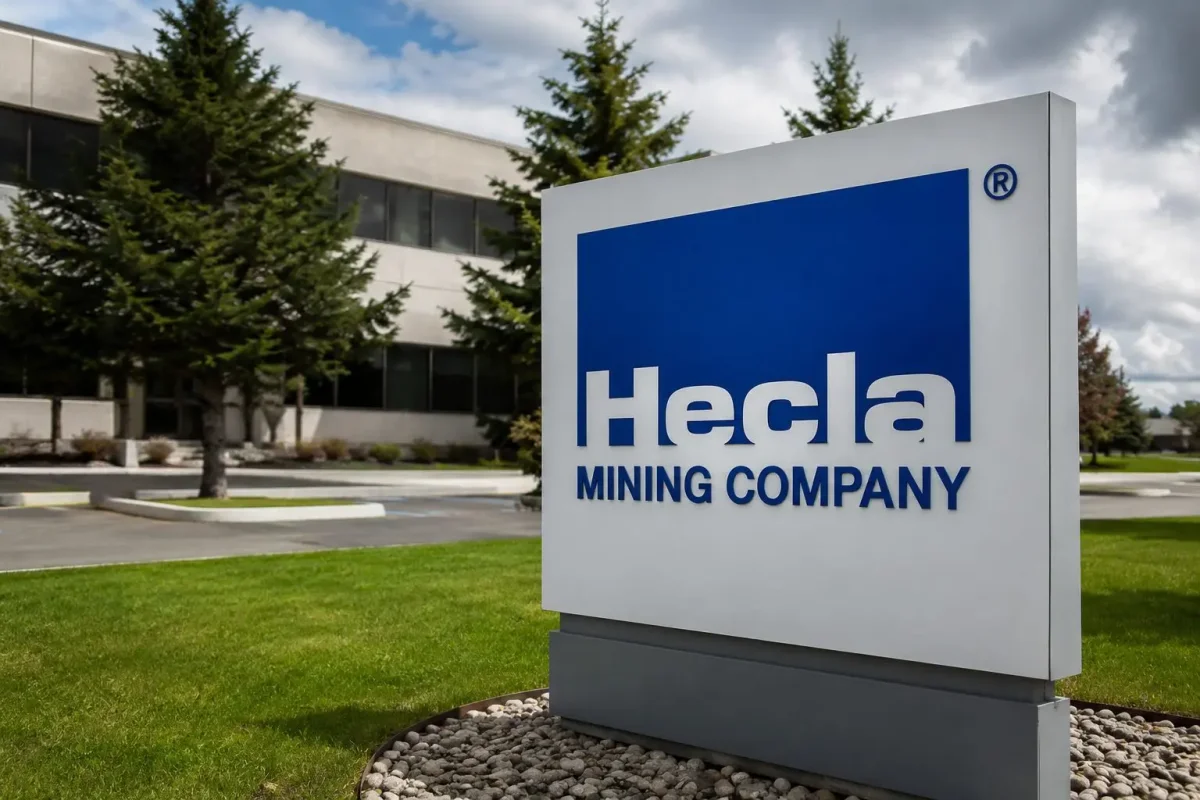
Hecla Mining Co (NYSE: HL) saw its shares decline on Friday as the price of silver remained significantly below the average the company realized in the first quarter. The stock was trading 0.5% lower at $14.45 by mid-afternoon, following a 6.1% drop on Thursday. While Friday's move was modest, the broader concern for investors is the shrinking cost buffer that Hecla enjoyed earlier this year.
In the first quarter, Hecla realized an average silver price of $82.70 per ounce, while spot silver was trading around $56.09 on Friday morning—a gap of 32.2%. Similarly, gold prices also faced pressure, with spot gold at $4,017 per ounce compared to Hecla's realized gold price of $4,899, an 18% difference.
Hecla reported a non-GAAP all-in sustaining cost (AISC) of $8.17 per silver ounce for the first quarter. Subtracting this from the realized silver price gives a spread of $74.53. If AISC remains unchanged and silver stays at Friday's spot price, the spread would shrink to $47.92, a reduction of 35.7%. This calculation is illustrative and not company guidance.
Cost Buffer Under Pressure
The current cushion may be overstated by this static calculation. Hecla noted that $13 million in increased by-product credits, primarily from its Greens Creek operation, helped lower the first-quarter AISC. However, with gold trading 18% below Hecla's realized rate, a decline in by-product credits could push future AISC higher, further compressing margins.
Keno Hill, which is not included in the AISC calculation, produced about 0.5 million silver ounces in the first quarter. Production was impacted by power constraints and lower-grade ore, though the company anticipated improved milled grades in the second quarter.
Market Performance and Valuation
Trading volumes were elevated, with approximately 48.0 million shares exchanged by early afternoon, about 55% above the 30.97 million average on Google Finance. By Friday afternoon, Hecla shares had fallen 8.7% from their July 10 close. Comex silver finished the week down 6.3%, meaning the stock underperformed the metal by roughly 2.4 percentage points.
Hecla still outperformed some peers: Coeur Mining (NYSE: CDE) dropped 3.0%, Pan American Silver (NYSE: PAAS) fell 0.9%, and First Majestic Silver (NYSE: AG) declined 0.8%. Valuation sensitivity remains high, with Hecla trading at about 35.3 times trailing earnings, compared to Coeur at 11.6 times.
Financial Position and Outlook
The company begins this period with a solid financial foundation. First-quarter sales totaled $411 million, and non-GAAP free cash flow from ongoing operations hit a record $144 million. In April, Hecla redeemed $263 million in notes. CEO Rob Krcmarov highlighted "the strongest balance sheet in the Company's recent history," with zero long-term debt and an undrawn $225 million revolving credit facility.
Looking ahead, Hecla expects increased milled grades at both Lucky Friday and Keno Hill in the second quarter, along with higher capital investment during warmer construction months. However, macro conditions remain challenging. Chris Gaffney of EverBank attributed the decline in bullion prices to "a stronger U.S. dollar and higher global inflation fears," noting that rising interest rates reduce the appeal of non-yielding assets like precious metals.
Risks are clustered: further declines in silver or gold could pressure sales and by-product credits, while any new power or sequencing issues at Keno Hill might delay grade improvements. A recovery in metals prices could help mitigate these risks. Hecla's cost buffer remains substantial, but Friday's metal prices suggest that simply extending the first-quarter gap may not be appropriate.