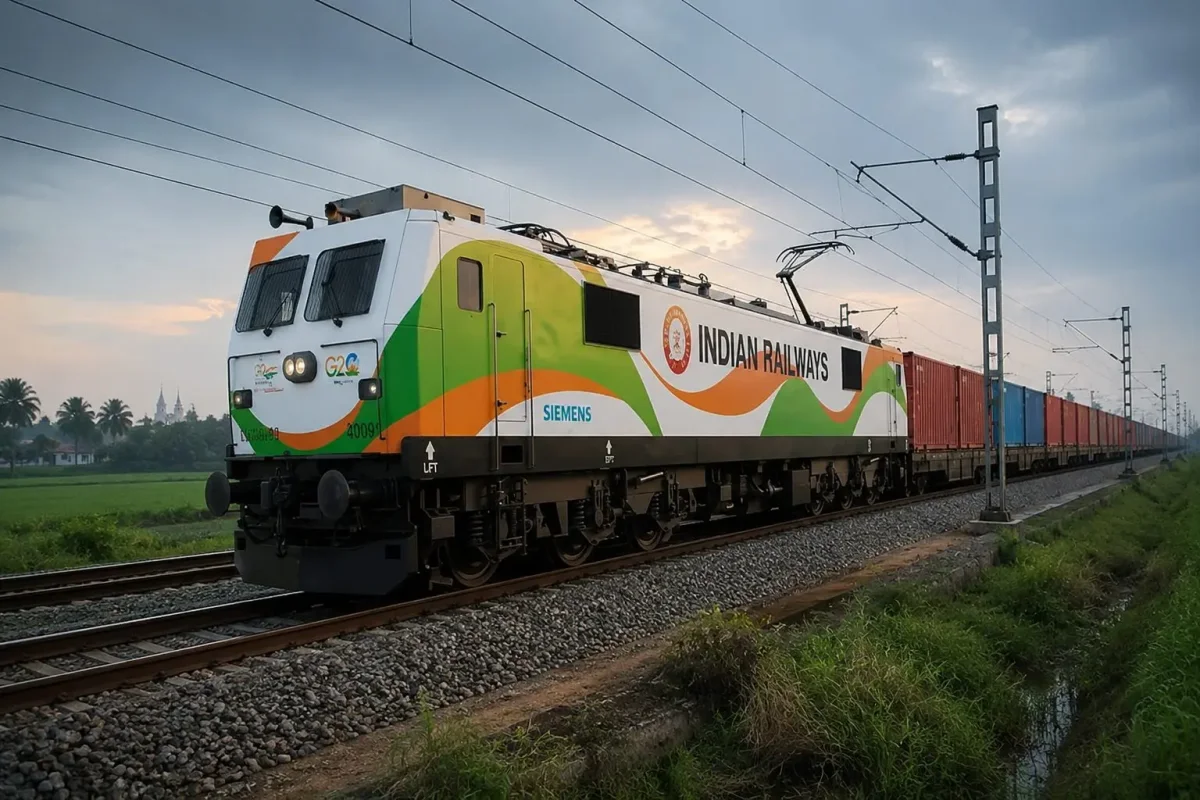
Indian Railways has given the green light for a ₹381 crore investment, but the funds are split between two distinct initiatives rather than being solely dedicated to the Kavach train protection system. According to an official release on Friday, approximately ₹206 crore—or 54.1% of the total—will be channeled into Kavach, an indigenous technology designed to automatically apply brakes if a driver passes a red signal. The remaining ₹175 crore is earmarked for expanding locomotive maintenance facilities at Raipur.
Kavach Rollout Details
The sanction for Delhi Division's Version 4.0 deployment covers 680 route kilometers at a cost of ₹30.3 lakh per route km. This aligns closely with the weighted average of ₹30.0 lakh per km observed across three other approvals since June 15, according to calculations based on the release. The four sanctions together cover 2,720 route km and total ₹817 crore.
| Approval | Route km | Sanction (₹ crore) | Implied ₹ lakh per route km |
|---|---|---|---|
| Ahmedabad Division, June 15 | 598 | 140 | 23.4 |
| Ambala Division, June 15 | 811 | 201 | 24.8 |
| East Coast Railway, June 22 | 631 | 270 | 42.8 |
| Delhi Division, July 10 | 680 | 206 | 30.3 |
| Weighted total | 2,720 | 817 | 30.0 |
However, the rates vary significantly, with Ahmedabad at ₹23.4 lakh per km and East Coast Railway at ₹42.8 lakh—an 83% difference. The release does not explain the disparity, and the average rate is merely a benchmark, not a fixed tariff.
Operational Milestones
Central Railway achieved a key operational milestone this week by commissioning Standard Kavach on the 149.476-km Solapur-Wadi stretch, the first such project in the Solapur Division. The deployment included 1,234 radio-frequency identification tags, or about 8.3 tags per route km. The system's collision-prevention and SOS features underwent tests set by the Research Designs and Standards Organisation.
As of March, Indian Railways had installed Kavach on 3,103 route km and 4,277 locomotives, with work ongoing across 24,427 km and 8,979 more locomotives. The four latest clearances cover routes equivalent to about 87.7% of what was in place as of March. Using the recent ₹30.0 lakh average per km, Railways' next 9,000-km goal would cost roughly ₹2,700 crore in route deployment, though this is not a formal estimate and excludes equipment or scope changes.
Raipur Expansion and Market Implications
The ₹175 crore allocated for Raipur will add space for 250 electric locomotives, at a cost of ₹70 lakh per slot. No supplier was named in the approval notice.
Market reaction to the news was mixed among Kavach-linked stocks. HBL Engineering (NSE:HBLENGINE) and Kernex Microsystems (NSE:KERNEX) gained on Friday, while Quadrant Future Tek (NSE:QUADFUTURE) declined. However, all three ended the July 3-10 week in negative territory.
| Company | Friday close (₹) | Friday move | July 3-10 |
|---|---|---|---|
| HBL Engineering | 765.85 | rose 0.75% | fell 6.26% |
| Kernex Microsystems | 2,157.50 | added 1.58% | dropped 9.30% |
| Quadrant Future Tek | 413.75 | slipped 3.36% | down 11.93% |
The race now depends on delivery timelines. HBL has a ₹1,714 crore contract from Chittaranjan Locomotive Works to supply Kavach 4.0 gear for locomotives, with a 12-month completion deadline. Kernex, on July 2, commissioned a 207-km system on the Tundla-Panki Dham stretch. Quadrant, in May, received approval to start passenger trials, the final step before commercial use.
Investors are watching "delivery timelines, margin stability, and cash-flow discipline," said Siddharth Maurya, founder and MD at Vibhavangal Anukulakara. Harshal Dasani, INVasset PMS business head, warned that "slip-ups could trigger sharp resets." Delays or cash stuck in unfinished work could limit earnings, even if sanction volumes increase.
Trading resumes on Monday, July 13. Investors await tender documents and formal awards naming suppliers and execution periods. If no new contract is awarded, the weekend numbers only indicate available funds, not actual booked revenue.