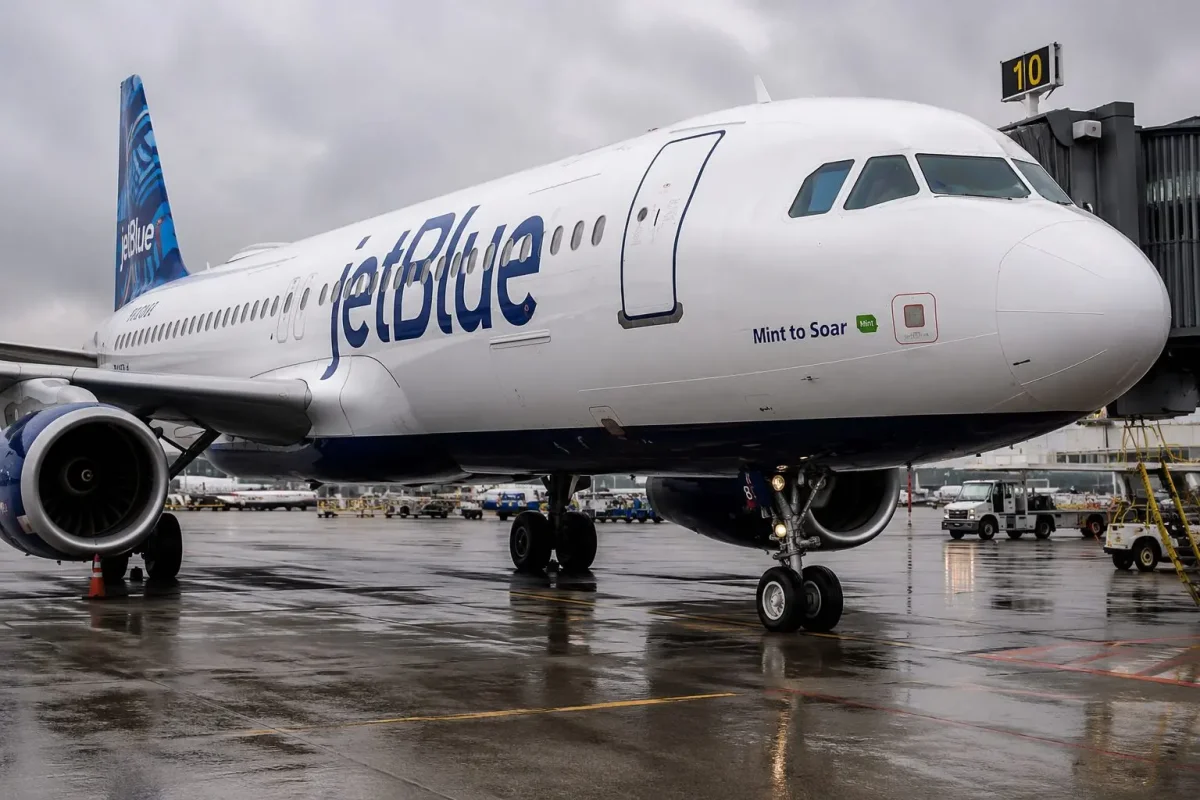
JetBlue Airways (NASDAQ: JBLU) has officially exited Manchester-Boston Regional Airport (MHT), ending a brief 17-month stint that began in January 2025. The carrier's last flight from the New Hampshire airport departed on July 8, with the airline citing a strategic shift toward busier hubs.
The decision comes as JetBlue reallocates resources to its Fort Lauderdale (FLL) hub, where it has aggressively expanded. The airline launched eight new nonstop routes from Fort Lauderdale on July 10, bringing its Florida schedule to over 125 daily departures and more than 55 destinations. CEO Joanna Geraghty has called Fort Lauderdale "a cornerstone of our network," with plans to operate roughly 150 daily flights from the airport this winter—a more than 75% increase year-over-year.
Data from the U.S. Department of Transportation reveals JetBlue held a 10.67% market share at MHT, carrying 145,000 passengers during the 12 months ending April 2026. In contrast, Southwest Airlines (NYSE: LUV) dominated with 632,000 passengers and a 46.50% share. Overall airport traffic rose 4.75% to 681,000 departing passengers, but scheduled departures jumped 8.60% to 10,602, pulling down the average passengers per departure by 3.5% to 64.2.
JetBlue's latest investor update forecasts second-quarter capacity growth of 2% to 4% and revenue per available seat mile (RASM) gains between 9% and 12%. The airline also expects fuel costs of $4.26 to $4.36 per gallon and plans to cover at least 40% of that increase. However, industry analysts note that low-cost carriers may need to raise fares by about 5% to offset fuel expenses, as highlighted by Delta Air Lines (NYSE: DAL) CEO Ed Bastian. Delta posted nearly 14% revenue growth on just 1% capacity expansion, recovering roughly 60% of its higher fuel bill in the quarter.
Despite JetBlue's network adjustments, its financial health remains precarious. S&P downgraded the airline to CCC+ in June, pushing it deeper into junk territory. The ratings agency projects JetBlue will not generate positive free cash flow before 2028 and sees leverage approaching 10 times by the end of 2027. If demand in Fort Lauderdale softens or fares decline after the summer, the Manchester exit may not provide sufficient savings to alter the trajectory.
Market reaction has been muted. JetBlue shares fell 2.70% on Friday to $5.76, underperforming peers: Southwest dropped 1.61%, Delta lost 1.81%, and United Airlines (NASDAQ: UAL) slipped 2.36%. The broader Nasdaq Composite and Dow Jones Industrial Average both rose on the day.
Looking ahead, investors will closely watch United Airlines' Q2 results on July 16 for signs of capacity discipline and the ability to pass on fuel costs. Meanwhile, Brent crude oil is on track for a 5.5% weekly gain amid tanker attacks in the Strait of Hormuz, adding further pressure on airline margins.