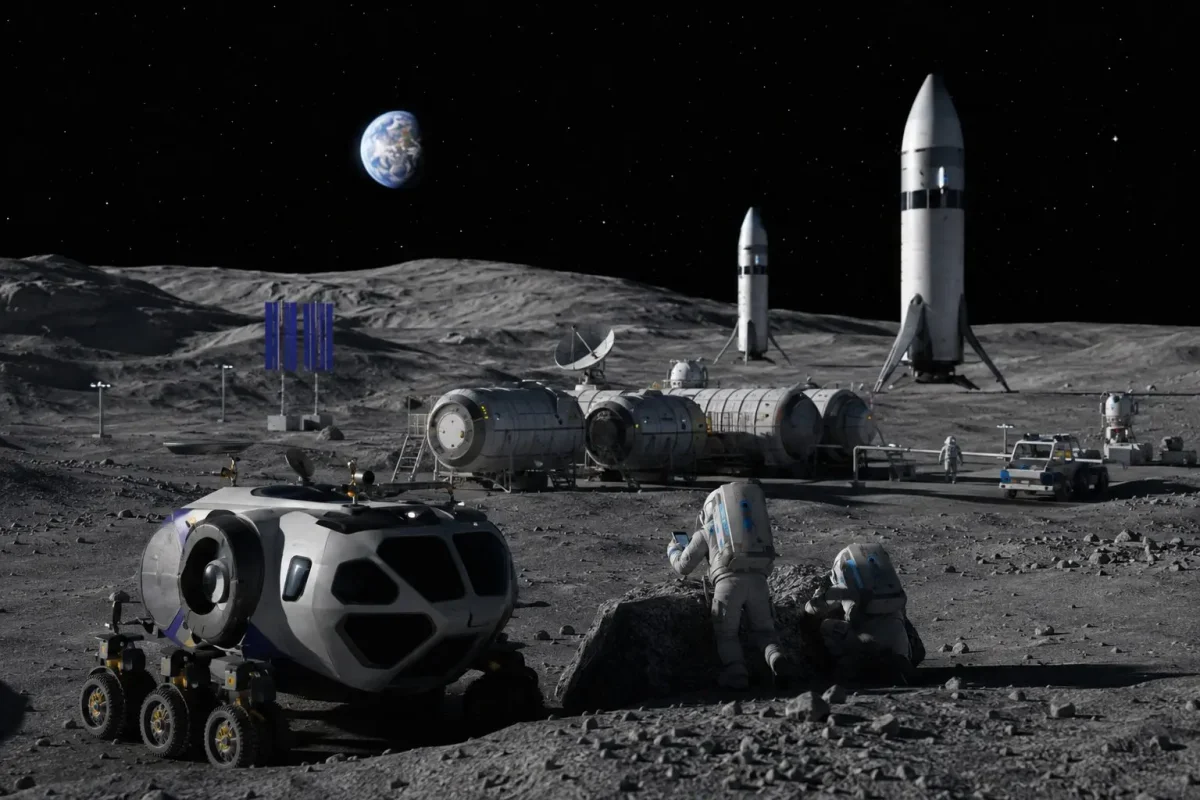
WASHINGTON, July 11, 2026 — NASA is turning to industry for solutions to potential supply chain bottlenecks as it plans for a sustained human presence on the Moon. A new study modeling a six-person lunar outpost operating at minimal workload suggests resupply missions every two weeks, totaling about 26 runs per year. That figure slightly exceeds NASA's target of 25 Moon Base missions by 2029, though the agency stresses this is a scale comparison, not a formal forecast.
The simulation, led by computational social scientist Anamaria Berea of George Mason University, uses an agent-based model with digital crew members following set rules over a three-month baseline. The worst-case scenario—four astronauts, monthly resupplies, and moderate-to-high environmental stress—completed only about 20% of planned tasks. Berea noted, "The team is more than the sum of its people," highlighting the need for greater automation, backup systems, and regular supply runs.
Funding Gap and Industry Opportunities
For investors, the funding gap is a key concern. If NASA establishes a permanent lunar base, it could transform lunar operations from one-off delivery missions to recurring services—including cargo transport, power supply, local repair, and even manufacturing. NASA's Lunar Enabling Infrastructure Accelerator (LEIA) is currently collecting industry feedback on five areas: surface and radioisotope power, new manufacturing methods, and converting lunar materials into fuel or water. Industry comments are open until July 17.
ispace and SpaceX Partnership
Japan's ispace (TYO:9348) last week secured 500 kilograms of payload space on a SpaceX Starship flight for $50 million, targeting a moon landing possibly as early as 2030. That works out to $100,000 per kilogram, though the price excludes later integration and service costs. ispace Executive Vice President Hideari Kamiya described the offering as a "bus" to the moon, with single-mission landers acting as "taxis." The deal underscores growing commercial lunar logistics.
Markets closed for the weekend, but ispace shares were volatile. The stock surged 18.69% to 508 yen on Thursday before sliding 12.4% to 445 yen on Friday. For the week, shares ended 1.1% lower from the prior Friday's close of 450 yen, but still up 4.0% from Wednesday. Investors appeared to price in the access opportunity quickly, then weighed the 2030 timeline and execution risks.
NASA Awards Lunar Contracts
Another key milestone is NASA's June 30 announcement of approximately $590 million in contracts for four uncrewed moon landings set for late 2028. Astrobotic received $297.9 million for two landers, Firefly Aerospace (NASDAQ:FLY) secured $144.2 million for one, and Intuitive Machines (NASDAQ:LUNR) won up to $148.3 million for another. Most awards fell between $144.2 million and $149 million per lander, a margin of about 3.3%, with payloads and incentives varying by contract.
Intuitive Machines Performance-Based Payout
Intuitive Machines' payout structure is tilted toward performance. Of the $148.3 million total, $79.7 million (53.7%) is tied to qualifying a repeatable production line, with the remaining $68.6 million for baseline mission work. CEO Steve Altemus said the company is moving from "custom aerospace engineering to commercial mass production of lunar infrastructure."
Human Staffing and Automation
Human staffing remains a critical factor. A separate study highlighted by The Urban Developer explores reducing crew needs through extended reality (XR). Adelaide University's Albert Rajkumar conducted tests using XR headsets to control a robotic arm for stacking blocks. "XR can help reconnect human perception and decision-making with robotic construction happening at a distance," he said. Rajkumar noted that remote supervision wouldn't reduce launch numbers but could shift cargo from people and shelters to machines, parts, and power gear.
Risks and Timelines
The numbers come with significant caveats. The crew study was purely a simulation, not a flight demand forecast. Starship's planned lunar flights aren't expected before 2030, and ispace's moon landers in 2023 and 2025 both crashed. This suggests a long wait between early contract wins and steady revenue, as listed firms continue spending on engineering, testing, and launch preparation.
The next key date is Friday, July 17, when the LEIA public comment period ends. NASA expects future winners to deliver prototypes and real test data. Investors are watching whether the final contract remains focused on development or sets up recurring service targets. "A sustained human presence at the Moon requires breakthrough ideas from a competitive U.S. industrial base," said Greg Stover, director of NASA's Advanced Research and Technology Division.