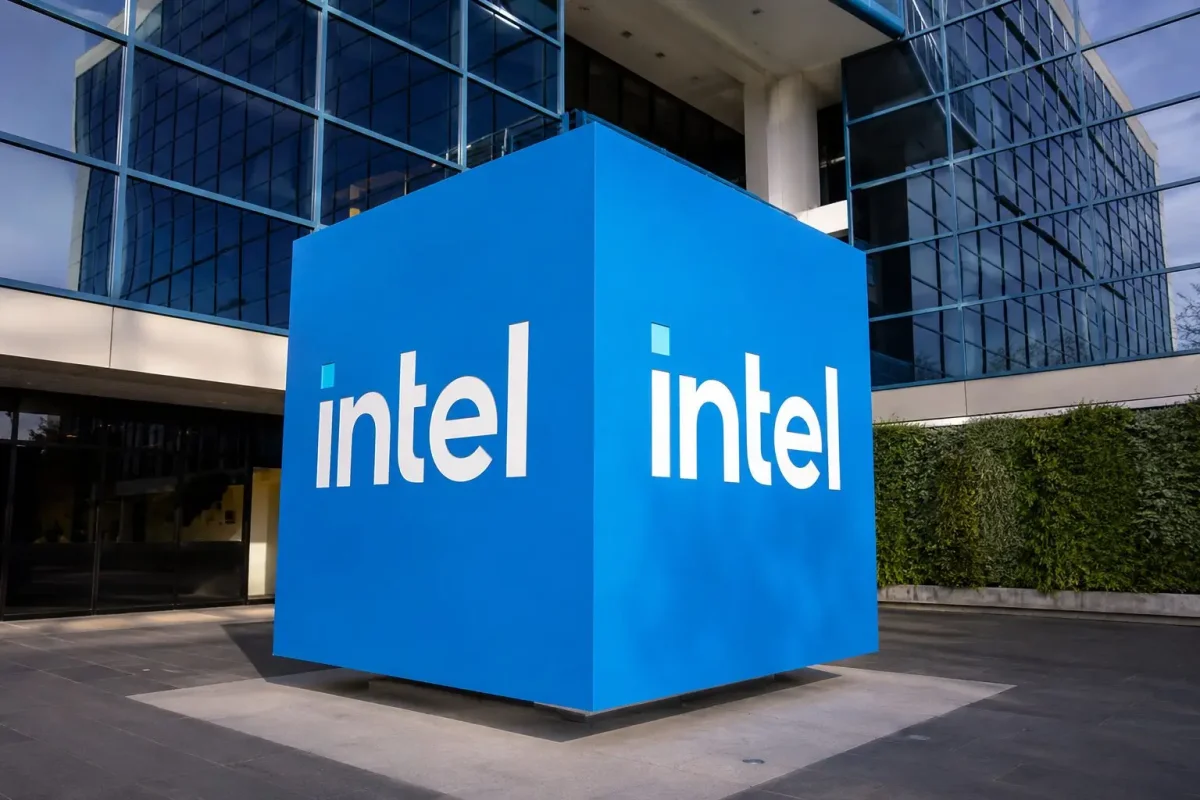
Intel Corporation (NASDAQ: INTC) shares closed down 5.1% at $114.68 on Friday, sharply underperforming the broader market as the Dow Jones Industrial Average, S&P 500, and Nasdaq Composite each closed at record highs. Trading volume surged to over 191 million shares, well above average, as investors rotated away from the chipmaker despite fresh signs of demand for its advanced packaging technology.
The decline came after Northland Capital Markets downgraded Intel to Market Perform earlier in the week, citing elevated valuation and the risk that hyperscale cloud providers could slow their AI infrastructure spending in 2027. While the firm acknowledged Intel is making 'measurable progress in its turnaround,' it kept its price target low, noting that shares remain expensive even if the data center business achieves 40% growth in 2027.
Intel's slide highlights a growing divergence among AI-related chip names. While Micron Technology (NASDAQ: MU) climbed 5.2% on Friday, Nvidia (NASDAQ: NVDA) dipped 1.2%, and Qualcomm (NASDAQ: QCOM) rose 3.2%. The mixed performance suggests the market is beginning to differentiate between AI beneficiaries rather than treating the sector as a single trade, according to analysts.
MediaTek announced Friday that it supports both TSMC's CoWoS and Intel's EMIB advanced packaging technologies, which link chip components in a single package for faster data transfer and lower power consumption. Senior Vice President Vince Hu told reporters in Taipei: 'We're one of the few custom silicon providers that support both.' Reuters reported, citing sources, that Intel's EMIB is being considered as an option for custom AI chips MediaTek is developing for Google, though MediaTek has not publicly confirmed Google as a customer.
Intel has been aggressively promoting its foundry and packaging capabilities as part of CEO Lip-Bu Tan's turnaround strategy. In April, Tan stated that the shift from AI training to AI inference and agentic AI is 'significantly increasing the need' for Intel's CPUs and packaging products. The company reported first-quarter revenue of $13.6 billion, up 7% year-over-year, with Data Center and AI revenue reaching $5.1 billion, a 22% increase.
Despite these positive developments, Intel's foundry business continues to weigh on profitability. The unit posted an operating loss of $2.44 billion in the last quarter, and adjusted free cash flow was negative $2.02 billion. D.A. Davidson's Gil Luria noted that high-bandwidth memory and longer contracts could be reshaping how memory chips are valued, but cautioned that CPUs may not be as differentiated as many investors believe.
Wells Fargo Chief Equity Strategist Ohsung Kwon described the market sentiment around AI as 'definitely euphoric,' driven by earnings. However, he cautioned that such enthusiasm can be fragile. For Intel, the path forward requires both sustained demand and flawless execution. If packaging interest from customers like MediaTek translates into firm orders and server CPU sales hold up, Friday's selloff may prove to be a temporary valuation reset. Conversely, a slowdown in hyperscaler spending or continued large losses in the foundry business could drive the stock lower.
Intel's stock moved in a wide range during the session, hitting a low of $113.67 and a high of $126.49, reflecting investor uncertainty. The company's ability to capture a larger share of AI infrastructure spending, despite Nvidia's dominance in accelerators and TSMC's lead in contract manufacturing, remains the key question for shareholders.