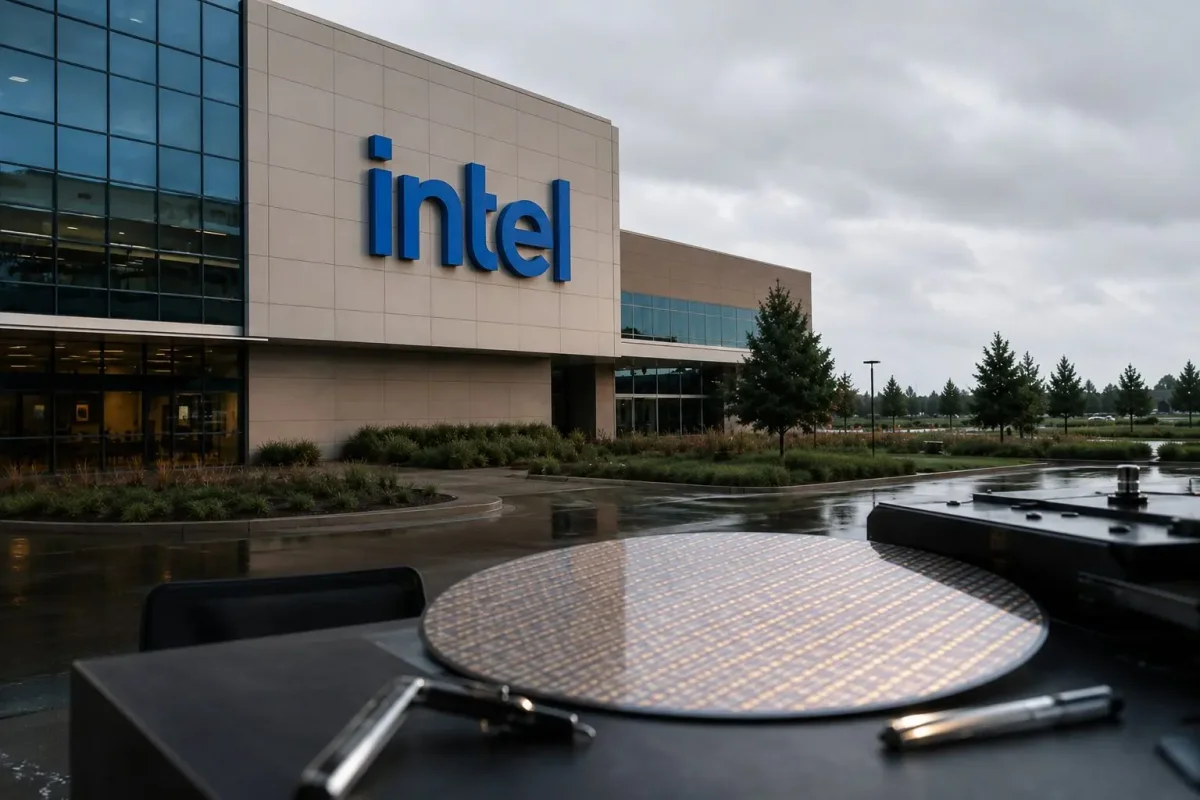
Intel Corporation (NASDAQ: INTC) saw its shares decline 0.8% in premarket trading to $111.78 on Friday, as a newly announced artificial intelligence partnership with Foxconn failed to offset the broader bearish sentiment gripping the semiconductor sector. The stock's modest drop came amid a second consecutive day of AI-led selling pressure, triggered by Broadcom's disappointing outlook that has cast a shadow over the entire chip industry.
Market Context
Nasdaq futures slid 1.2% and S&P 500 futures lost 0.6% as investors continued to reassess the lofty valuations of AI-related stocks ahead of the U.S. nonfarm payrolls report later in the day. The selloff reflects growing skepticism about whether AI companies can deliver the revenue growth implied by their recent share price surges. Charu Chanana, strategist at Saxo, noted that while AI demand remains intact, market expectations have become extremely high, leaving little room for disappointment.
Broadcom was among the hardest hit, falling after its quarterly results failed to meet investor hopes for custom AI chip revenue. Matt Britzman, senior equity analyst at Hargreaves Lansdown, described the reaction as a classic case of very high expectations meeting a market demanding perfection. The Philadelphia Semiconductor Index dropped 2.2% on Thursday, while the Nasdaq Composite slipped 0.09%.
The Foxconn-Intel Deal
On Thursday, Foxconn announced a collaboration with Intel to develop and deploy new AI infrastructure, including servers, chips, cooling systems, and networking equipment for artificial intelligence applications. The partnership will leverage Intel's Xeon processors, AI accelerators, high-speed interconnects, and systems designed for data centers, smart factories, smart cities, and robotics. Foxconn Chairman and CEO Young Liu stated that the collaboration would combine the strengths of both companies. However, no financial terms or customer names were disclosed, and a timeline for product launches was not provided.
Despite the headline, investors remained underwhelmed. The lack of concrete details on margins, timing, and demand left many questioning whether the agreement would translate into meaningful revenue for Intel. The company's turnaround story has heavily relied on AI and its U.S. fabrication expansion, but recent guidance cuts from rivals have dampened enthusiasm. Even the Foxconn deal failed to shift sentiment, as traders demanded hard results rather than strategic announcements.
Broader Sector Dynamics
The chip sector is under pressure from multiple angles. Broadcom's custom AI chip miss highlights the challenge of meeting elevated expectations. AMD remains a key player in server CPUs and accelerators, while Nvidia continues to dominate overall AI spending trends. Intel's position is particularly precarious; unless the Foxconn partnership leads to significant order volume, the company may struggle to gain traction against its more established competitors.
The technology sector's rally has left little room for error. Intel and AMD have both surged over 160% since the market's March low, driven by a semiconductor boom that pushed technology's weighting in the S&P 500 to a record high. Walter Todd, chief investment officer at Greenwood Capital, likened the move to “driving a race car at 200 miles an hour.”
Intel's Broader Challenges
Intel also showcased its latest PC chips at Computex, highlighting six thin-and-light laptops powered by its new Core Series 3 processors. The company expects more than 70 designs from brands like Acer, ASUS, Dell, and MSI. Gary Chuang of Acer described the new models as everyday performance laptops with up to 19 hours of battery life. However, these announcements have done little to address the fundamental concerns around Intel's turnaround.
The company recently reported a net loss of $3.73 billion and will require tens of billions of dollars in additional investment to support its contract chip-making ambitions. If AI infrastructure orders fail to materialize soon, or if customers continue to favor Nvidia, AMD, Broadcom, or Taiwan Semiconductor Manufacturing, Intel's rally could falter. Friday's jobs report adds another layer of risk: a strong U.S. employment print could raise interest rate expectations, making investors less willing to wait for a chip sector recovery.