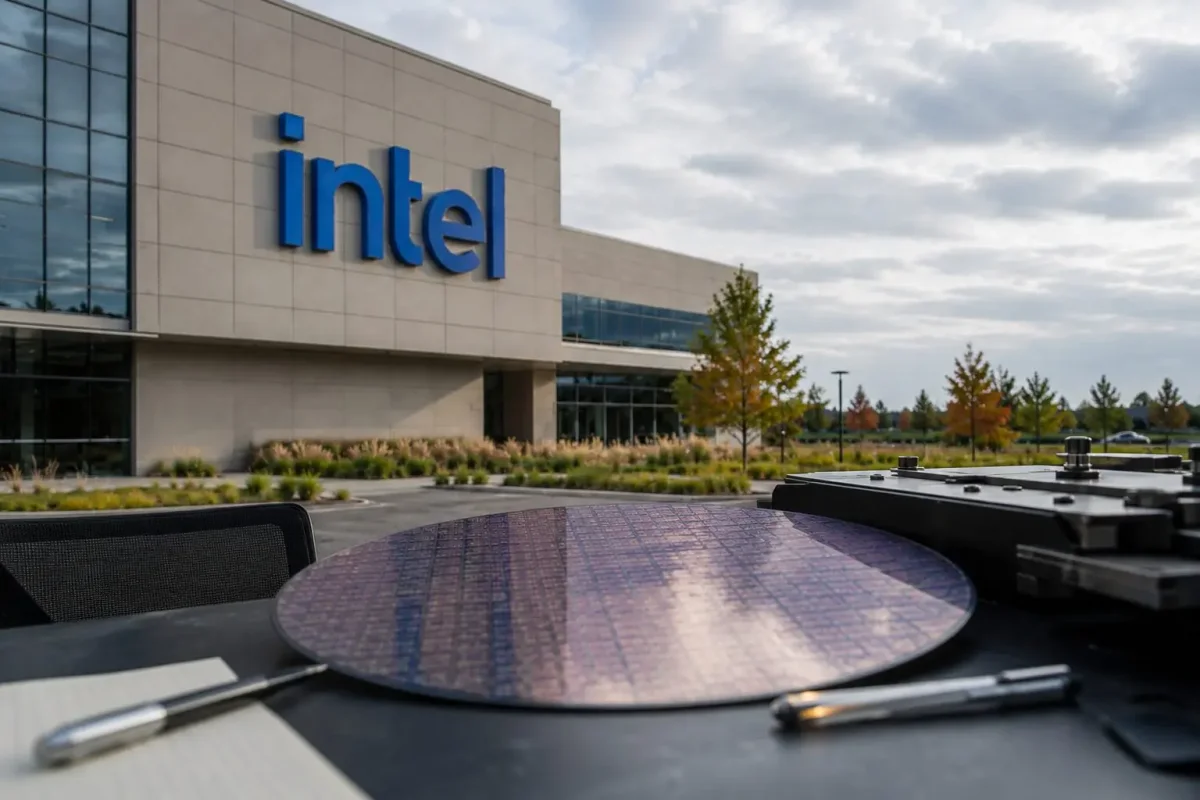
Intel Corporation (NASDAQ: INTC) faces a challenging week ahead after its shares suffered a steep decline on Friday, closing at $99.17, down $12.76 or 11.4%. The drop came amid a broad selloff in technology and semiconductor stocks, triggered by stronger-than-expected May jobs data that reignited fears of prolonged Federal Reserve interest rate hikes.
The PHLX Semiconductor Index tumbled 10.3%, marking its worst single-day performance since March 2020. Major chipmakers were hit hard: Nvidia fell 6%, AMD dropped nearly 11%, and Broadcom slid 7.9% after its AI-chip forecast disappointed investors. Intel's trading volume surged to approximately 145.2 million shares, reflecting heightened investor anxiety.
Market strategists weighed in on the rout. Ryan Detrick, chief market strategist at Carson Group, described it as "the dam just broke today" after an extended rally in tech and chip stocks. Dennis Dick of Triple D Trading noted that "blindly buying the dip" is no longer effective, while Ohsung Kwon of Wells Fargo expressed optimism, stating he doesn't believe this marks "the end" of the bull run for semiconductors.
Despite the market turmoil, Intel announced two strategic partnerships aimed at bolstering its position in artificial intelligence. The company revealed a collaboration with Hitachi focused on "physical AI" for real-world systems such as robotics and industrial equipment. The deal covers advanced computing, digital infrastructure across manufacturing, energy, and mobility, as well as foundry tools, quantum computing, and factory automation. Intel CEO Lip-Bu Tan emphasized that "physical AI will transform the industrial edge" through robotics and autonomous machines.
Earlier in the week, Foxconn disclosed plans to team up with Intel on AI infrastructure, specifically server racks built with Intel Xeon chips and AI accelerators. Foxconn Chairman Young Liu said the partnership would "combine the strengths of both companies" in hardware, integration, and supply chain. No financial terms or customer details were disclosed.
Intel bulls argue that the company can capture a larger share of AI infrastructure spending through its CPUs and AI inference capabilities. In April, Intel projected second-quarter revenue of $13.8 billion to $14.8 billion, exceeding the $13.07 billion consensus from LSEG. Tan told analysts that the CPU recovery is not "just our wishful thinking."
However, execution remains a key question. Intel must prove that its partnerships translate into real volume and that its foundry unit can scale up. J.P. Morgan's Harlan Sur cautioned that it may take 12 to 18 months to assess manufacturing progress and at least five years to determine foundry profitability.
Looking ahead, the economic calendar is relatively light, with U.S. consumer inflation data due Wednesday and producer prices on Thursday. Earnings from Oracle and Adobe will provide further insight into the AI and tech rally's resilience. Additionally, SpaceX's anticipated IPO, with a valuation of $1.75 trillion, could divert attention and capital to another high-growth name.
Intel faces a critical test in the coming sessions. The stock's ability to recover will depend on whether buyers return to the chip sector after the first major pullback in months. If inflation data cools or AI-driven earnings hold up, the group could stabilize. But with rates potentially staying higher and signs of rotation out of crowded semiconductor stocks, Friday's low may be tested again.