IonQ (NYSE: IONQ) delivered a standout first-quarter report that topped Wall Street expectations, prompting the quantum computing company to lift its full-year revenue outlook. However, the stock slipped in after-hours trading as market participants continued to question when the technology will translate into sustainable profits.
Revenue Surge and Upgraded Guidance
The company reported first-quarter revenue of $64.7 million, significantly exceeding the analyst consensus of $49.7 million compiled by LSEG. This represented a 755% jump compared to the same period last year and landed 30% above the midpoint of IonQ's own guidance. In response, management raised its 2026 revenue forecast to a range of $260 million to $270 million, up from the previous estimate of $225 million to $245 million.
CEO Niccolo de Masi characterized the quarter as the company's “biggest” yet, citing robust demand for quantum systems and an expanding platform as key drivers for the upgraded annual targets.
Backlog Growth and Commercial Traction
A key highlight was the surge in remaining performance obligations (RPO), which reached $470 million at the end of the quarter—a 554% increase year over year. These obligations represent contracted sales that have not yet been recognized as revenue. Chief Operating and Financial Officer Inder Singh noted that for every dollar of revenue IonQ booked during the quarter, it added approximately $2.50 in RPO.
Revenue composition showed growing commercial adoption: commercial customers accounted for about 60% of sales, international markets contributed 35%, and clients purchasing more than one product also represented 35% of the total.
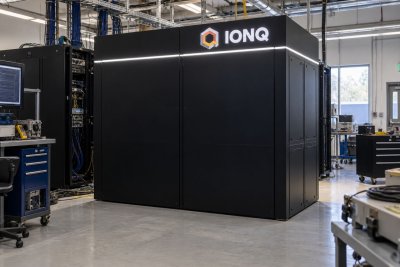
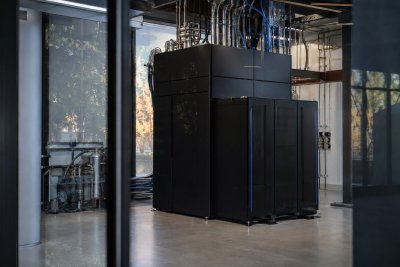
IonQ also announced its first sale of a sixth-generation, chip-based 256-qubit system to the University of Cambridge. Qubits, the fundamental units of quantum information, offer far greater computational power than classical bits but remain challenging to stabilize and operate with precision.
Technology Approach and Competitive Landscape
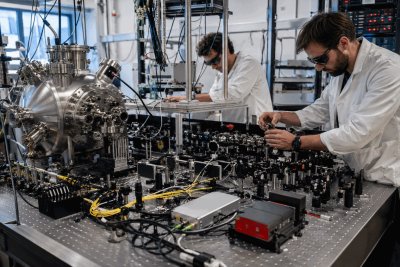
IonQ’s technology relies on trapped-ion quantum computing, which uses lasers and electromagnetic fields to manipulate charged atoms within a vacuum. This approach differentiates it from competitors like D-Wave Quantum, Rigetti Computing, and Quantum Computing Inc., which employ alternative qubit technologies. D.A. Davidson analyst Alex Platt told Reuters that the post-earnings selloff reflected “high expectations” coupled with lingering skepticism about the technology’s viability and IonQ’s trapped-ion bet.
The stock’s decline also swept up peer names, with D-Wave and Rigetti moving lower in sympathy during premarket trading, as noted by Barron’s.
Profitability Still on the Horizon
Despite the revenue beat, IonQ continues to operate at a loss from core operations. The company reiterated its 2026 adjusted EBITDA loss outlook of $310 million to $330 million. Adjusted EBITDA, a non-GAAP metric, excludes interest, taxes, depreciation, amortization, and certain other expenses.
On a GAAP basis, IonQ reported net income of $805.4 million for the quarter, but Singh explained that the bulk of that figure came from a roughly $1.1 billion non-cash mark-to-market adjustment related to warrant valuation—tied to stock price movements and unrelated to operational performance.
The company ended March with $3.1 billion in cash, cash equivalents, and investments, which Singh described as “financial firepower.” However, costs are escalating: GAAP research and development expenses jumped 215% year over year to $125.7 million, underscoring the heavy investment required to advance quantum systems.
Market Reaction and Outlook
IonQ shares fell about 6% in after-hours trading following the earnings release, according to Reuters. The decline suggests that while the quarterly numbers were strong, investors remain focused on the path to profitability and the commercial scalability of quantum computing.
CEO Niccolo de Masi told Reuters that profit is not the company’s immediate priority this year; instead, IonQ is channeling resources into revenue growth and R&D. The central challenge for the company—and the broader quantum sector—remains convincing the market that these systems can evolve from expensive, speculative hardware into dependable, commercially viable solutions.