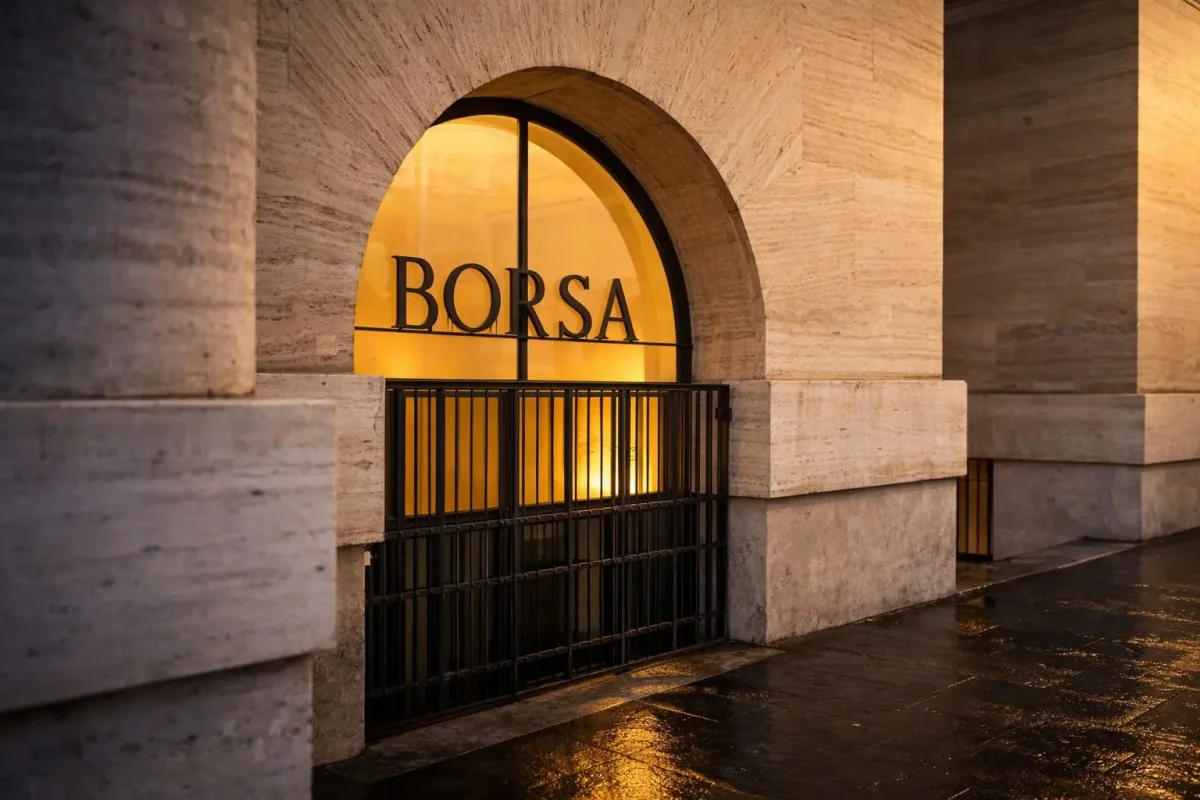
The Italian equity market faced a severe downturn last week, with the benchmark FTSE MIB index closing Friday's session at 44,152.26. This represented a significant weekly decline of 6.48% from its level on February 27, leaving it well below the 52-week high of 47,650.97 reached just days earlier. The sell-off in Milan was part of a broader European retreat, with the continent's STOXX 600 index sliding 5.5% over the same period.
Broad-Based Sell-Off Grips Europe
Financial hubs across the continent felt the pressure. Frankfurt and Paris recorded their steepest weekly declines since April of the previous year, while Madrid's performance was even worse, marking its most significant weekly drop in four years. The banking sector was notably weak, falling 1.7% on Friday alone. Analysts pointed to heightened sensitivity to rising oil prices and the specter of stagflation—a toxic mix of sluggish economic growth and persistent inflation—as key drivers of the weakness. Ciaran Callaghan, head of European equity research at Amundi, noted that Europe appeared particularly exposed to these macroeconomic headwinds.
ECB Policy and Oil Prices in Focus
The resurgence of energy costs is directly influencing monetary policy expectations. European Central Bank Executive Board member Isabel Schnabel recently described current policy as being in a "good place," but cautioned that the surge in energy costs has complicated the inflation outlook. In response, financial markets have increased their wagers on a potential ECB interest rate hike in 2026, reflecting growing concerns that inflationary pressures may prove more stubborn than anticipated.
The situation at the critical Strait of Hormuz remains a focal point for commodity traders. Goldman Sachs analysts warned that Brent crude oil could surpass $100 per barrel as early as this week if geopolitical tensions in the region fail to stabilize. This potential supply shock underscores the fragile sentiment that drove a sharp, albeit brief, market rebound on Wednesday. XTB analyst Kathleen Brooks characterized the bounce as a reaction to the "merest whiff" of a possible resolution, highlighting the underlying nervousness among investors.
Notable Italian Movers
The week saw dramatic moves among individual Italian constituents. Semiconductor manufacturer STMicroelectronics slid 5.06%. The banking sector was broadly lower, with BPER Banca tumbling 3.80%, Banca Monte dei Paschi di Siena falling 2.74%, and Banco BPM declining 1.88%.
However, not all news was negative. Defense and aerospace giant Leonardo climbed 3.39%, leading the Milan session, after securing a £1 billion helicopter contract with the United Kingdom earlier in the week. Shipbuilder Fincantieri advanced 2.59%, and energy major Eni rose 1.51%.
Nexi's Strategic Pivot Meets Market Skepticism
One of the most dramatic stories of the week came from payments company Nexi. Its shares plunged as much as 22% to a record low on Thursday after the firm unveiled a new three-year strategic plan. The strategy is aimed at defending against intensifying competition and adapting to softer near-term growth projections. Some analysts suggested the market's reaction was excessive. In an effort to manage expectations, CEO Paolo Bertoluzzo addressed investors frankly, stating, "You don't have to believe we can go to the moon," while emphasizing the company's shift towards more stable and predictable cash flows.
Political and Regulatory Overhangs
Italian banks also contended with domestic political risks. The European Commission in Brussels continues to pressure Rome for further adjustments to its "golden power" rules. This mechanism allows the Italian government to block or impose conditions on strategic corporate transactions. The issue gained prominence after UniCredit cited government intervention as a reason for abandoning its approach for Banco BPM. Official data showed that 903 deals were flagged under this regime in 2025, a 37% increase from the previous year.
Looking ahead, the financial sector faces several imminent developments. Banca Monte dei Paschi di Siena is scheduled to disclose the share-swap terms for its planned full acquisition of Mediobanca on March 10. Both stocks fell over 6% on February 27 as investors grew anxious over the lack of detailed information.
The overarching calculation for Milan's market is straightforward: continued vulnerability is likely if oil prices maintain their upward trajectory. The interplay between energy costs, central bank policy, and corporate earnings will dictate near-term direction for Italian equities as investors navigate an increasingly complex macroeconomic landscape.