Joby Aviation Inc. (NYSE:JOBY) shares found their footing on Friday, July 17, 2026, after a volatile session that saw the stock dip to $6.90 before recovering to close near $7.34. The stabilization followed a sharp 5.4% decline on Thursday, which erased approximately $413 million in market value—a loss roughly 88 times the value of a proposed share sale by the Joby Trust.
The Joby Trust, which holds existing shares from a 2016 membership-interest conversion, filed a Form 144 on July 15 to sell 596,666 common shares. The sale, valued at $4.71 million and signed by CEO JoeBen Bevirt, represents a modest 0.061% of the company's 983.6 million outstanding shares. Importantly, the transaction involves existing shares, not new issuance, meaning no direct dilution for current shareholders.
The filing referenced a Rule 10b5-1 trading plan dated March 5, with an expected sale date of July 15. Despite the modest scale, the disclosure has refocused investor attention on Joby's premium valuation relative to peers. By early Friday afternoon, trading volume had reached 42.5 million shares, about 84% of Thursday's total, yet the stock remained virtually unchanged, suggesting the market had already priced in the news.
In comparison, Archer Aviation Inc. (NYSE:ACHR) shares rose 1.2% to $4.55, underscoring a widening gap in market perception. Joby's market capitalization of $6.92 billion is nearly double Archer's $3.49 billion, even though both companies reported similar first-quarter adjusted EBITDA losses of $178.5 million and $172.5 million, respectively. After subtracting reported liquidity—$2.50 billion for Joby versus $1.776 billion for Archer—the equity premium for Joby stands at roughly 2.6 times that of Archer.
Joby's first-quarter revenue reached $24 million, primarily driven by its newly acquired passenger operations, though the company posted a net loss of $110 million. The company expects full-year 2026 revenue between $105 million and $115 million, placing its current valuation at approximately 63 times the midpoint of that range. This multiple highlights the market's bet on future growth, but also raises questions about sustainability.
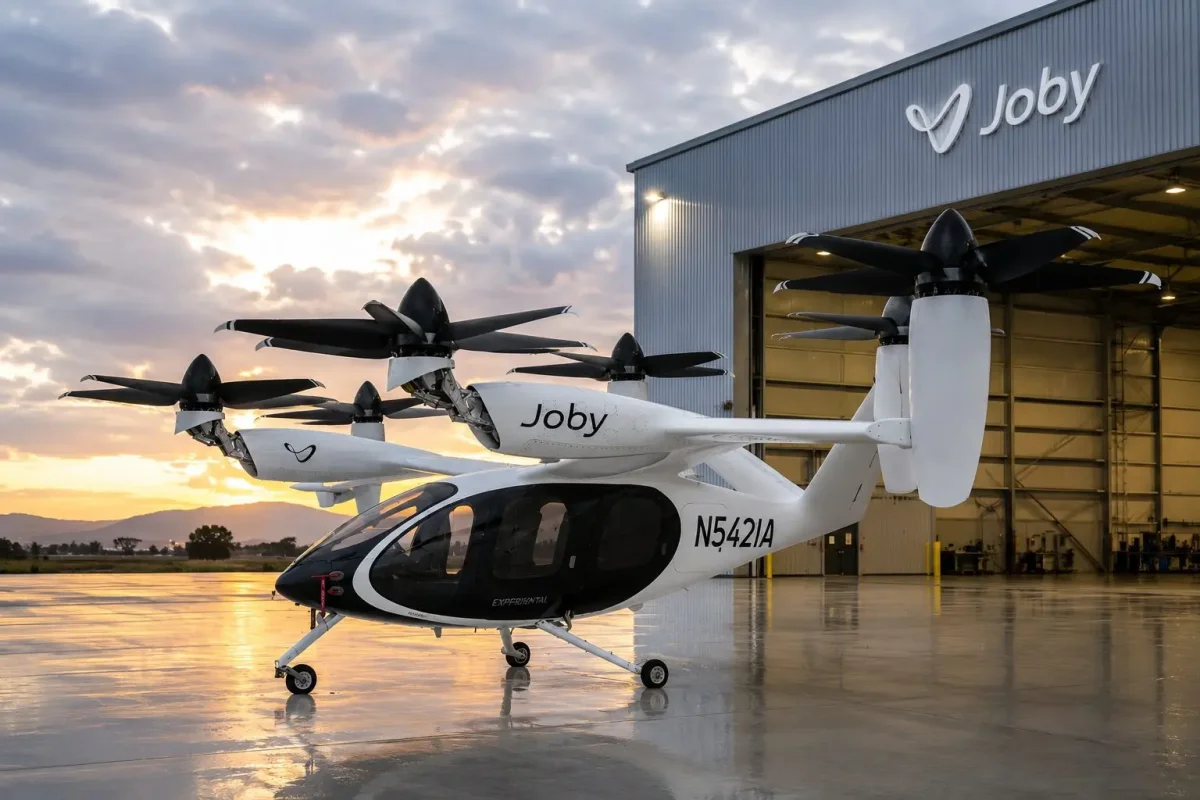
Operationally, Joby's 2025 impact report, released Thursday, showed progress. The company completed over 850 flights with five aircraft over the past year, a 2.6-fold increase from 2024. International activities included 41 flights at the Osaka World Expo and initial test flights in Dubai, signaling expansion beyond the United States. However, certification remains the primary hurdle for scaling passenger service. In May, Bevirt stated that Joby has “the clearest path we’ve ever had to beginning passenger operations,” following the first flight of its FAA-conforming aircraft and completion of the SR3 audit, the third of four major certification evaluations.
Toyota Motor Corp. (TYO:7203) has taken a 51% stake in a production joint venture, with Joby retaining 49%. An additional $250 million investment from Toyota is still subject to further agreements and regulatory approvals. This partnership is seen as a key catalyst, but delays or additional insider sales could weigh on the stock's premium.
The modest scale of the trust sale alone does not explain Thursday's sharp decline. Instead, it has shifted the market's focus to the key risks: certification delays from the FAA or UAE, production slowdowns, cash burn, potential dilution, and further insider transactions. The premium valuation of Joby remains under scrutiny, as investors weigh its technological lead against the path to profitability.