New York, July 15, 2026, 14:09 EDT — Fresh insider-sale filings at Joby Aviation (NYSE:JOBY) reveal that two executives sold a combined 50,553 shares for approximately $384,000. The majority of these sales were explicitly tied to tax obligations from vested stock awards, with the remainder executed under a pre-established trading plan. While insider sales often draw attention, the more significant signal for investors lies in Joby's valuation: its market capitalization currently stands at roughly three times the cash and short-term investments reported as of March 31.
Joby shares slipped about 1.3% to $7.79 in New York afternoon trading, following a 5.5% gain on Tuesday. The stock touched $7.43 on Monday, the bottom of its 52-week range, underscoring that the scale and structure of these sales carry more weight than the headline figure alone.
Insider Sale Details
Chief Product Officer Eric Allison sold 27,932 shares on July 13 after 53,549 restricted stock units—shares granted as compensation—settled a day earlier. Chief Legal Officer Kate DeHoff sold 8,381 shares on July 13 and 14,240 on July 14, with her filing citing tax obligations and an approved Rule 10b5-1 plan, which schedules trades in advance. Together, these sales represent about 0.15% of Joby's 34.8 million shares traded by early afternoon on Wednesday, a volume too small to explain the day's turnover on its own. While the disclosures may affect sentiment, they do not indicate a sudden, wholesale exit by either officer.
Cash Runway vs. Valuation
The balance sheet carries more weight. Joby ended the first quarter with $2.466 billion in cash, cash equivalents, and short-term investments. It used $144.4 million in operations and spent $77.9 million on property and equipment, implying a simple runway of about 11.1 quarters if that pace remains unchanged—a straight-line estimate, not company guidance. Against Archer Aviation (NYSE:ACHR) and Eve Holding (NYSE:EVEX), Joby's cash advantage is clear, though smaller than its valuation gap. Live market values and the companies' first-quarter disclosures reveal the following comparison:
- Joby Aviation: Market cap $7.35B, liquidity $2.47B, cash use $222M, runway 11.1 quarters, market cap/liquidity 3.0x
- Archer Aviation: Market cap $3.69B, liquidity $1.78B, cash use $182M, runway 9.8 quarters, market cap/liquidity 2.1x
- Eve Holding: Market cap $822M, liquidity $441M, cash use $68.6M, runway 6.4 quarters, market cap/liquidity 1.9x
Joby therefore has only about 1.3 quarters more estimated runway than Archer at the first-quarter pace, while carrying roughly twice Archer's market value. Subtract reported liquidity from market capitalization, and Joby has about $4.9 billion of value beyond those liquid holdings—more than double the roughly $2.3 billion for Archer and Eve combined. This rough measure is not enterprise value and ignores debt and other claims, but it shows how much investors are assigning to execution rather than cash.
The Certification Gamble
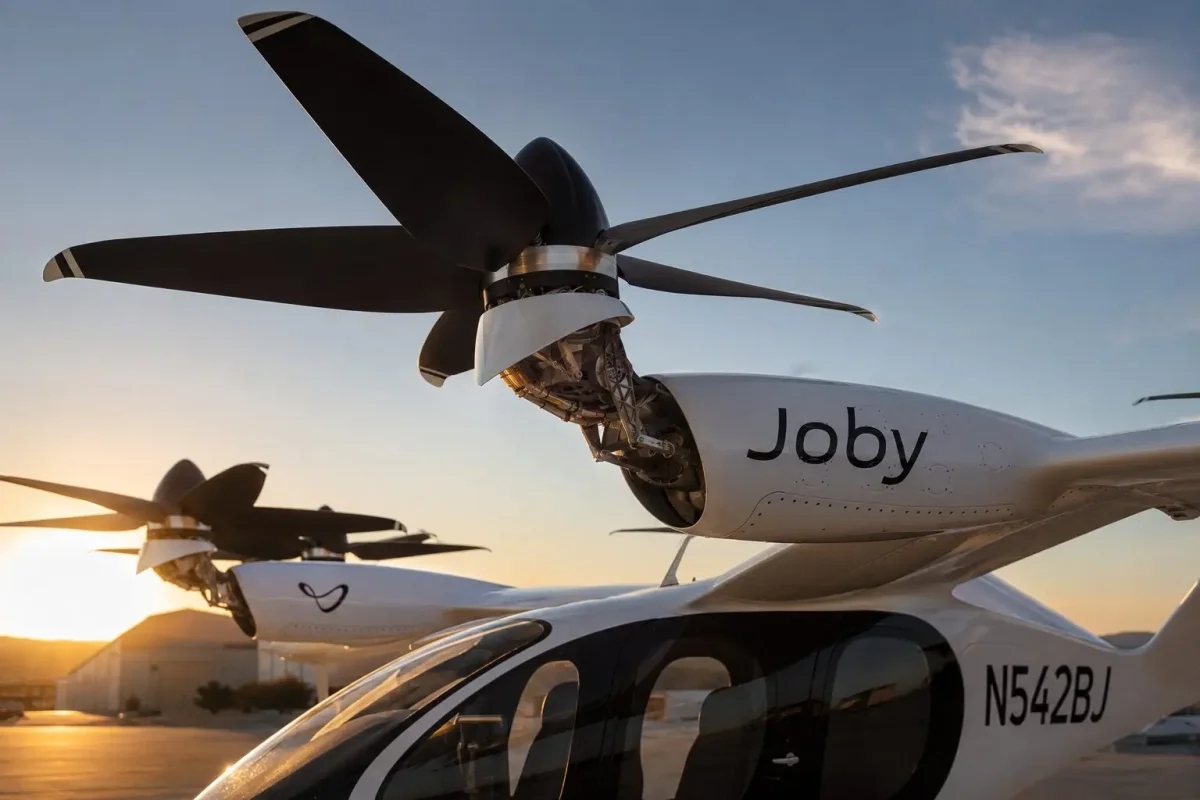
That premium rests on the chance Joby converts certification work into passenger service. Its first FAA-conforming electric vertical takeoff and landing (eVTOL) aircraft, which lifts like a helicopter and cruises on wings, has begun flying. Joby has also completed the third of four major FAA certification reviews and said early U.S. operations could begin this year under a federal pilot program before full type certification. Chief Executive JoeBen Bevirt stated in May that the company had “the clearest path we’ve ever had to beginning passenger operations.” Toyota Motor Corp (NYSE:TM) adds manufacturing support, but some of that commitment remains conditional. Toyota owns 51% of a new production joint venture, and Joby owns 49%; their initial cash contributions totaled just $2 million. A second $250 million Toyota investment tranche cannot close until future manufacturing and intellectual-property agreements take effect, and either side may end the venture if those terms cannot be agreed. Bevirt said the alliance reflected “shared confidence in the opportunity ahead.”
Risks Ahead
But the runway math can break quickly. Joby's operating cash use rose 30% from a year earlier, while property spending increased more than fivefold. The company also reported $701.1 million of long-term debt, and certification tests, factory work, or a slower service launch could lift spending above the first-quarter rate. The next quarterly filing will show whether cash use is stabilizing as aircraft production expands. Investors will also watch FAA testing and the final Toyota agreements. Joby's $24.2 million of first-quarter revenue came mainly from its existing Blade passenger operation and other services, not its new aircraft, leaving the stock chiefly priced on certification and manufacturing results that have yet to produce commercial air-taxi revenue.