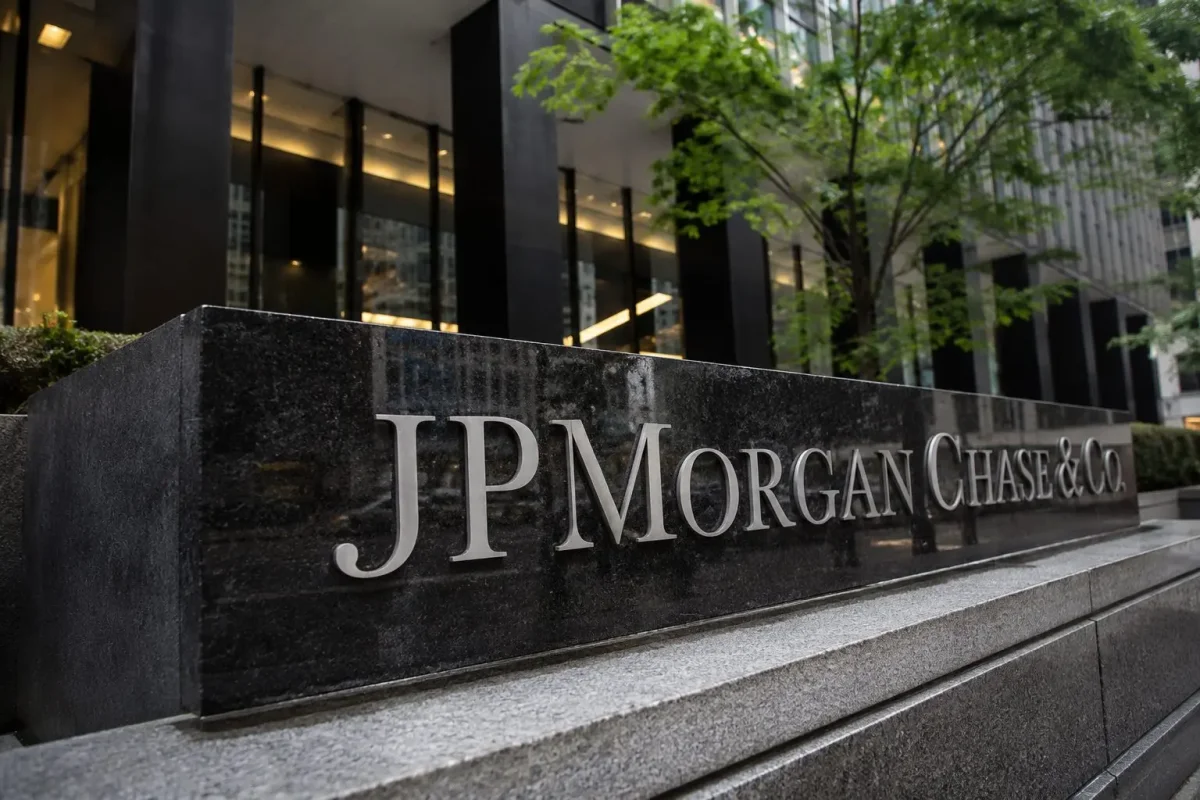
JPMorgan Chase (NYSE: JPM) shares slipped 0.2% to $346.32 on Thursday as the bank released updated guidance that balanced higher interest income with an equal increase in adjusted expenses. The New York-based lender now projects 2026 net interest income of approximately $105.5 billion, up from a prior $103 billion, while adjusted expenses are seen at $107.5 billion, compared with $105 billion previously. Each revision amounts to $2.5 billion, effectively neutralizing any automatic earnings lift from the forecast changes.
This arithmetic puts the onus on fee income and trading gains to outpace rising costs, a dynamic that tests JPMorgan's steep valuation premium. The stock trades near 3.1 times tangible book value, well above major peers: Bank of America (NYSE: BAC) at 2.1 times and Citigroup (NYSE: C) at 1.3 times. JPMorgan's price-to-tangible-book multiple is roughly 45% above Bank of America's and about 130% above Citigroup's, while the corresponding gaps in return on tangible common equity (ROTCE) are narrower, suggesting investors are paying extra for perceived durability.
In the second quarter, JPMorgan reported an adjusted ROTCE of 23.0%, excluding significant items, compared with Bank of America's 17.0% and Citigroup's 13.0%. These figures anchor the valuation comparison, with JPMorgan's premium reflecting confidence in its ability to sustain superior profitability through diverse revenue streams.
The bank's reported net income hit a record $21.2 billion, but excluding significant items—notably a $4.6 billion gain from Visa (NYSE: V) shares—adjusted net income was $16.9 billion. Recurring fundamentals remained solid: average loans rose 10% year-over-year, non-markets interest income increased 4% to $23.7 billion, and card loss guidance improved to 3.2% from 3.4%.
Operating leverage was evident within the commercial and investment bank, where revenue surged 27% against an 18% increase in expenses. Markets revenue climbed 35%, with equity-markets revenue jumping an impressive 86%. "The biggest beats were coming from investment banking, capital markets, and trading," said Neville Javeri, a portfolio manager at Allspring Global Investments. That mix is powerful but also cyclical, introducing uncertainty about sustainability.
Chief Executive Jamie Dimon described markets as "healthy, active and exuberant," but added a cautionary note: "We just don’t know how long it will continue." This warning underscores the valuation math: JPMorgan's premium relies on continued execution, particularly in revenue growth outpacing expenses. Risks include a rapid fade in trading volumes, a slowdown in deal activity that would expose the higher cost base, and sticky inflation that could pressure credit and funding costs.
For investors, the next catalyst is not another record headline but evidence that revenue growth can consistently stay ahead of expenses. Until then, JPMorgan's premium rests on the bank's ability to deliver on that promise. The updated guidance provides a clear framework: net interest income near $105.5 billion and adjusted expenses near $107.5 billion, leaving net income dependent on fee and trading performance.
As the largest U.S. bank by assets, JPMorgan's results carry significant weight for the broader financial sector, and its valuation premium is a key metric for investors assessing risk and reward. The coming quarters will test whether the bank can maintain its edge amid evolving market conditions.