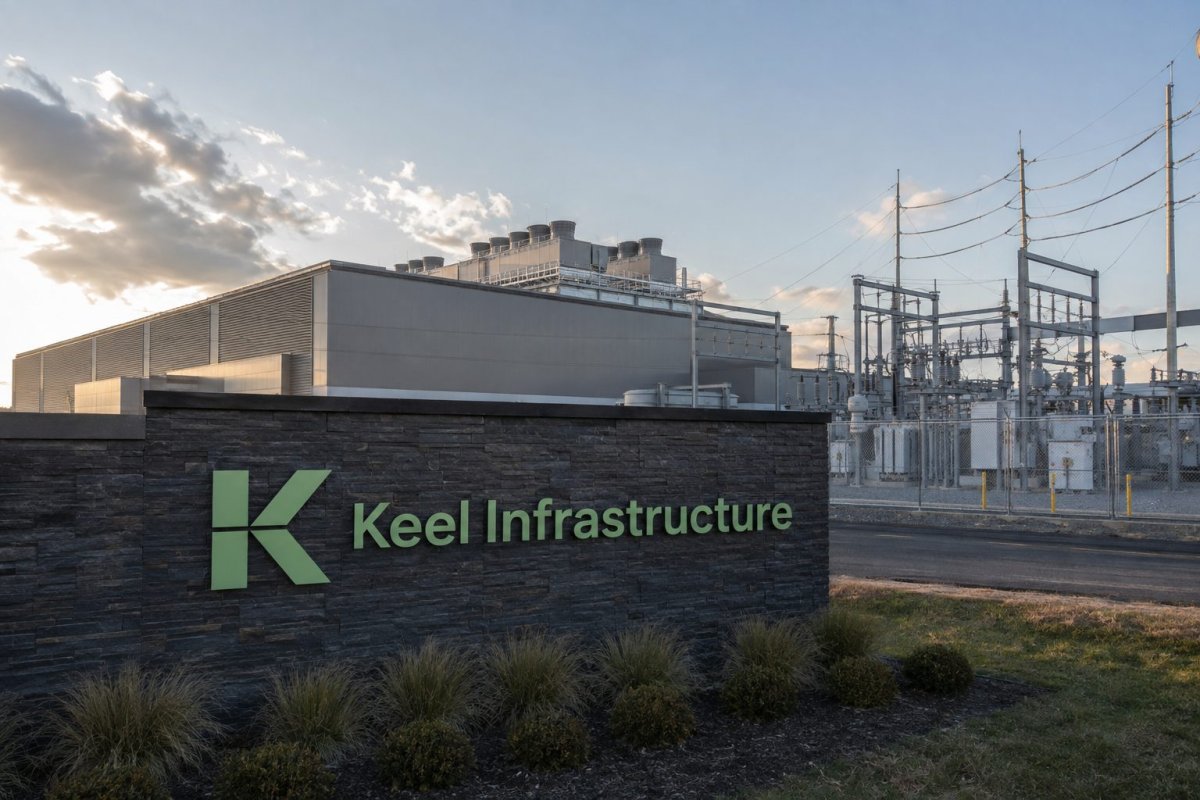
Keel Infrastructure (KEEL) saw its shares tumble 8.0% on Friday, closing at $3.22, even as the company disclosed a substantial liquidity position and reiterated its ambitious artificial intelligence data-center pipeline. The selloff erased roughly $160 million in market capitalization, bringing the company's valuation to about $1.99 billion. Trading volume reached 43.63 million shares, nearly matching the recent daily average.
The drop reflects investor concerns over the company's transitional phase, as it pivots from Bitcoin mining to high-performance computing (HPC) campuses. While management highlighted $819 million in available liquidity—representing 41% of its market value—the market focused on the immediate revenue decline. Second-quarter revenue fell by half to $30.4 million, primarily due to mining shutdowns and lower Bitcoin prices.
AI Pipeline Progress
Keel operates a North American power pipeline totaling 2.2 gigawatts (GW). Of that, 341 megawatts (MW) have been brought online, and 430 MW are under binding lease agreements. The remaining 1.5 GW are either under evaluation or pending expansion applications. Management noted that discussions are ongoing at three separate locations to secure additional tenants.
The company is repurposing former Bitcoin mining facilities into AI-ready data centers, a strategy that has temporarily halted revenue from those sites until new leases commence. This explains the sharp drop in quarterly revenue and the negative adjusted EBITDA of $23.7 million, reversing from a positive $6.6 million in the prior year.
Financial Position and Risks
Despite the operational losses, Keel's liquidity buffer is substantial—27 times its quarterly revenue. However, the company has yet to record any HPC data-center revenue from converted locations. As a result, the timing of lease agreements is more critical to the investment thesis than current mining output.
The firm recently raised $458 million through the issuance of 1.25% convertible notes due 2032, generating net proceeds of $444.5 million. This capital injection provides runway, but it also introduces dilution risk. Additionally, the company reported an operating loss of $141 million and a loss from continuing operations of $64 million, or 11 cents per share.
Market Context
The stock's decline comes amid a broader selloff in AI-related infrastructure plays, as investors grow more selective about companies with unproven revenue streams. Keel's valuation, at 2.5 times its liquidity, suggests the market is pricing in significant future lease income, but evidence of actual AI tenancy remains limited.
Analysts point to several risks that could erode the liquidity advantage: lease agreements may not materialize from ongoing discussions, project timelines could slip, power delivery costs may escalate, and the convertible notes could dilute existing shareholders. Additionally, the company continues to burn cash, which could reduce the buffer over time.
In the near term, Keel's fate hinges on converting its pipeline into signed leases. With 341 MW already online and 430 MW locked in, the company has made progress, but the remaining 1.5 GW under evaluation will determine whether the AI transition pays off. Investors will be watching for updates on lease negotiations and any signs of HPC revenue in upcoming quarters.
At $3.22, the stock sits near recent lows, and the market's skepticism is palpable. However, the liquidity cushion provides a measure of downside protection if the company can execute on its strategic pivot without further delays.
