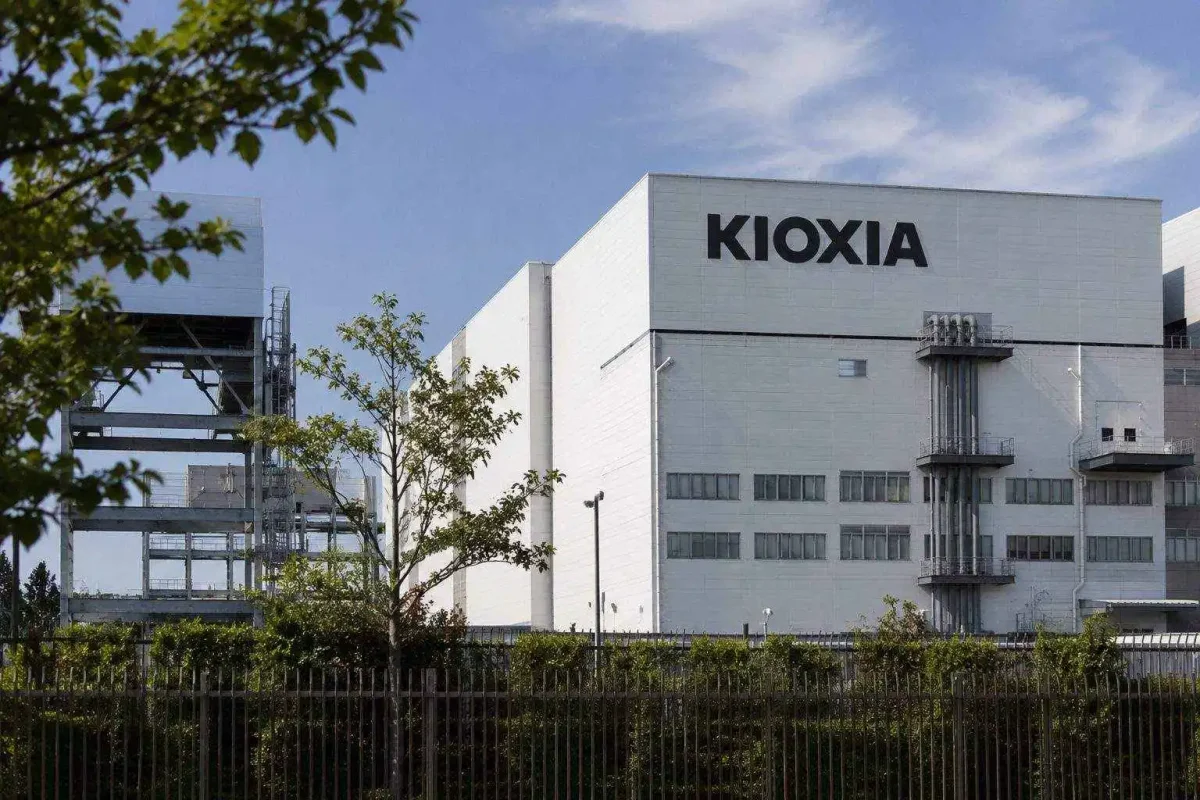
Kioxia Holdings Corp. closed at ¥108,600 on Friday, a 12.1% gain that marked its highest level in a year and an all-time high on the Tokyo Stock Exchange. The memory-chip maker led the session's gainers, with trading volume reaching 34.87 million shares by the 15:30 JST close. The stock's market capitalization now stands at approximately ¥59.33 trillion.
The surge comes as Kioxia posted robust financial results for the fiscal year ended March 2026, with revenue of ¥2.34 trillion and operating profit of ¥870.4 billion. The company also provided an optimistic outlook for the April-June quarter, forecasting revenue of ¥1.75 trillion and operating profit of ¥1.298 trillion. Operating profit, which excludes tax and financing costs, serves as a key measure of core business performance.
Kioxia's growth narrative is closely tied to artificial intelligence. President and CEO Hiroo Ota has emphasized that generative AI training and inference require massive data processing capabilities, driving demand for NAND flash memory, which stores data when power is off. The company aims for data-center and enterprise markets to account for over 60% of sales in the medium to long term, a strategy supported by multi-year supply agreements that provide greater earnings visibility.
To support this shift, Kioxia plans to invest approximately ¥470 billion annually in capital expenditures and ¥230 billion in research and development over the next three years. The company is focusing on long-term contracts, BiCS memory technology migration, and efficiency improvements at its domestic fabrication plants rather than aggressive capacity expansion, a cautious approach in an industry prone to overbuilding.
The stock's rally also reflects broader market dynamics. Kioxia was added to the Nikkei 225 stock average in April, drawing attention from passive funds and benchmark managers. Japan's main index is heading for a weekly gain of 7.6%, supported by softer oil prices and thin U.S. holiday trading that have steadied global markets. South Korean markets also pushed higher on Friday.
Investor enthusiasm, however, is tempered by the inherent risks of the memory-chip industry, known for sharp boom-bust cycles and heavy capital demands. Morningstar's bear case warns that aggressive expansion of Chinese NAND output could lead to oversupply and weaker prices. Kioxia also faces stiff competition from Samsung Electronics, SK Hynix, and Micron Technology, which have larger stakes in DRAM and high-bandwidth memory, while Kioxia remains more focused on NAND and solid-state drives.
Kioxia is preparing to list American depositary shares in the U.S. to broaden its investor base, but the Tokyo-listed stock is already being treated as a global AI infrastructure play. Friday's close suggests that the storage shortage trade still has momentum, but the key question remains whether Kioxia can sustain pricing discipline, capacity controls, and cash flow generation in a volatile market.