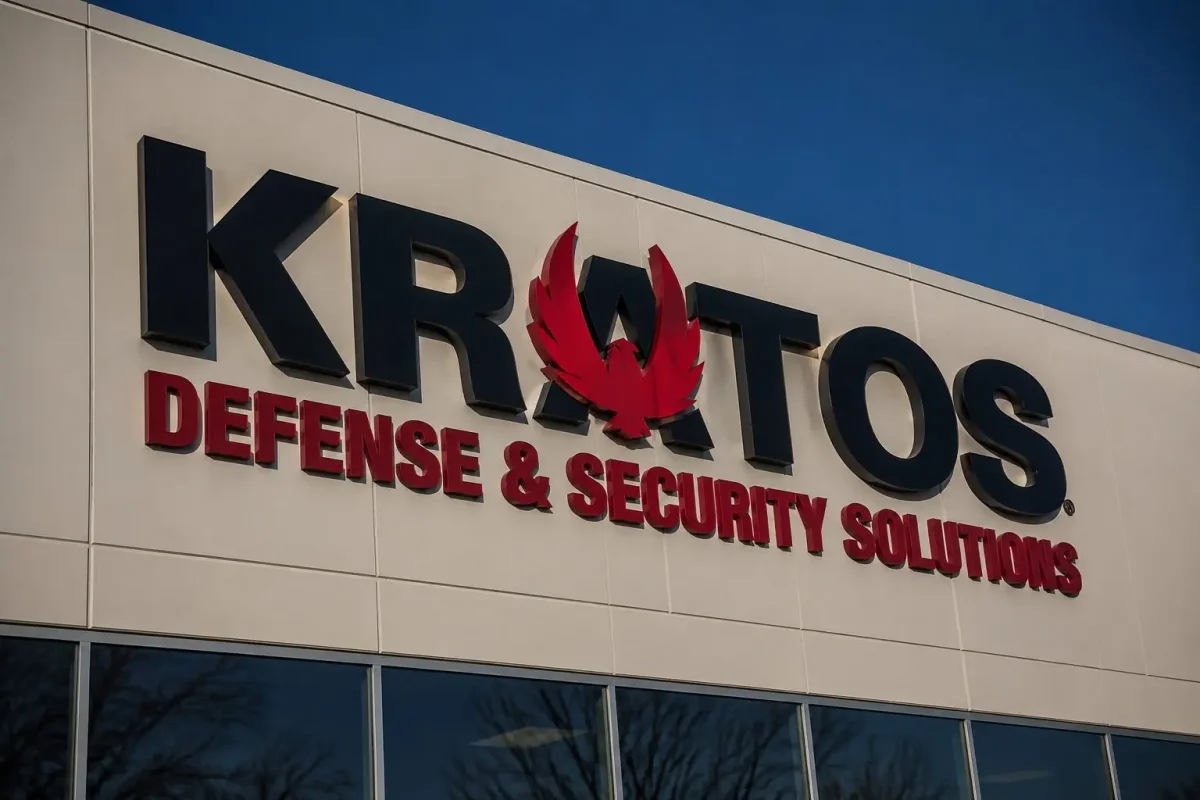
Shares of Kratos Defense & Security Solutions (KTOS) surged 11.2% in premarket trading on Thursday, leading a rally among drone-related stocks after reports emerged that the Trump administration is considering funding for domestic unmanned aircraft manufacturers. The move comes amid heightened geopolitical tensions and a broader push to bolster the U.S. defense industrial base.
The stock ended Wednesday's regular session at $57.30, up 0.88%. The premarket gains were fueled by a Reuters report, citing The Wall Street Journal, that the Pentagon and the Office of Strategic Capital are in discussions about providing financial support for companies critical to national security supply chains. While Kratos was not specifically named as a direct recipient, the company's focus on jet-powered drones, rocket and missile products, propulsion technology, and hypersonic systems positions it as a key player in the same conversation.
Other drone makers also saw significant premarket gains. AeroVironment (AVAV) rose 9.1%, and Unusual Machines (UMA) rallied 33%, reflecting investor optimism that smaller defense-tech firms could benefit from increased government backing, not just traditional large defense contractors.
U.S. stock index futures pointed lower early Thursday, with Dow E-minis down 0.1% and S&P 500 E-minis losing 0.09% as of 04:54 a.m. ET. Nasdaq 100 E-minis slipped 0.21%. The broader market was pressured by renewed U.S.-Iran tensions, which also pushed oil prices up more than 2% and lifted Treasury yields.
Investors are also focused on upcoming inflation data, particularly the personal consumption expenditures (PCE) index, the Federal Reserve's preferred inflation gauge. “A higher-than-expected print will further boost hawkish Federal Reserve expectations,” said Ipek Ozkardeskaya, senior market analyst at Swissquote Bank.
Kratos recently reported first-quarter revenue of $371 million, a 22.6% increase year-over-year, with adjusted earnings per share of 16 cents. Bookings reached $605.2 million, and the book-to-bill ratio stood at 1.6. The company's consolidated backlog as of March 29 was $2.01 billion, up from $1.57 billion at the end of December.
CEO Eric DeMarco described the current environment as a “generational recapitalization” of the U.S. defense industrial base, stating that “demand signals are real.” For fiscal 2026, Kratos guided for revenue between $1.70 billion and $1.76 billion and adjusted EBITDA between $170 million and $176 million, including contributions from Orbit Technologies.
Kratos is also investing in its own capabilities. On May 8, the company announced it would build a new arc jet and laser facility in Odon, Indiana, focused on hypersonic materials testing. Michael Johns, senior vice president at Kratos, noted that the location selection was a “highly competitive process.”
However, risks remain. The funding discussions may not materialize into concrete deals, and Kratos is not explicitly listed as a potential recipient. Debt or equity from the government would fall short of a full production contract. Kratos has also flagged that higher spending on staff, inventory, and plants is squeezing margins and free cash flow, along with supply-chain and output risks.
For now, the stock is trading on signals rather than awards. The key question is whether Washington's drone push translates into funded orders and whether Kratos can convert its backlog and investment cycle into cash flow, rather than just further growth.