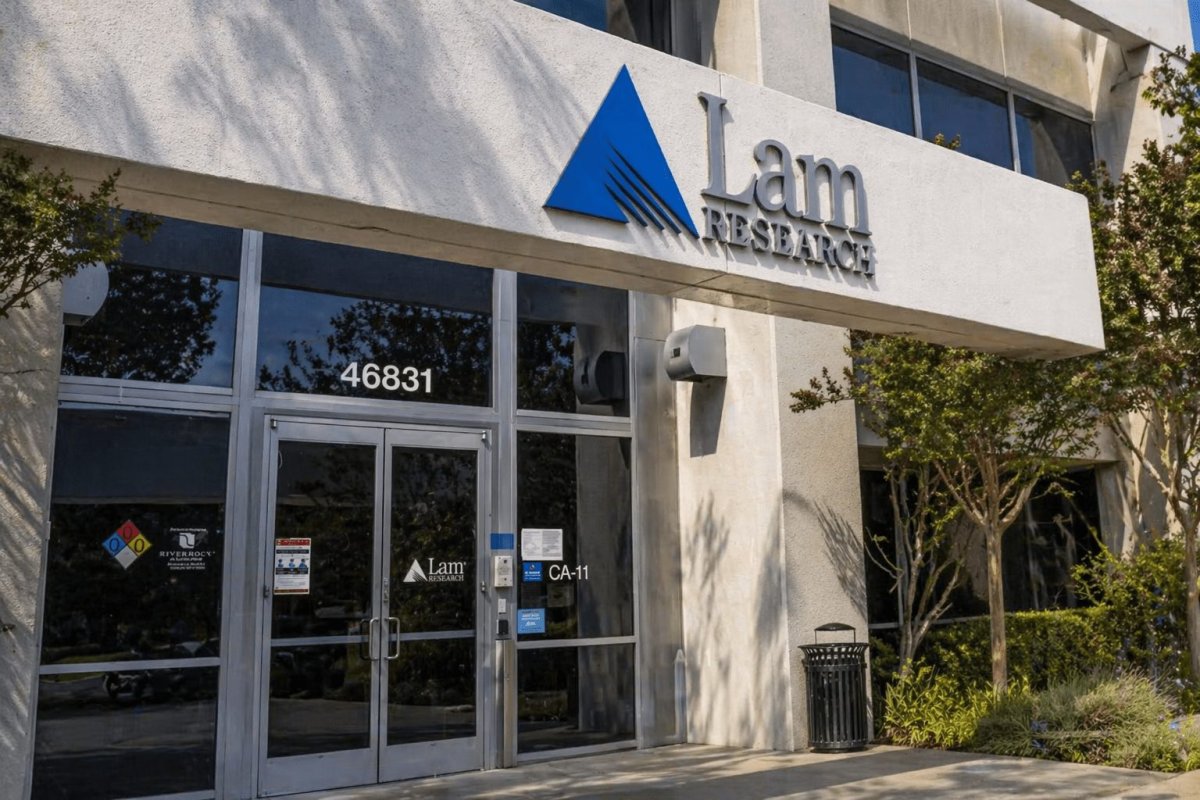
Lam Research Corporation delivered a standout performance in its fiscal third quarter, sending its stock higher in after-hours trading. The semiconductor equipment manufacturer reported all-time high revenue and profit, exceeding Wall Street expectations and providing an optimistic outlook fueled by artificial intelligence investments.
Record Financial Results
For the quarter ended March 2026, Lam Research posted revenue of $5.84 billion, a 24% increase compared to the same period last year. Adjusted earnings per share reached $1.47, significantly above the consensus estimate of $1.36. On a GAAP basis, diluted earnings per share were $1.45, up from $1.03 a year earlier. The company's systems sales contributed $3.73 billion, while support-related revenue—encompassing services, spares, and upgrades—surpassed $2.11 billion for the first time, breaking the $2 billion threshold.
AI Demand Drives Upgraded Outlook
In a significant update, Lam Research raised its 2026 wafer fabrication equipment (WFE) market forecast to $140 billion, indicating that risks are skewed toward even higher figures. This revision underscores the immense demand for AI infrastructure, which is compelling chipmakers to accelerate investments in tools, advanced packaging, and memory. "Artificial intelligence infrastructure demand is immense, and supply is scarce," noted William Kerwin, senior equity analyst at Morningstar, in a February commentary. Lam expects its revenue in the second half of 2026 to exceed the first six months and projects advanced packaging revenue to surge more than 50% this year.
Management Commentary and Competitive Position
Chief Executive Tim Archer highlighted that Lam achieved record revenue and EPS in the March quarter, attributing the success to AI-fueled demand that is transforming the semiconductor industry. He emphasized that the company's strategic bets are paying off. Lam, alongside Applied Materials and KLA, belongs to a select group of U.S. equipment suppliers providing critical technology to Taiwan Semiconductor Manufacturing Company (TSMC) for its leading-edge processors.
Geographic Revenue Mix and Guidance
Geographically, China remained Lam's largest market, accounting for 34% of total revenue in the quarter. Korea and Taiwan each contributed 23%, while the United States represented 6%. Looking ahead, Lam provided strong guidance for the June quarter, forecasting revenue of approximately $6.6 billion, plus or minus $400 million, and adjusted earnings per share of $1.65, plus or minus 15 cents. This outlook surpasses the consensus estimates, which had centered around $6.05 billion to $6.1 billion in revenue and roughly $1.45 per share in earnings.
Industry-Wide Optimism and Regulatory Considerations
The positive sentiment extends across the semiconductor equipment sector. Applied Materials CEO Gary Dickerson previously attributed the demand surge to "the acceleration of industry investments in AI computing," while KLA also issued a bullish outlook earlier this year. However, regulatory developments pose a potential headwind. On Wednesday, a House panel advanced the MATCH Act, aiming to close loopholes in U.S. regulations governing chipmaking equipment sales to China. Although lawmakers softened an earlier draft that had alarmed the industry—scrapping a broad ban on certain etch tools—any policy shift in Washington could rapidly impact Lam's earnings, given China's substantial revenue contribution.
Market Implications
Lam Research's performance and upgraded forecast serve as a key indicator of ongoing strength in semiconductor capital expenditure, particularly for AI processors and memory. The company's backlog offers a window into sustained demand, suggesting that the AI investment cycle continues to gain momentum. As chipmakers ramp up capacity to meet this demand, equipment suppliers like Lam are positioned to benefit significantly, though geopolitical factors remain a watchpoint for investors.