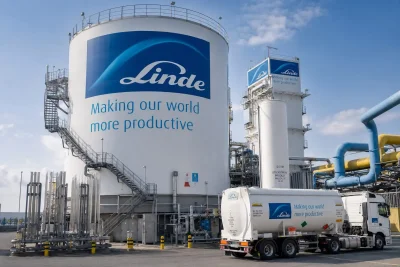
Linde plc has raised €1.6 billion (approximately $1.9 billion) through a new euro-denominated bond offering, a move that bolsters its financial flexibility following a strong first-quarter earnings report and an upgraded 2026 outlook. The bond sale, detailed in market data released on Friday, includes three tranches: a €600 million floating-rate note due 2028, a €500 million fixed-rate note due 2030, and another €500 million fixed-rate note due 2036.
The timing of the issuance is notable, as Linde pushes forward with long-cycle capital projects even as some investors question the strength of industrial demand. At the end of the first quarter, the company reported a $7.1 billion backlog in contractual sale-of-gas projects. These are long-term agreements in which Linde builds and operates production capacity for customers. For 2026, Linde anticipates capital expenditures between $5.0 billion and $5.5 billion.
Linde also continues to return significant capital to shareholders. First-quarter operating cash flow rose 4% to $2.24 billion, while free cash flow reached $898 million after $1.34 billion in capital spending. During the period, the company returned $1.55 billion to investors through dividends and share buybacks, net of new issuances.
The bond offering follows a base prospectus filing that allows Linde to issue debt securities, preferred shares, depositary shares, and ordinary shares. Proceeds from the bonds could be used for a variety of purposes, including debt repayment, share repurchases, capital expenditures, acquisitions, or general corporate needs.
Linde reported first-quarter adjusted earnings per share of $4.15, beating analyst expectations. The company raised its full-year adjusted EPS guidance to a range of $17.60 to $17.90, up from the previous $17.40 to $17.90 range. Chief Executive Sanjiv Lamba credited employees for delivering "another solid quarter," highlighting 10% adjusted EPS growth and a 30% operating margin.
Despite these positive results, demand remains uneven across regions. In Europe, the Middle East, and Africa, underlying sales slipped 2% in the first quarter, hurt by weaker volumes in chemicals, energy, and manufacturing. This weakness underscores the importance of Linde's price discipline and its substantial order backlog in sustaining earnings growth.
Linde operates in a fiercely competitive industrial gas market that continues to expand. A Research and Markets report released Friday projects the global industrial gases market will grow from $122.01 billion in 2026 to $193.72 billion by 2036, driven by trends in decarbonisation, healthcare, and electronics manufacturing. Linde, along with Air Liquide and Air Products and Chemicals, is identified as a key player in this growth.
Market reaction to the bond news was muted. Linde shares closed at $493.16 on Friday, down 0.14%. Air Products edged up to $295.41. Investors appear to be waiting for clearer evidence that new projects and pricing power will offset the weaker demand in certain regions.
CFO Matt White emphasized during the earnings call that current customer obligations take precedence for helium deliveries, with any extra supply potentially going to new multi-year deals with "high-quality customers." This strategy, combined with stable contract flows and major projects, underpins Linde's ability to tap debt markets for funding.