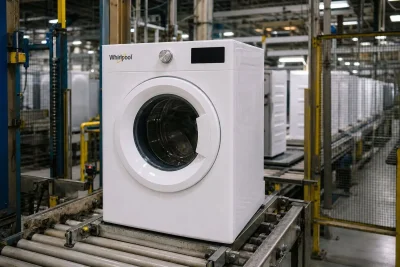
Whirlpool Corporation (WHR) has suspended its common stock dividend and slashed its 2026 profit forecast, sending shares tumbling to their lowest level in over 14 years. The stock closed at $44.96 on Friday, down sharply from $48.21 the prior day and well below Wednesday's close of $54.73.
The move ends a roughly 70-year streak of uninterrupted dividend payments, marking a significant shift for investors who viewed Whirlpool as a reliable income stock alongside its core business of washers, refrigerators, and KitchenAid mixers.
First-Quarter Results Disappoint
For the first quarter, Whirlpool reported net sales of $3.27 billion, a 9.6% decline year-over-year. The company swung to a GAAP net loss of $85 million, or $1.43 per diluted share. On an ongoing basis, which excludes certain items, the loss was 56 cents per share. Free cash flow was negative $896 million after capital expenditures.
The weak performance was driven primarily by sluggish U.S. demand for major appliances, persistent high borrowing costs, and a sharp drop in consumer confidence following geopolitical tensions in Iran, which weighed on energy prices and overall sentiment.
Revised Outlook and Strategic Response
Whirlpool now expects 2026 net sales of approximately $15 billion and ongoing earnings per share in the range of $3.00 to $3.50, down from prior guidance. The company projects free cash flow of over $300 million and cash from operations of roughly $700 million. It aims to reduce debt by more than $900 million this year.
CEO Marc Bitzer said the company acted quickly on pricing and costs as macroeconomic conditions deteriorated. CFO Roxanne Warner highlighted inventory reductions, recapitalization efforts, and a planned $2.25 billion asset-based credit facility as providing financial flexibility.
North America Segment Under Pressure
Whirlpool's North America segment, which includes its core appliance brands, saw net sales fall 7.5% to $2.24 billion. Segment EBIT plunged to just $6 million from $149 million a year earlier.
To shore up margins, the company is raising prices. Juan Carlos Puente, executive president for North America and global sourcing, told analysts that a promotional price increase of over 10% compared with the first quarter has already been implemented, with an additional list price hike of about 4% scheduled for July 9.
Market Challenges and Competitive Landscape
Bitzer described March demand as a "shock to the system," noting that while April showed some improvement, volumes remained negative. Consumers continued to face budget constraints, dragging on product mix, even as replacement demand held up.
The company faces intense competition from Samsung Electronics, LG Electronics, and GE Appliances (owned by Haier). Whirlpool argues that a revamped Section 232 import-duty scheme could benefit U.S. manufacturers, but noted that industry pricing took a hit after a Supreme Court ruling affecting IEEPA tariffs.
Higher prices may help margins but risk further dampening demand as consumers may opt for repairs over new purchases. Additionally, Whirlpool flagged that its credit rating falling below investment grade has made the commercial paper market more expensive and harder to access.
Debt and Liquidity Concerns
As of March 31, Whirlpool reported long-term debt at a fair value of $5.5 billion, including current maturities. The terms of its revised long-term credit agreement require a complete refinancing by July 1. Investors will be watching closely to see how the company manages its deleveraging timeline amid weak demand.