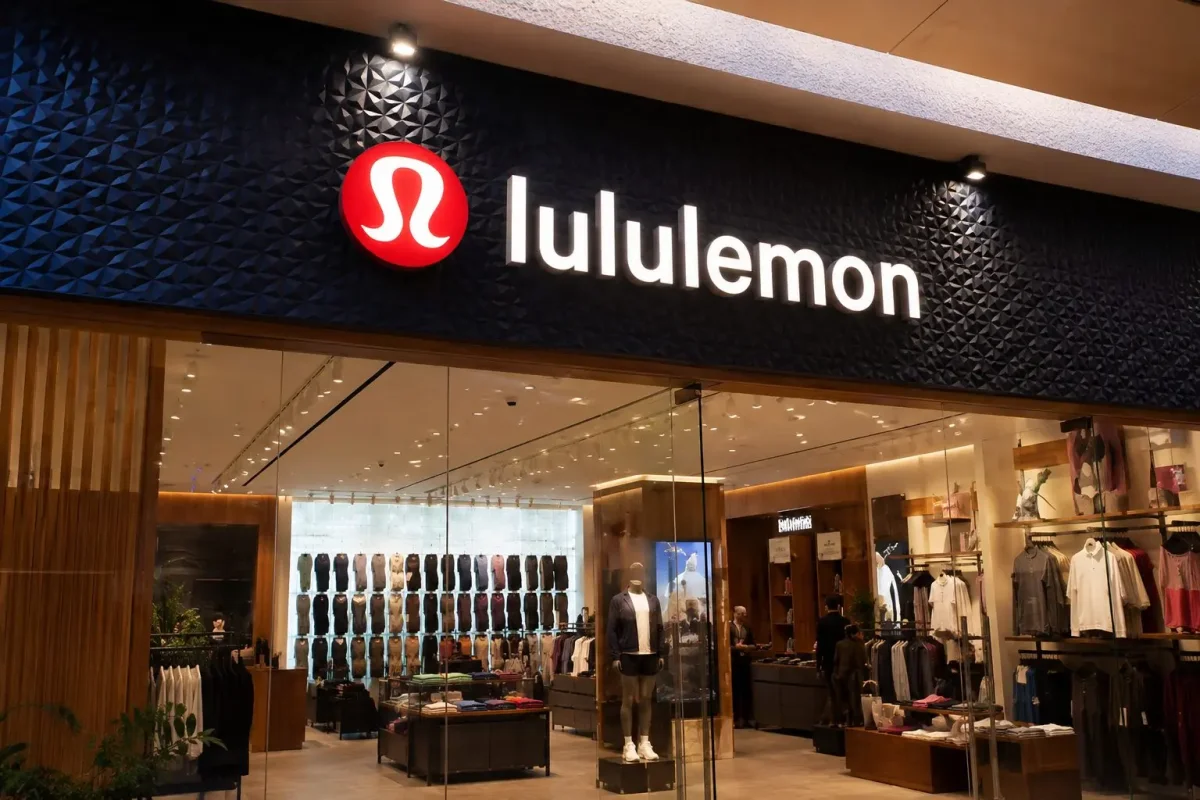
Lululemon Athletica slashed its annual revenue and profit forecasts on Thursday, citing persistent weakness in U.S. demand that overshadowed gains in international markets. The revised guidance sent shares tumbling about 9% in after-hours trading and intensified the challenges facing the company as it prepares to welcome a new chief executive.
The athletic apparel retailer now expects fiscal 2026 revenue in the range of $11.00 billion to $11.15 billion, which would represent either a 1% decline or flat sales compared with the prior year. Diluted earnings per share are forecast at $10.95 to $11.15, down sharply from the March guidance of $12.10 to $12.30. The outlook for the current quarter is similarly subdued, with revenue projected to fall 2% to 3% and EPS between $1.76 and $1.81.
The timing of the downgrade is particularly challenging. Heidi O’Neill, a longtime Nike executive, is set to take over as CEO on September 8, leaving a leadership vacuum during a critical period. The company only resolved a board dispute with founder Chip Wilson last week, which had diverted attention from operational issues just as sales momentum slowed. Interim co-CEO and CFO Meghan Frank noted that while the company saw some “positive signals” in North America with stronger full-price sales, newer headwinds prompted the cut in guidance.
First-quarter results showed a mixed picture. Revenue rose 4% to $2.47 billion, and earnings of $1.69 per share beat the company’s March forecast. However, the underlying trends were less encouraging. Americas net revenue dropped 3%, even as international sales surged 22%. Comparable sales overall edged up just 1%, but fell 5% in the Americas. U.S. revenue, measured at constant exchange rates, declined 4%, while sales in China jumped 23%.
Margins came under significant pressure. Gross margin contracted by 410 basis points to 54.2%, and operating income fell 37% to $276.9 million. The company attributed the margin decline to higher costs and a less favorable sales mix. Interim co-CEO and chief commercial officer André Maestrini acknowledged, “We recognize that we have more work to do.”
Lululemon faces intensifying competition in its home market from upstarts like Alo Yoga and Vuori, as well as from established athletic brands. The competitive landscape is also a factor in overseas markets. O’Neill, who spent over three decades at Nike, has said she aims to “accelerate product breakthroughs” and boost the brand’s cultural relevance, but executing that strategy against a backdrop of slowing U.S. demand and margin compression will be a formidable task.
The board dispute with Wilson concluded with a cooperation agreement on May 27. Under the deal, Laura Gentile, former chief marketing officer at ESPN, and Marc Maurer, former co-CEO at On, will join the board after the 2026 annual meeting. Lululemon will also appoint one more director with apparel product and brand experience by October 1. Executive chair Marti Morfitt said the agreement provides “a clear path forward” for O’Neill and the leadership team. Wilson, who holds about 8.7% of shares, agreed to standstill and non-disparagement terms for roughly 18 months.
Despite the headwinds, Lululemon maintains a solid financial position. The company ended the quarter with $1.5 billion in cash and cash equivalents, providing a buffer against uncertainty. It also repurchased $358.3 million in shares and opened five net new stores, bringing the total to 816. Inventories were up 2% in dollar terms but down 4% by units, suggesting that the company is not simply accumulating unsold goods.
The revised outlook comes with several caveats. Lululemon noted that its forecast excludes potential tariff refunds, future share buybacks, and does not account for unknown future impacts from tariffs or broader economic trends. With cautious U.S. consumers and potential delays in product launches, the incoming CEO will have limited room to maneuver, even with a strong balance sheet.