Shares of Lumentum Holdings Inc. experienced a significant rally on Wednesday, climbing as much as 14.3% during the trading session. The surge followed an ambitious financial roadmap presented by the optical components manufacturer, which outlined a trajectory toward achieving $1.25 billion in quarterly revenue, with a longer-term goal of reaching $2 billion per quarter. This growth projection is directly tied to the explosive demand for artificial intelligence infrastructure within data centers.
Nvidia's Strategic Investment Fuels Optimism
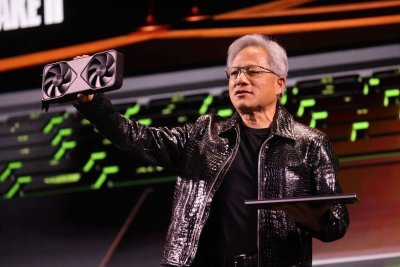
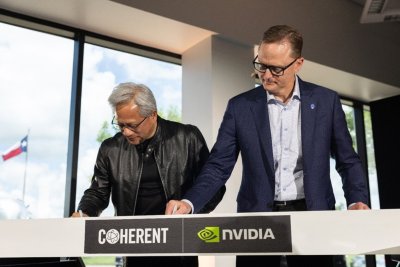
The bullish sentiment was further reinforced by a recent strategic move from AI chip giant Nvidia. Earlier this month, Nvidia committed to investing $2 billion in both Lumentum and its primary competitor, Coherent Inc. This capital infusion is accompanied by multi-billion-dollar purchase agreements and future rights on manufacturing capacity, effectively tethering both photonics firms to Nvidia's next-generation AI hardware ecosystem. Despite Nvidia CEO Jensen Huang's recent comments acknowledging a continued role for copper interconnects in future systems, the market interpreted the investment as a strong endorsement of optical technology's critical role.
Rival Coherent Shares Upbeat Long-Term Vision
Coherent, trading as Lumentum's main listed rival, also saw its stock advance, rising 3.4%. The company presented its own compelling outlook to investors, estimating that the total addressable market for datacenter components could exceed $70 billion by the year 2030. Lumentum's assessment was even more expansive, valuing the broader optical AI segment at over $90 billion and predicting industry revenue could grow at an approximate annual rate of 40%.
The presentations, made at the OFC conference in Los Angeles, highlighted a pivotal shift in the industry conversation. The debate is no longer about whether optics will be adopted in AI clusters, but rather the speed at which optical links can evolve from connecting racks over longer distances to being integrated into much shorter-range, chip-adjacent applications.
Detailed Financial Models and Market Segmentation
In its March 17 presentation, Lumentum contrasted current fiscal 2026 consensus revenue estimates of $2.9 billion against its higher-potential scenarios. The company modeled a path to roughly $5 billion in annual revenue based on a $1.25 billion quarterly run rate, and a scenario reaching $8 billion annually at a $2 billion quarterly pace. Accompanying operating margin projections also climbed, from 33-37% at the first revenue step to 38-42% at the second. Management clarified this was a target model, not formal guidance.
Lumentum's strategy, as explained by Chief Strategy Officer Rafik Ward, focuses on delivering the "scale, speed, and efficiency" demanded by modern AI infrastructure. Chief Technology Officer Matt Sysak noted the performance pressures facing traditional electrical interconnects due to AI buildouts. The company is launching new product families, including VCSEL-powered and pluggable optics, designed to serve both short in-rack links and longer rack-to-rack connections.
Coherent's Technology Roadmap and Capacity Build-Out
Coherent's strategy runs in parallel. The company noted its optical circuit switches are already generating revenue, and it expects co-packaged or near-packaged optics—which place optical links directly beside processors—to begin contributing to sales in the second half of 2026. Multi-rail offerings are slated for 2027. Beck Mason, head of semiconductor devices at Coherent, emphasized that indium phosphide (InP) is "central to high-performance optical connectivity." The company plans to more than double its InP manufacturing capacity by the end of 2027.
The market reaction underscored a sorting of potential winners and losers. While Lumentum and Coherent rallied, shares of other optical players like Corning and Applied Optoelectronics declined earlier in the week following Huang's comments on copper. Credo Technology, which is tied to copper interconnect solutions, weathered the news better, with its stock dipping a mere 0.2% on Wednesday, highlighting the ongoing, nuanced debate between copper and optics.
Caution Amid the Excitement
Analysts and company management injected notes of caution. Lumentum's projections are based on modeled scenarios, not locked-in purchase orders, and real-world results and timelines could shift based on market adoption and execution risks. An analyst cited by Reuters last week described co-packaged optics as key for large AI clusters but cautioned that widespread deployment depends significantly on driving costs down.
For nearer-term metrics, investors are watching Lumentum's guidance for the March quarter, which targets revenue between $780 million and $830 million, up from $665.5 million in the December period. The company also disclosed in February that its backlog for optical circuit switches had surpassed $400 million. Furthermore, a separate co-packaged optics order valued at several hundred million dollars is scheduled for delivery in the first half of 2027, a point management has described as just the "starting line" for these advanced technologies.