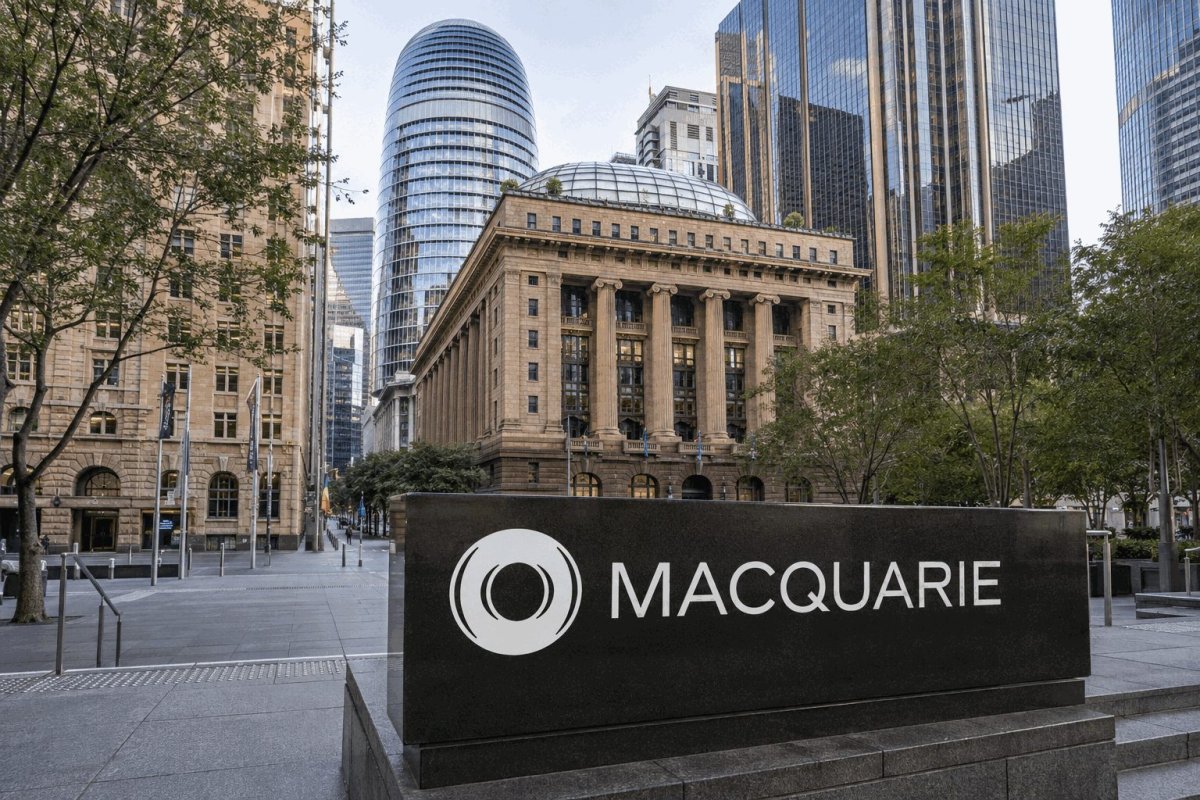
Macquarie Group (ASX: MQG) has suffered a dramatic reversal of fortune, with its shares tumbling 5.14% over the past week and closing at A$248.43 on Friday. The decline, which spanned five consecutive trading sessions, erased approximately A$4.96 billion in market capitalisation—a sum that marginally exceeds the company's full-year FY26 net profit of A$4.847 billion. This sharp selloff has wiped out the year's gains and left investors questioning whether the stock has finally found a floor.
The weekly performance was particularly harsh when measured against the broader market. While the S&P/ASX 200 index slipped only about 0.7% during the same period, Macquarie underperformed the benchmark by roughly 4.4 percentage points. The selloff was driven by rising bond yields and inflation concerns that weighed heavily on financial and technology stocks, sectors in which Macquarie has significant exposure.
Despite the steep decline, valuation metrics suggest limited upside. According to data from 13 analysts, the average price target for Macquarie stands at A$255.84, implying a modest potential gain of just 2.98% from Friday's closing price. The consensus rating remains a 'buy,' with eight analysts recommending the stock, three advising a hold, and two suggesting a sell. However, the tight range of targets—from a low of A$205.00 to a high of A$284.03—reflects uncertainty about the company's near-term prospects.
Macquarie's slide was steady and relentless. After opening the week at A$261.90, the shares fell in every session, with the largest single-day drop of 1.99% occurring on Tuesday. By Friday, the stock had slipped below the A$250 mark for the first time this month, closing at A$248.43—its lowest finish of the week. The cumulative decline of A$13.47 per share translates to a market value loss of approximately A$4.96 billion, based on the company's outstanding share count of roughly 368 million.
Fundamentally, Macquarie's recent earnings report painted a picture of robust growth. The company posted a 30% increase in full-year net profit to A$4.847 billion, with earnings per share climbing 30% to A$12.77 and return on equity improving to 14.0% from 11.2%. Net operating income rose 13% to A$19.477 billion, with international income accounting for 68% of the total. The ordinary dividend was set at A$7.00, representing a 55% payout ratio.
Chief Executive Shemara Wikramanayake attributed the strong performance to the company's ability to leverage specialised knowledge across all business units. Asset management earnings surged 27%, commodities and global markets jumped 49%, and Macquarie Capital saw a 43% increase. Notably, the company finalised its A$11.7 billion acquisition of Qube Holdings on August 14, a move that expands its exposure to ports, terminals, and transport infrastructure. Despite this positive development, the share price continued its downward trajectory.
When compared to its banking peers, Macquarie trades at a premium valuation. The stock is priced at 19.75 times trailing earnings, a level comparable to National Australia Bank (NAB) but above Westpac's 16.67 times. Its dividend yield of 2.82% is the lowest among the major four banks, reflecting the market's expectation of continued earnings growth. Analysts at JPMorgan have set a target of A$275, suggesting a potential gain of 10.7%, while Citi's more conservative target of A$240 implies a 3.4% downside.
Technical levels will be crucial in the coming sessions. Friday's intraday low of A$247.36 serves as the first key support; a breach could open the door to a test of Citi's A$240 target. Conversely, regaining A$252.30 would signal a reversal of Friday's decline, with the consensus target of A$255.84 representing the next resistance. The market will also be watching for the half-year results, scheduled for November 6, 2026.
Risks remain skewed to the downside. Rising bond yields could continue to pressure financial valuations, while fluctuations in asset-sale and performance-fee income create earnings volatility. Credit losses, commodity price swings, regulatory changes, and execution challenges on major infrastructure projects are additional factors that could weigh on the stock. As Monday's trading session approaches, investors will be watching closely to see if the recent selloff represents a reset opportunity or the beginning of a deeper correction.