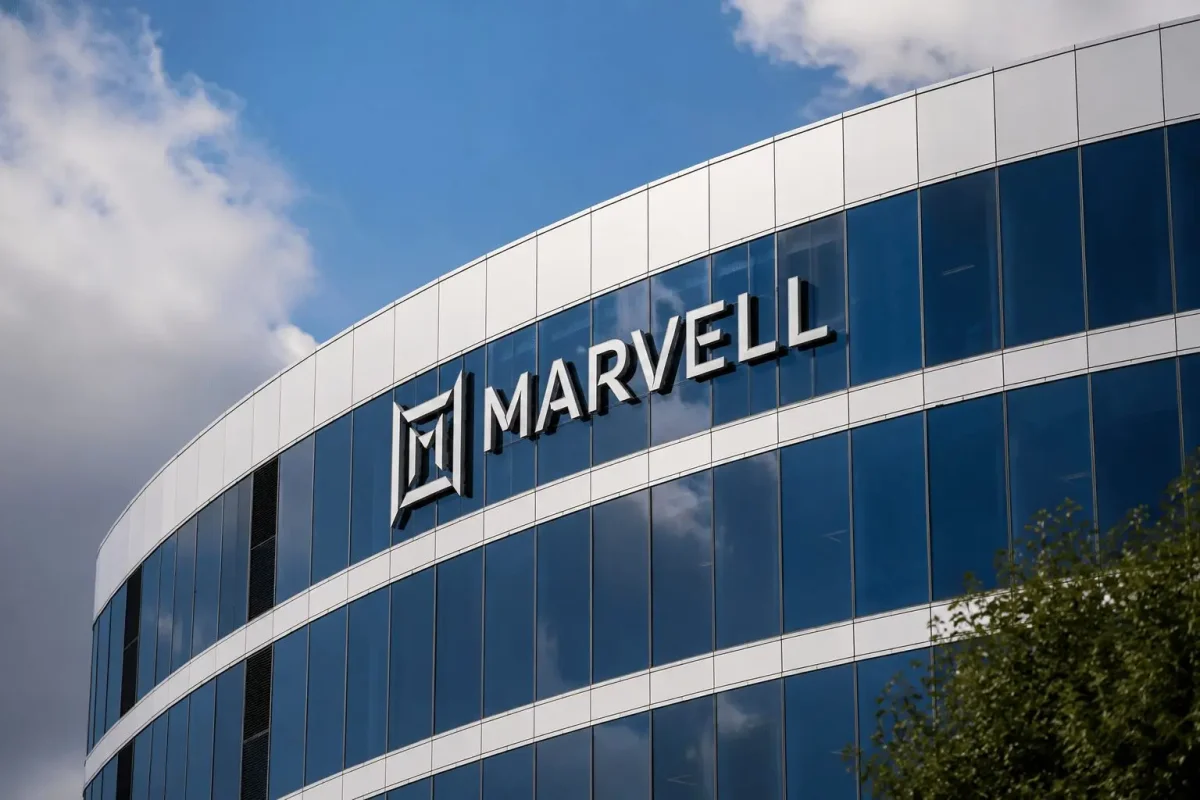
Marvell Technology (MRVL) saw its stock climb 2.4% to $203.50 on Thursday, touching an intraday high of $210.70, after the semiconductor company outlined an ambitious custom-chip revenue target of more than $10 billion by fiscal 2029. The announcement reinforced investor confidence in Marvell's expanding role in the artificial intelligence infrastructure buildout, moving beyond its traditional networking chip business.
The company's first-quarter fiscal results, reported Thursday, showed revenue of $2.418 billion, a 28% year-over-year increase. Data center sales accounted for $1.83 billion, or 76% of total revenue, highlighting Marvell's pivot toward AI-centric operations. Non-GAAP earnings came in at $0.80 per share, matching analyst expectations. However, GAAP net income fell sharply to $34.5 million, or $0.04 per share, from $177.9 million a year earlier, weighed down by acquisition charges, stock-based compensation, and other non-cash items.
CEO Matt Murphy emphasized the company's strong AI-related bookings, noting that Marvell is seeing exceptional demand from cloud hyperscalers. The company expects to receive approximately $1 billion in prepayments this fiscal year to secure manufacturing capacity, a sign of robust forward demand but also of the capital-intensive nature of the custom-chip business.
Marvell operates in a strategic niche between Nvidia (NVDA) and major cloud providers. While Nvidia continues to dominate the AI accelerator market, Amazon (AMZN), Alphabet (GOOGL), and other large cloud operators are increasing investments in custom silicon to better control costs, power efficiency, and supply chain. This positions Marvell as a direct competitor to Broadcom (AVGO) in the custom-chip space.
For the current quarter, Marvell guided revenue of $2.7 billion at the midpoint, signaling continued momentum. Morningstar analyst William Kerwin estimated the custom-chip opportunity could represent $5 billion in incremental revenue between fiscal 2028 and 2029, according to Reuters. Murphy told analysts during the earnings call that Marvell has custom chip engagements "across the board at all the U.S. hyperscalers."
A significant catalyst came in March when Nvidia announced a strategic partnership with Marvell on its NVLink Fusion platform, which enables third-party chips to connect with Nvidia AI hardware. Nvidia also invested $2 billion in Marvell at that time. Nvidia CEO Jensen Huang declared that the "inference inflection has arrived," while Murphy said the partnership ties Marvell's optical, analog, and custom silicon expertise into Nvidia's AI ecosystem.
The broader semiconductor sector also gained ground Thursday. The iShares Semiconductor ETF (SOXX) rose 1.9%, the Invesco QQQ Trust (QQQ) added nearly 0.9%, and Broadcom shares advanced 1.3%. Nvidia edged up 0.5%. Marvell outperformed the group, reflecting its unique position in the AI supply chain.
Despite the positive outlook, risks remain. Marvell's revenue is concentrated among a handful of large customers, and those firms could choose to develop chips in-house or switch suppliers. Supply chain disruptions, tariffs, or trade restrictions could impact production and margins. A slowdown in cloud capital spending or the failure of a key custom-chip program could reverse the stock's recent gains.
Investors will now focus on Marvell's ability to deliver on its $2.7 billion revenue forecast for the July quarter and sustain margin expansion. The company's aggressive capacity investments suggest management is betting on long-term AI demand, but execution will be key to maintaining momentum.