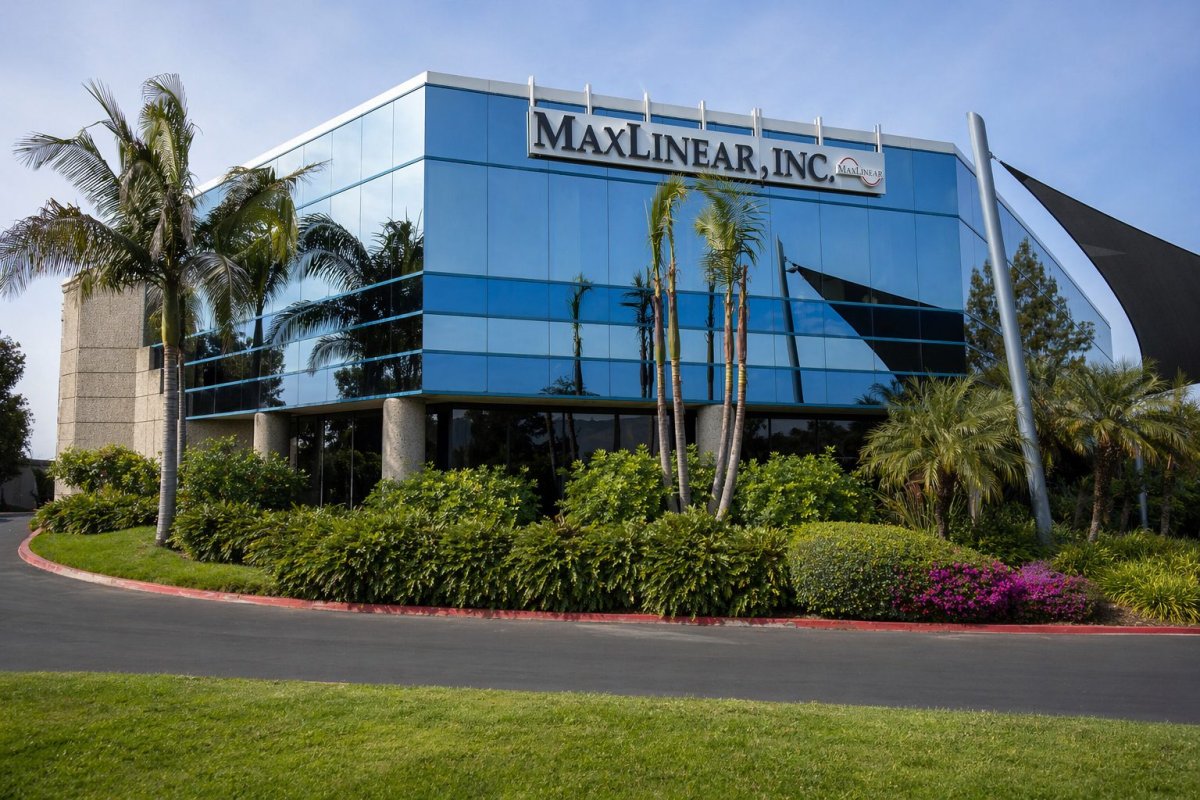
Shares of MaxLinear Inc. (MXL) jumped more than 23% in after-hours trading Thursday, reaching $42.47, after the chipmaker delivered a first-quarter earnings beat and an exceptionally strong second-quarter revenue forecast that far exceeded Wall Street expectations. The company credited surging demand for its optical data-center products, driven by massive investments in artificial intelligence infrastructure by cloud hyperscalers.
Q1 Results and Q2 Guidance
For the first quarter ended March 31, 2026, MaxLinear reported revenue of $137.2 million, a 43% increase year-over-year and a 1% sequential rise. Adjusted earnings came in at $0.22 per share, beating the consensus estimate of $0.18 per share, according to FactSet data compiled by Investor's Business Daily. However, on a GAAP basis, the company recorded a net loss of $0.52 per share, reflecting stock-based compensation and acquisition-related costs.
Looking ahead, management projected second-quarter revenue in the range of $160 million to $170 million, well above the $137.1 million analysts had anticipated. This guidance marks a clear acceleration and signals that the company's pivot toward AI data-center connectivity is gaining traction.
Infrastructure Segment Surges
The standout performer was the infrastructure segment, which encompasses high-speed optical interconnect products used in AI data centers. Infrastructure revenue jumped 136% year-over-year to approximately $63 million, becoming the company's largest revenue segment at 46% of total sales, up from just 28% a year ago. Broadband revenue came in at about $44 million, connectivity contributed $19 million, and industrial/multi-market revenue was around $12 million.
CEO Kishore Seendripu described the quarter as "the start of a multi-year growth phase," citing a "clear inflection point" in optical data-center connectivity. He noted that the company is ramping optical products with several hyperscale customers, including major cloud providers.
Optical Technology and Competition
MaxLinear's core technology involves chips for optical modules that convert electrical signals to light, enabling high-speed data transmission between servers and switches. The company highlighted its PAM4 digital signal processors (DSPs), which are critical for 800G and 1.6T optical links being deployed by U.S. and Chinese cloud giants.
The competitive landscape remains intense. In its latest quarterly filing, MaxLinear listed Broadcom (AVGO), Marvell Technology (MRVL), and Credo Technology (CRDO) as key competitors across optical interconnect, analog chips, and communications markets. The company also acknowledged that some customers may choose to develop their own components in-house rather than rely on MaxLinear's offerings.
Balance Sheet and Supply Chain
MaxLinear also announced an amendment to its credit agreement with Wells Fargo and other lenders, extending the maturity of its revolving credit facility to March 2028 from June 2026 and increasing total commitments by $30 million to $130 million. At quarter-end, the facility remained undrawn.
On the supply chain front, CFO Steve Litchfield acknowledged "some supply constraints" but stated that the company has "planned well" with partners, including foundries TSMC and UMC. He expects infrastructure to become "a much bigger driver of growth" next year, though he declined to provide full-year revenue guidance.
Outlook and Risks
While the second-quarter outlook is encouraging, MaxLinear still faces risks. The company continues to report GAAP losses, relies on external manufacturers, and sources certain components from single suppliers. In its filing, MaxLinear warned that capacity shortages could disrupt shipments, while weaker-than-expected demand could lead to excess inventory. The company also noted that revenue remains subject to semiconductor cycle volatility, product mix shifts, and manufacturing costs.
Nevertheless, the strong guidance and infrastructure momentum suggest that MaxLinear is successfully positioning itself as a key enabler of AI data-center optical connectivity. Investors will be watching closely to see if this growth trajectory can be sustained.