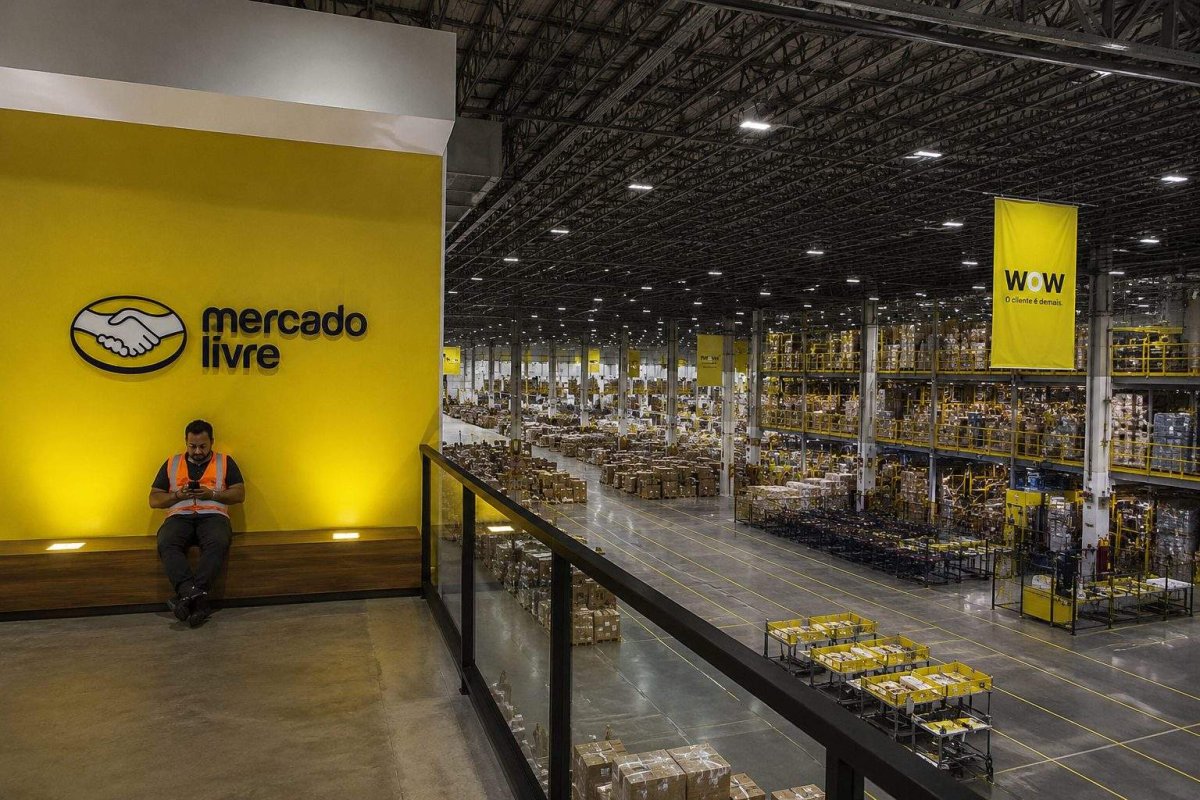
Investors are showing cautious optimism for MercadoLibre (NASDAQ:MELI) ahead of its second-quarter earnings report, with shares climbing 4.2% last week to close Friday at $1,877.95. The stock's recent gains come despite a sharp downward revision in analyst profit expectations, highlighting a growing focus on the company's ability to balance rapid expansion with profitability.
Earnings Estimates Slashed, Revenue Forecast Strong
According to the latest consensus from analysts, MercadoLibre is projected to report revenue of $9.74 billion for the second quarter, representing a substantial 43.5% increase from the same period last year. However, earnings per share (EPS) are expected to decline to $8.67, down 15.9% from the $10.31 reported in Q2 2025.
The dramatic divergence between revenue growth and profit expectations has become a central point of concern. The consensus EPS estimate has fallen 22.4% over the past three months, from $11.17 to $8.67, with the most recent revision occurring just a month ago when the estimate stood at $8.74. Similarly, full-year 2026 EPS forecasts have been trimmed by 16.9% during the same period, now sitting at $39.34.
Growth vs. Profitability: The Core Tension
The company's recent financial performance illustrates the trade-off. In the first quarter of 2026, revenue surged 49% year-over-year, marking the fastest growth in nearly four years. However, operating income fell 20%, and the operating margin contracted sharply to 6.9% from 12.9% in the prior-year quarter. This pattern of accelerating sales paired with softer profitability has become a recurring theme across recent quarters.
Management has been transparent about its strategy, with investor relations head Leandro Cuccioli stating in May, "We are willing to sacrifice these short term profits because we think that the opportunity is worth it." This deliberate investment phase is aimed at capturing long-term market share, particularly in Brazil, where the company sees significant potential.
Brazil: The Key to Margin Recovery
Brazil remains the most promising avenue for improving economics. In Q1, items sold in the country climbed 56%, and unique buyers increased 32%. Notably, unit shipping costs dropped 17% in local currency, suggesting that scale is beginning to drive efficiencies. If a similar trend continues in Q2, it would strengthen the case for eventual margin expansion.
However, the fintech segment introduces both opportunity and risk. The credit portfolio has grown to $14.6 billion, an 87% increase year-over-year. While the non-performing loan ratio for 15-to-90-day loans remains stable at around 8.0%, the net interest margin after losses has declined by 4.9 percentage points compared to a year ago, reflecting the costs of aggressive credit expansion.
Valuation and Peer Comparison
Valuation continues to be a sticking point for investors. MercadoLibre trades at 49.6 times trailing earnings, a premium to Amazon.com (NASDAQ:AMZN) at 32.5 times and Nu Holdings (NYSE:NU) at 22.1 times. While the comparison is not perfect due to differing business mixes, the higher multiple leaves little room for another margin shortfall.
The stock is currently 26.3% below its 52-week high of $2,548.50. Analysts have set an average price target of $2,243.59, implying a potential upside of 19.5% from Friday's close. The most bearish target stands at $1,750, which would represent a 6.8% decline.
Upcoming Earnings and Key Risks
MercadoLibre is scheduled to release its second-quarter results on August 5, followed by a conference call at 5 p.m. EDT. Investors will be closely monitoring operating margin, shipping costs in Brazil, credit provisions, and the volume of products sold directly by the company.
Key risks include another margin shortfall, increased credit provisions, and softer regional currencies. Intense competition in Brazil could also prolong the investment phase. As one analyst noted, "Shares might not be shielded by a revenue beat alone."
The market's expectations are clear: strong growth with reduced profit per share. Wednesday's report will be the ultimate test of whether this gap is merely a temporary phase or a sign of more persistent challenges.