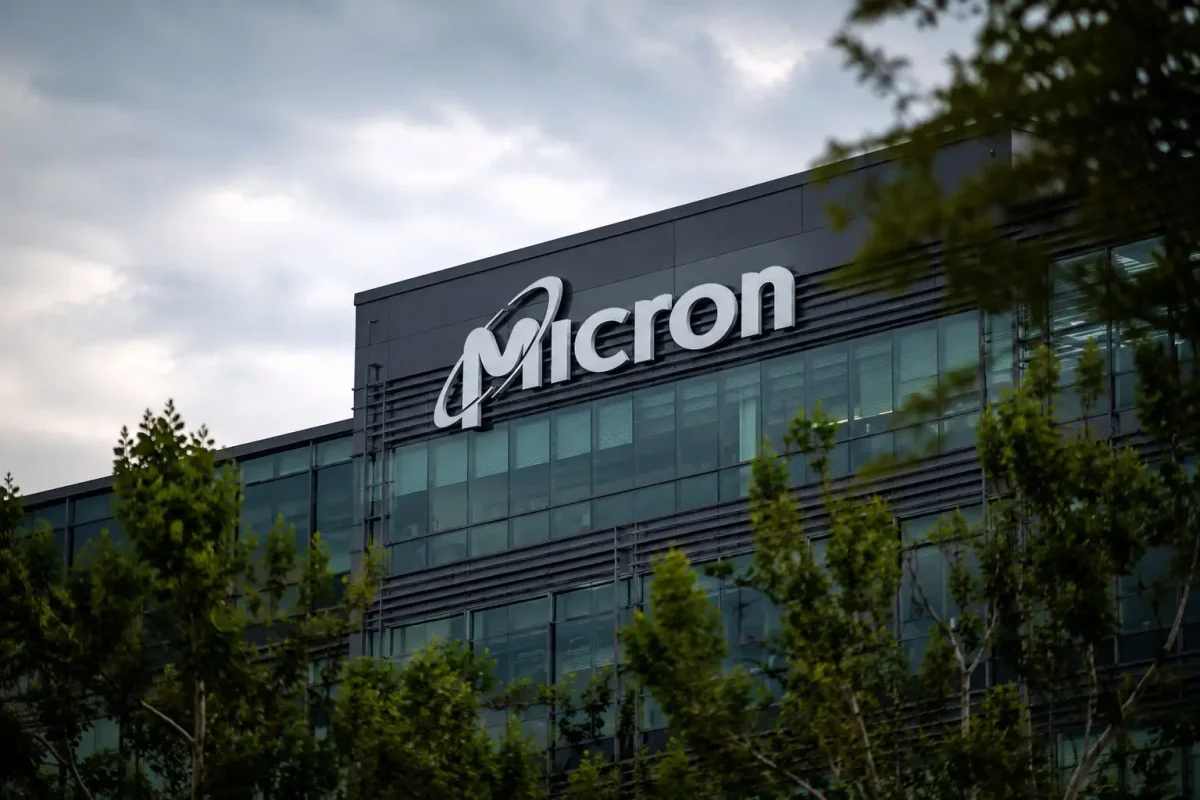
Micron Technology (NASDAQ:MU) experienced a sharp decline on July 1, with shares closing at $1,032.28, down 10.57% from the previous session. The drop erased approximately $138 billion in market value, based on the company's 1.13 billion outstanding shares. In premarket trading on July 2, the stock continued to slide, quoted at $995.51, down an additional 3.56%.
The selloff has brought renewed attention to Micron's outsized influence on the Nasdaq-100 index. According to data from Jefferies, Micron accounted for 26% of the index's first-half return, during which the Nasdaq-100 gained roughly 20%. The stock had quadrupled over the same period, pushing its market capitalization to $1.3 trillion.
Despite the stock's decline, memory chip pricing remained largely stable. KeyBanc analyst John Vinh reported that DRAM prices increased by about 3% in June, while NAND flash rose 2.4%. Vinh noted that meaningful new capacity is not expected until 2027, driven by outsized data center demand for high-bandwidth memory (HBM) and DDR5. This suggests that the selloff may be more about profit-taking than a fundamental shift in demand.
Other memory-related stocks also fell in sympathy. SanDisk Corp. (NASDAQ:SNDK) dropped 10.6%, Western Digital Corp. (NASDAQ:WDC) lost 6.3%, and Seagate Technology Holdings plc (NASDAQ:STX) declined 5.2%. The broad-based decline indicates a sector-wide pullback after a strong first half.
In a move that underscores the expanding role of memory in automotive applications, General Motors Co. (NYSE:GM) announced a long-term supply agreement with Micron on July 1. The deal covers LPDRAM, NOR, and UFS NAND products for use in vehicle manufacturing. Supply will come from Micron's DRAM fab in Manassas, Virginia, which underwent a $2 billion upgrade earlier this year. GM CEO Mary Barra described the agreement as key to building a resilient supply chain, while Micron CEO Sanjay Mehrotra emphasized the company's investment in extending supply availability.
Micron's financial performance continues to strengthen. In fiscal Q3 2026, the company reported revenue of $41.46 billion, up from $23.86 billion in Q2 and $9.30 billion in the year-ago quarter. Non-GAAP gross margin expanded to 84.9%, compared to 74.9% in Q2 and 39.0% in Q3 2025. Non-GAAP EPS came in at $25.11, versus $12.20 in the prior quarter and $1.91 a year earlier. Auto and embedded revenue reached $4.63 billion, up from $2.71 billion in Q2.
Looking ahead, Micron guided fiscal Q4 revenue of $50 billion, plus or minus $1 billion, and non-GAAP EPS of $31, plus or minus $1. The midpoint implies roughly 21% sequential revenue growth, suggesting that the selloff may be disconnected from the company's underlying business momentum.
The stock's 52-week range spans from $103.38 to $1,255.00, and the average analyst price target on Google Finance stands at $1,563.93. While the recent pullback has been sharp, it is set against a backdrop of strong earnings and steady memory pricing. Investors will be watching to see whether the selloff deepens or if buyers step in to support the stock near the $1,000 level.