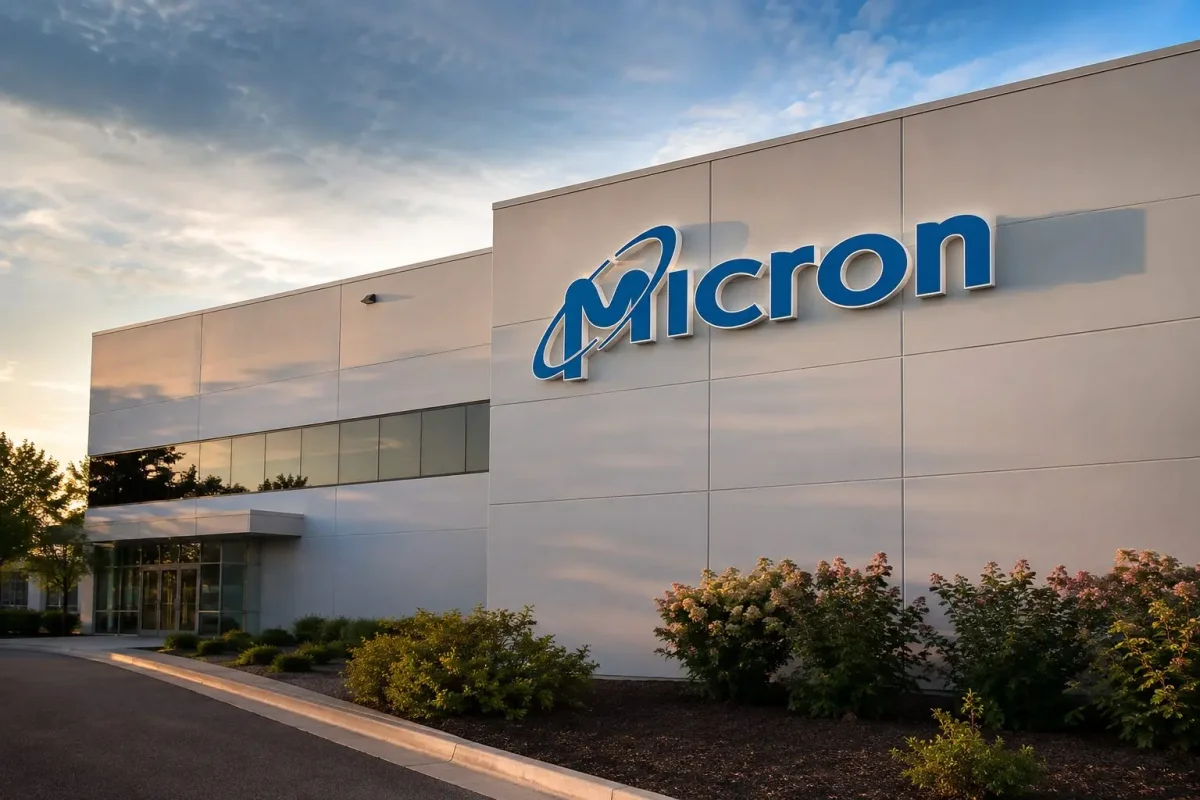
Micron Technology Inc. extended its recent recovery on Tuesday, with shares climbing 3.77% in premarket trading to $985.04, as investor confidence returned to AI-focused memory stocks. The stock closed Monday at $949.28, up nearly 10% from the prior session, signaling renewed appetite for semiconductor plays after a volatile period.
The uptick comes after a broad sell-off in chip stocks last week, triggered by a cautious forecast from Broadcom and a stronger-than-expected U.S. jobs report that reignited fears of further Federal Reserve rate hikes. The Nasdaq 100 futures led U.S. index gains ahead of the open, with Nvidia, Broadcom, and Micron each rising between 0.8% and 4.4% in premarket action, according to Reuters.
Investors are now closely watching May CPI data, due Wednesday, for clues on inflation and monetary policy direction. The memory sector remains in focus as Wall Street debates whether the traditional boom-and-bust cycle is giving way to a more stable, AI-driven demand environment.
Analyst optimism has been a key driver. Cantor Fitzgerald raised its price target on Micron to $1,500 from $700, maintaining an Overweight rating. Wells Fargo also boosted its target to $1,220 from $550. UBS had already raised its target to $1,625 in late May, citing long-term supply agreements that could smooth earnings volatility. Cantor's C.J. Muse told MarketWatch that "the memory trade is alive and well," pointing to sustained demand for high-bandwidth memory (HBM) and ongoing shortages in DRAM and NAND.
Micron's financials underscore the momentum. The company reported fiscal Q2 revenue of $23.86 billion and non-GAAP earnings of $12.20 per share. For the current quarter, it guided revenue of $33.5 billion, plus or minus $750 million. CEO Sanjay Mehrotra recently stated that "memory has become a strategic asset," reflecting the shift toward AI-optimized memory solutions.
However, the path is not without risks. Heavy capital spending—Micron raised its fiscal 2026 capex by $5 billion to over $25 billion—has raised concerns about oversupply. Mike O'Rourke of JonesTrading noted that such spending could signal the shortage may not persist. The company also faces intense competition from Samsung Electronics and SK Hynix, the other two global memory suppliers.
Nvidia CEO Jensen Huang highlighted the alignment between the two firms, saying, "Micron and Nvidia really lined up all of our road map." This partnership has pushed Micron deeper into high-margin, long-term supply agreements, reinforcing its role in the AI hardware ecosystem.
The next major catalyst is Micron's fiscal Q3 earnings report, scheduled for June 24 after the market close. Investors will scrutinize revenue, pricing trends, and forward guidance to validate the stock's premium valuation, which now mirrors that of AI suppliers rather than traditional memory chipmakers. The stock's premarket gains suggest continued faith in the AI memory thesis, but the earnings call will be the true test of its sustainability.