Micron Technology (NASDAQ:MU) shares surrendered nearly all of their early gains on Thursday, as the initial surge fueled by Nvidia's blockbuster earnings quickly faded. The stock opened at $967.01, up 3.05% from Wednesday's close of $938.40, but by 09:39 EDT it had slipped to $943.46, leaving it just 0.54% higher. This move effectively erased about 82% of the opening gap, transforming what began as a broad AI-memory rally into a more focused valuation debate for a stock that has already climbed more than sevenfold over the past year.
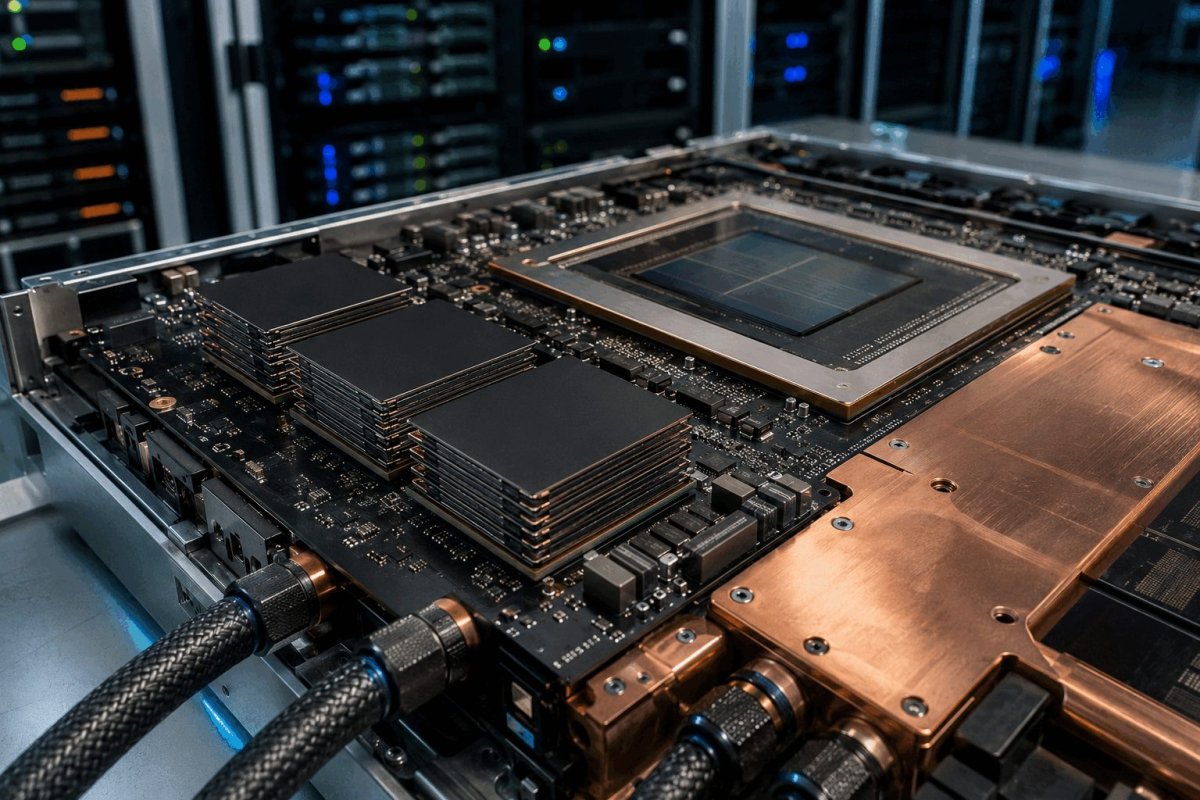
The catalyst for the early optimism was Nvidia's fiscal second-quarter report, which showed revenue of $96.22 billion, up 106% year-over-year. Data-center revenue alone reached $89.0 billion, and the company guided for current-quarter revenue of approximately $108.0 billion, with a potential variance of 2%. For Micron, the significance lies in its high-bandwidth memory (HBM) products, which are positioned directly alongside Nvidia's AI accelerators. In its fiscal first quarter, Micron began volume shipments of its 36-gigabyte HBM4 for Nvidia's Vera Rubin platform, a component that delivers over 2.8 terabytes per second of bandwidth and offers more than 20% greater power efficiency than its predecessor, HBM3E.
Micron's own financials reflect the strength of the memory market. Fiscal third-quarter revenue surged to $41.46 billion, up from $23.86 billion in the prior quarter. Operating cash flow more than doubled sequentially to $25.39 billion, while adjusted free cash flow reached $18.3 billion. These figures underscore the company's ability to capitalize on the AI-driven demand for memory, but they also highlight the cyclical nature of the industry, where pricing and capacity decisions can swing dramatically.
The $1,300 price target that has been generating search interest implies a potential gain of 37.8% from the current price of $943.46 and represents roughly 8.4 times anticipated earnings for fiscal 2027. This target is not the most bullish on the Street; in fact, it sits well below the consensus. BMO Capital Markets initiated coverage with a $1,300 target on August 20, and Mizuho lowered its projection to $1,300 from $1,375 on August 25. The average price target among 47 analysts surveyed by S&P Global stands at $1,515, with 43 issuing Buy or Strong Buy ratings.
The math behind the $1,300 target is straightforward but demanding. Dividing the target by the consensus fiscal 2027 earnings-per-share estimate of $155.03 yields an implied multiple of 8.4. At the current price, the stock trades at roughly 6.1 times that estimate. The difference hinges on whether analysts' earnings projections hold up through the next memory cycle, rather than on an aggressive multiple expansion.
Micron's early decline suggests investors are drawing a distinction between Nvidia's demand outlook and Micron's own execution. Nvidia reported that Vera Rubin racks have entered full-scale production, but Micron must now convert that rollout into substantial HBM shipment volumes while maintaining pricing power and margins. The challenge is to avoid flooding the market with conventional memory capacity, which could undermine the favorable supply-demand dynamics.
Management has taken steps to strengthen its execution chain. On Wednesday, Manish Bhatia was appointed president and chief operating officer, overseeing capital investment, manufacturing, customer demand, pricing, and delivery. Scott DeBoer assumed the role of president and chief technology and products officer. These appointments signal a focus on operational efficiency and product leadership as Micron navigates the AI-driven memory boom.
Risks remain significant. Memory is a notoriously cyclical industry, and Micron's fiscal third-quarter adjusted gross margin of 84.9% leaves little room for error. A slowdown in AI-server deployments, softer HBM pricing, or aggressive capacity expansion by competitors could pressure both profits and the stock's valuation multiple. With a beta of 2.21, Micron is also highly sensitive to broader market swings, amplifying both upside and downside moves.
The next major test comes on September 30, when Micron releases its fiscal fourth-quarter results at 2:30 p.m. Mountain time. Investors will be looking for robust data on shipments, pricing, and margins to validate the earnings assumptions embedded in the $1,300 target and the consensus forecasts. Until then, the market's reaction to Nvidia's numbers will likely continue to shape sentiment around Micron and the broader memory sector.