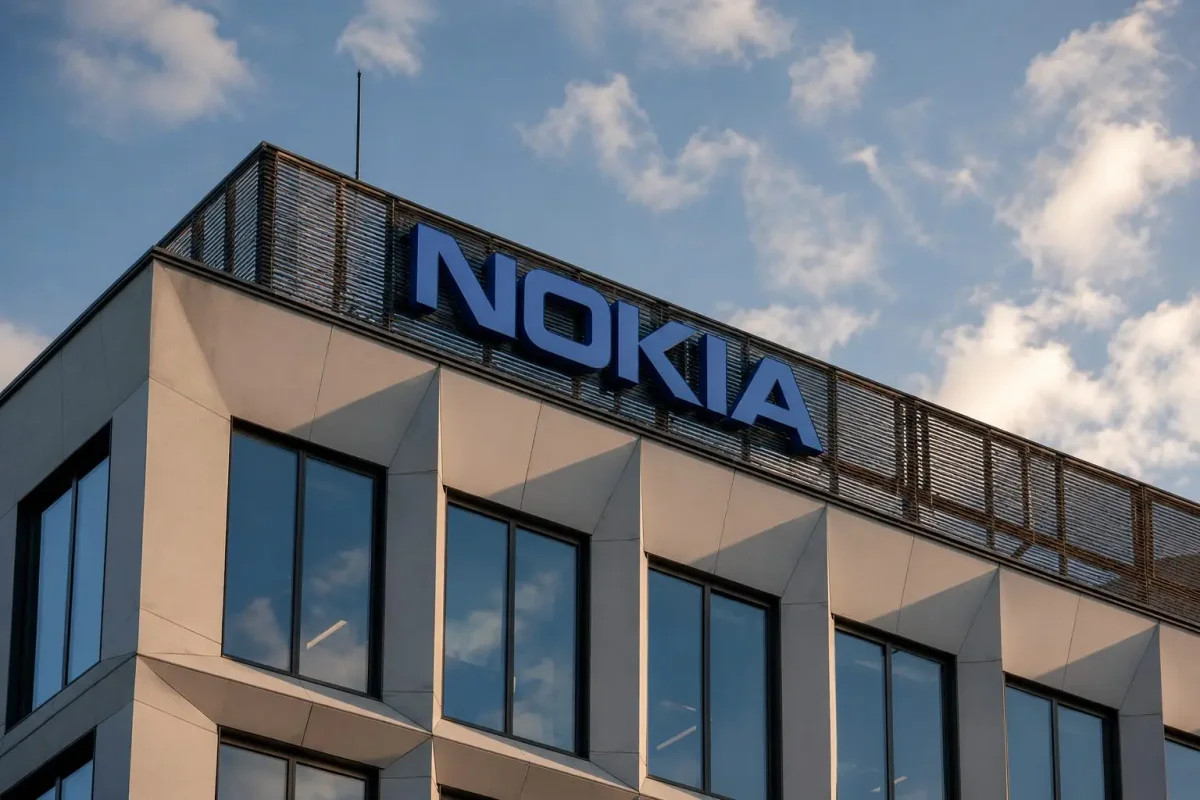
HELSINKI, June 24, 2026, 13:05 EEST – Nokia Oyj saw its shares climb as much as 3.6% on Wednesday, following a series of announcements regarding AI-driven network automation releases in partnership with major cloud providers. The broader Helsinki market remained nearly flat, highlighting the company-specific nature of the move.
By 12:37 EEST, Nokia shares were trading at 12.34 euros, up 2.83%, according to Google Finance. Trading Economics reported the Helsinki 25 index at 6,214.95, a mere 0.02% decline, while Nokia shares rose to 12.43 euros, a 3.58% increase on the June 24 component list. The divergence between Nokia and the broader index underscores investor focus on whether the company can convert its AI software narrative into tangible orders.
Rapid-Fire Announcements
Since June 22, Nokia has released four autonomous-network updates in quick succession. The timeline began with a Google Cloud partnership on June 22, followed by a portfolio update the next day, and collaborations with AWS and Databricks on June 24. These autonomous networks are designed to help telecom operators identify and resolve faults with reduced human intervention.
Google Cloud Integration
Google Cloud provided the most detailed product roadmap. Nokia is integrating six AI agents built on Gemini into its Nokia Assurance Center. Agentic AI refers to software capable of autonomously selecting the next step in a process with minimal human input. Two of these agents are already operational, and Nokia plans a SaaS launch on Google Cloud Marketplace in September 2026, with additional releases scheduled from late 2026 into 2027. Vivek Jaiswal, senior vice president for autonomous networks at Nokia, stated the goal is to create a network that is “programmable, AI-native, and able to operate at machine speed.”
AWS Metrics
Details from the AWS partnership offered a glimpse into operational improvements. Nokia reports that its autonomous networks portfolio already achieves automation rates exceeding 90%. Service delivery times are four hours or less, and annual service interruptions are limited to a minute or less. The company claims it can reduce network-slice rollout time by up to 85% and lower customer-affecting incidents by up to 50%. A network slice is a reserved lane on shared telecom infrastructure.
Databricks Data Layer
Nokia also announced a proof of concept with Databricks to develop a unified data platform. This platform is designed to share data with AI agents across both cloud and on-premises environments without requiring code rewrites. “This helps build data foundations required for next-generation autonomous networks,” said Oguz Sunay, Nokia’s CTO for AI and autonomous networks.
Analyst Endorsement
Nokia brought in an outside analyst to bolster its product narrative. Chris Silberberg, research manager for global telecom operations and monetization at IDC, stated that Nokia’s approach is “already achieving quantifiable business value.” In the same June 23 release, Nokia noted that productivity gains typically range between 60% and 80% compared with traditional operations.
Market Context and Risks
Nokia shares have already benefited from AI-related demand. Reuters reported in April that first-quarter comparable operating profit jumped 54% to 281 million euros, with AI and cloud deals up 49%. The company also secured 1 billion euros in new orders. CEO Justin Hotard indicated at the time that Nokia was “tracking somewhat above” the midpoint of its 2026 comparable operating profit outlook.
Ericsson’s B shares, Nokia’s closest Nordic peer in mobile network equipment, traded at 111.55 Swedish crowns in Stockholm on June 24, down 0.4%, indicating that Nokia’s gains were not part of a broader Nordic telecom-equipment trend.
However, risks remain regarding the timing between new product launches and actual revenue generation. The recent announcements focused on operational updates and rollout plans but did not include any contract win numbers. Operators may delay automation budgets, or competitors could secure major radio gear deals while Nokia emphasizes software adoption. This could leave second-quarter results insufficient to justify the recent share price movement.
Nokia is scheduled to report its second-quarter and first-half 2026 results on July 23.