In a strategic expansion of its artificial intelligence ecosystem, Nvidia has optimized Google's newly released Gemma 4 open-source AI models to operate across its hardware portfolio, from high-performance data-center systems to consumer PCs and edge computing modules. The announcement, made on Thursday, April 3, 2026, represents a concerted effort by the chipmaker to maintain developer loyalty as AI workloads increasingly migrate beyond massive cloud clusters to local and on-premises deployments.
Shifting Market Dynamics: The Inference Inflection
The timing of this rollout is critical, coinciding with a broader industry transition. The AI market is pivoting from the initial phase of training large foundational models to the subsequent "inference" stage, where trained systems generate answers and execute tasks. This shift also encompasses the rise of agentic AI systems capable of planning and using tools autonomously. At Nvidia's recent GTC developer conference, CEO Jensen Huang declared that "the inference inflection has arrived." Analysts, including eMarketer's Jacob Bourne, have noted that Nvidia's forecast of a $1 trillion revenue opportunity underscores persistent, robust demand for its AI infrastructure, despite investor concerns over the return from heavy capital expenditures.
Gemma 4: Google's Open-Source Powerhouse
Google DeepMind executives Clement Farabet and Olivier Lacombe introduced Gemma 4 as the company's most capable open model family to date. Released under the permissive Apache 2.0 license, which allows commercial use and modification, the Gemma series has seen remarkable adoption. Since its initial launch, developers have downloaded the models over 400 million times and created more than 100,000 variants.
The Gemma 4 family comprises four distinct model sizes. The larger 26-billion and 31-billion parameter versions are designed to fit on a single 80GB Nvidia H100 data-center GPU and, in a compressed form, can even run on consumer-grade graphics cards. The smaller E2B and E4B models are built for fully offline operation on resource-constrained devices like smartphones, Raspberry Pi boards, and Nvidia's Jetson Orin Nano modules. All models were trained on datasets spanning more than 140 languages and support multimodal inputs, including audio, image, and video.
Nvidia's Hardware Tuning and the On-Premises Appeal
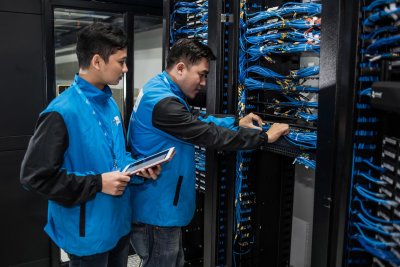
Nvidia stated it has specifically tuned the Gemma 4 models across its hardware spectrum, from next-generation Blackwell data-center systems down to Jetson edge devices. In a technical blog post, the company highlighted that local deployment offers significant advantages for customers in sectors like healthcare and finance, who often require on-premises systems for enhanced data control, security, and faster response times, bypassing cloud latency.
Despite this push into edge and PC AI, Nvidia's financial foundation remains firmly in the data center. Its latest quarterly report revealed staggering figures: data-center sales accounted for $62.3 billion of its total $68.1 billion in revenue. In contrast, revenue from its gaming and AI PC segments was $3.7 billion. In the earnings report, Huang pointed to accelerating enterprise adoption of AI agents as a key driver of rising computing demand.
Growing Competitive Pressures
This growth brings inherent risks. The inference market is attracting intensified competition. As reported last month, inference workloads are increasingly being targeted not just by Nvidia's GPUs but also by central processors (CPUs) and custom application-specific chips developed by major tech firms for their specific needs. Companies like Google and Meta Platforms are designing their own silicon. "Nvidia is definitely going to see more competition compared to a year ago," noted KinNgai Chan, a managing director at Summit Insights Group.
Google itself emphasized that Gemma 4 is not a Nvidia-exclusive platform. The models are optimized to run efficiently on a range of hardware, including AMD GPUs and Google's proprietary Tensor Processing Units (TPUs). This positions Nvidia as one of several viable hardware options for deploying Gemma 4, rather than the sole provider.
The collaboration and optimization effort between Nvidia and Google on Gemma 4 marks a significant step in the democratization and decentralization of advanced AI. It reflects a mature market where performance, efficiency, and deployment flexibility are becoming paramount, even as the competitive landscape for the underlying silicon grows more crowded and complex.